

What is Blink?
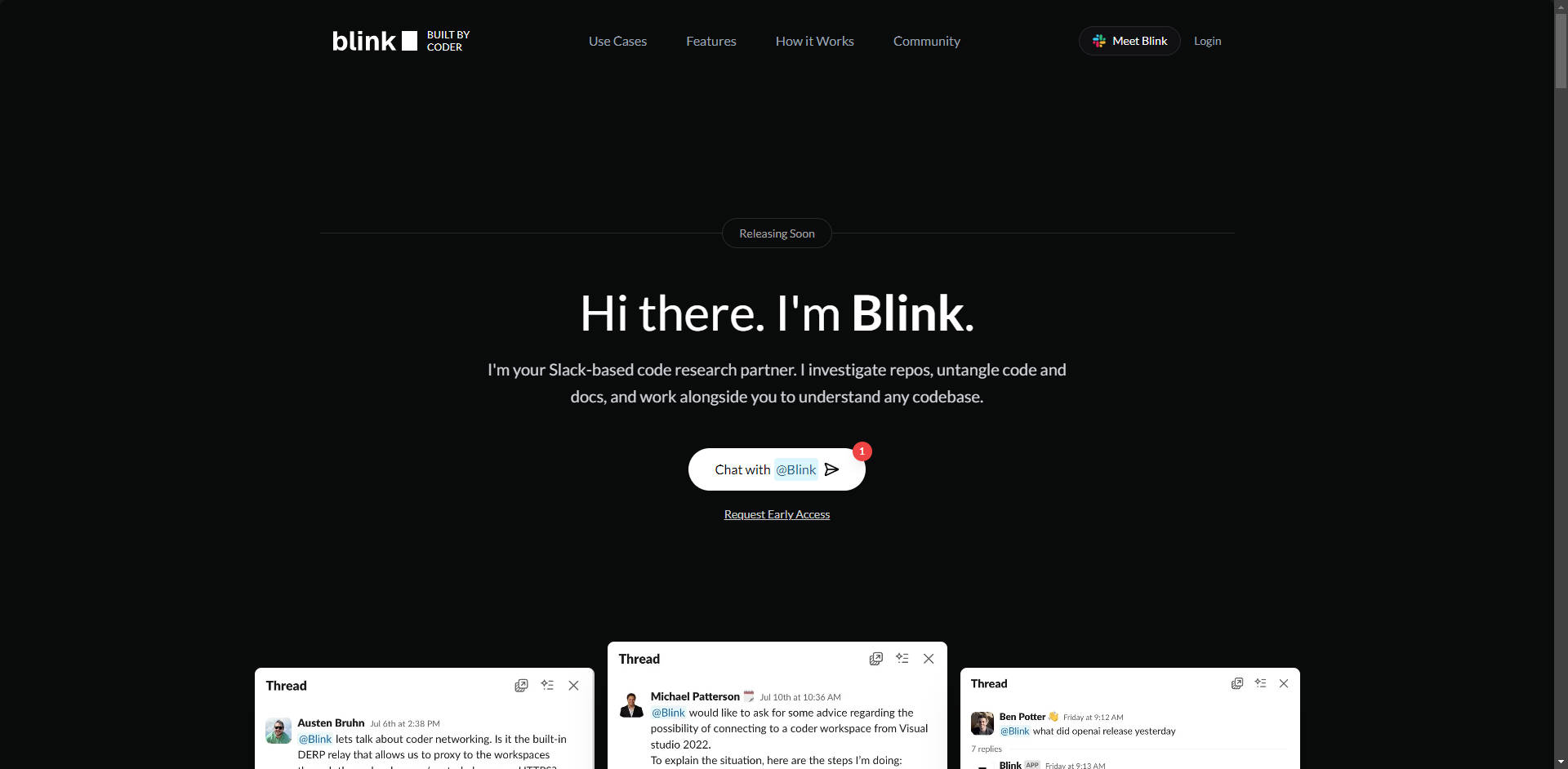
Blink is your team's dedicated code research partner, designed to operate directly within Slack. It’s built for engineering teams who need to investigate repositories, untangle complex code, and gain a deep understanding of any codebase without breaking their workflow. Blink moves beyond simple Q&A to become an active participant in your development process.
Key Features
⚙️ Execute Code in Ephemeral Workspaces Blink doesn't just read your code; it runs it. By spinning up isolated development environments on demand, it can execute tests, perform builds, and validate changes. This allows you to get verifiable answers and working code, not just static analysis or suggestions.
🔗 Understand Multiple Repositories Simultaneously Modern systems are complex. Blink traces logic, dependencies, and data flow across your entire ecosystem of repositories. You can ask it to analyze how a change in one service will impact others, giving you a holistic view that’s difficult to achieve manually.
🤝 Integrate Deeply with GitHub Blink securely authenticates with your private and public repositories to do real work. It can analyze commit histories to understand project evolution, identify key contributors, and even draft and create pull requests based on your conversations.
✅ Track Tasks and Progress Intelligently When you give Blink a complex request, it automatically breaks the work down into a clear to-do list. You can see its progress in real-time directly in Slack, ensuring complete transparency as it analyzes, builds, and completes each step.
Use Cases
Blink is designed to handle serious engineering challenges. Here’s where it excels:
Accelerating New Engineer Onboarding: A new developer can ask Blink, "Trace a user login request from the web app through the authentication service to the user database." Blink will map out the entire flow across multiple repositories, explaining the function of each component and providing direct links to the relevant code.
Investigating Complex Bugs: When a critical bug is reported, you can direct Blink to analyze recent commits across three related microservices. It can then attempt to replicate the issue by running specific tests in an isolated workspace, helping you pinpoint the root cause in a fraction of the time.
Planning a Major Refactor: Before refactoring a legacy service, you can use Blink to identify all its dependencies and understand its role in the larger system. This ensures your team has a clear and accurate picture of the potential impact before making significant architectural changes.
Why Choose Blink?
While many AI tools can read code, Blink is engineered to actively participate in your development cycle. Its core advantage lies in its ability to execute and interact with your codebase, providing a level of insight that static analysis tools cannot match.
From Suggestion to Execution: Instead of just suggesting code changes, Blink uses ephemeral workspaces to run tests and builds, verifying that its solutions actually work.
True System-Wide Context: Blink is built to navigate the complexity of multi-repository architectures, providing insights that account for inter-service dependencies.
Seamless Workflow Integration: By living in Slack and integrating directly with GitHub, Blink delivers its findings and contributions where your team already collaborates, eliminating context switching and keeping everyone in the loop.
Conclusion
Blink is more than a code-aware chatbot; it's a powerful research agent that actively works alongside your team. By providing deep, multi-repository analysis and the unique ability to execute code, it helps you build, maintain, and understand complex software systems with greater confidence and speed.
More information on Blink
Launched
2020-07
Pricing Model
Starting Price
Global Rank
Follow
Month Visit
<5k
Tech used
Blink was manually vetted by our editorial team and was first featured on 2025-08-19.
Related Searches
Blink Alternatives
Load more Alternatives-

Streamline everyday workflows and protect organizations better with Blink, a powerful no-code security platform. Build faster with 7,000+ automations.
-

-
-

-
