 Dcup.dev
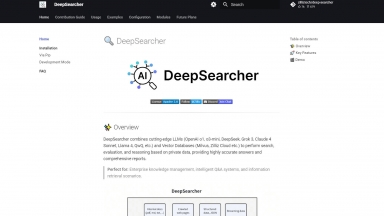
 DeepSearcher
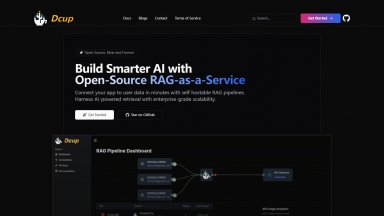
Dcup.dev
| Launched | |
| Pricing Model | Free |
| Starting Price | $29.99 /month |
| Tech used | |
| Tag | Data Pipelines,Developer Tools,Software Development |
DeepSearcher
| Launched | |
| Pricing Model | Free |
| Starting Price | |
| Tech used | |
| Tag |
Dcup.dev Rank/Visit
| Global Rank | |
| Country | |
| Month Visit |
Top 5 Countries
Traffic Sources
DeepSearcher Rank/Visit
| Global Rank | |
| Country | |
| Month Visit |
Top 5 Countries
Traffic Sources
Estimated traffic data from Similarweb
What are some alternatives?
Ragdoll AI - Ragdoll AI simplifies retrieval augmented generation for no-code and low-code teams. Connect your data, configure settings, and deploy powerful RAG APIs quickly.
PuppyAgent - PuppyAgent: Transform proprietary knowledge into self-evolving AI agents. Build powerful agentic RAG systems to automate workflows & boost insights.
Denser AI - Transform customer engagement with DenserAI's enterprise AI agents. Get instant, source-backed answers from your data, 24/7. Boost efficiency & trust.
ApeRAG - ApeRAG: Production-ready GraphRAG for intelligent AI agents. Unlock deep context & reliable reasoning from all your multi-modal enterprise data.
cocoindex - CocoInsight is a companion tool that provides observability into your CocoIndex pipelines. It helps you visualize data transformations, understand lineage, compare configurations (like different chunking methods), and ultimately optimize your indexing strategy.