
What is Elicit?
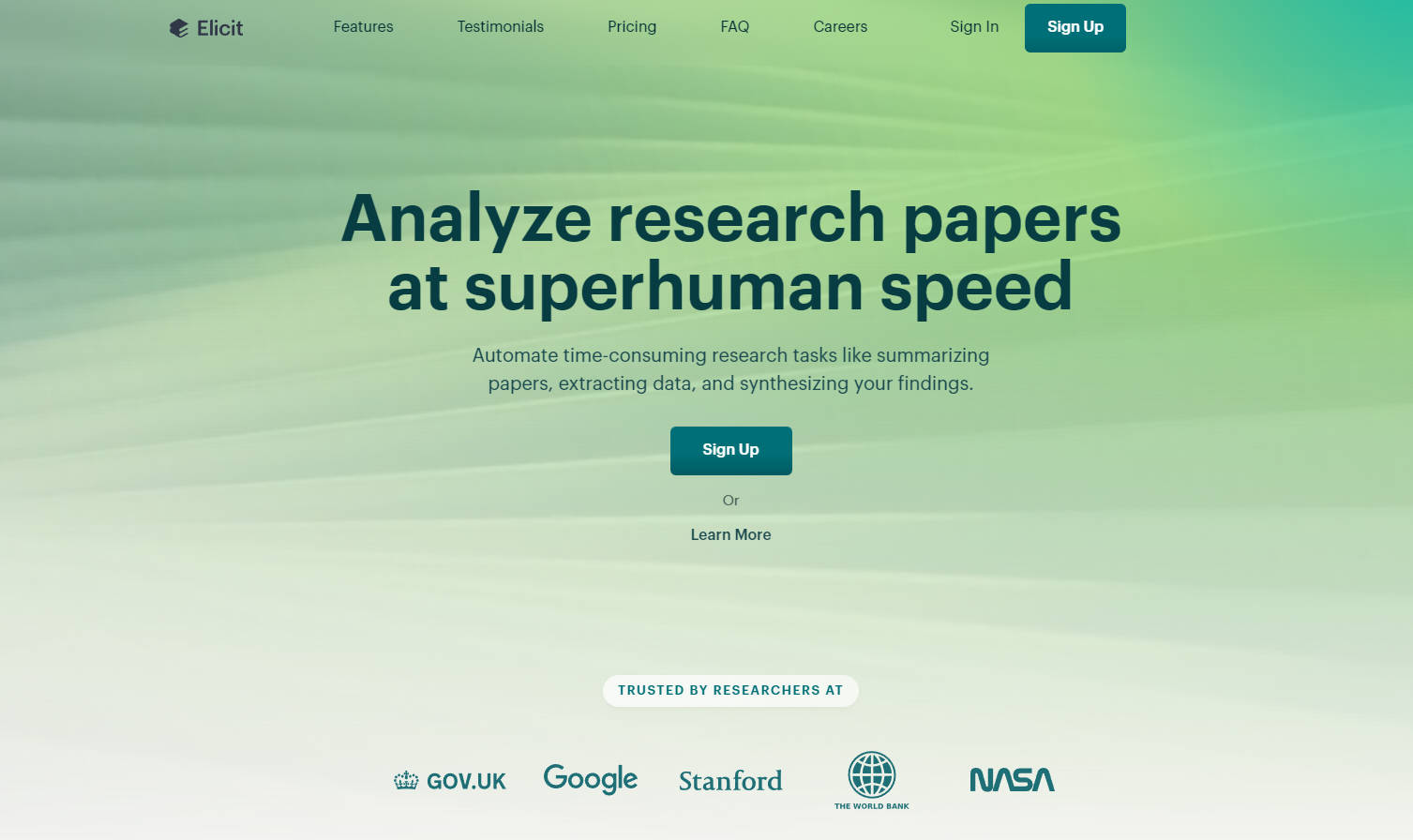
Navigating the vast ocean of academic research can feel overwhelming. You likely spend countless hours searching for relevant papers, summarizing their findings, and extracting key data points. Elicit is an AI research assistant designed to streamline this process, helping you find, understand, and synthesize information from over 125 million academic papers.
Key Features:
🔎 Discover Relevant Papers Quickly: Input a research question in natural language, and Elicit instantly returns a list of relevant papers from its extensive database.
📝 Generate Concise Abstract Summaries: Get one-sentence summaries of each paper's core findings, allowing you to quickly assess its relevance to your work. You can also select a set of related papers and have Elicit search for additional similiar papers.
📊 Extract Key Data with Ease: Automatically populate tables with crucial information extracted directly from research papers.
💡 Synthesize Findings Across Multiple Papers: Identify common themes, concepts, and findings across a collection of papers. For example, you can ask, "What are all of the effects of this drug?" and Elicit will compile a synthesized list from multiple sources.
Use Cases:
Accelerated Literature Review: Imagine you're starting a new research project on the impact of social media on mental health. Instead of spending days searching databases, you can ask Elicit, "What are the effects of social media use on adolescent anxiety and depression?" Elicit will provide a curated list of relevant papers and summaries, allowing you to quickly identify key studies and researchers in the field.
Efficient Data Extraction for Meta-Analysis: You're conducting a meta-analysis on the effectiveness of a specific drug. Elicit can automatically extract data points like sample sizes, effect sizes, and participant demographics from dozens of papers into a structured table, saving you potentially weeks of manual labor.
Rapid Domain Familiarization: You're exploring a new research area, such as the application of AI in healthcare. Elicit can help you quickly grasp the key concepts, methodologies, and findings in this field by providing access to relevant papers and synthesizing information across multiple sources.
Conclusion:
Elicit is more than just a search engine; it's a powerful tool that empowers you to conduct research more efficiently and effectively. By automating time-consuming tasks and providing intelligent synthesis capabilities, Elicit frees you to focus on what truly matters: analyzing information, generating insights, and advancing your research. Elicit users save up to 5 hours per week. Elicit can cut data extraction times in half.
FAQ:
How do researchers use Elicit?
Researchers use Elicit to speed up literature reviews, discover papers they might have missed, automate systematic reviews and meta-analyses, and quickly learn about new research domains. It is proven to be most effective when used in empirical fields, such as biomedicine and machine learning, that involve experiments and definite results.
When is Elicit not a good fit?
Elicit is not designed to answer questions or surface information not found within academic papers. It's less effective for identifying general facts (e.g., "What is the population of London?") or for exploring theoretical or non-empirical domains.
What types of data can Elicit search?
Elicit searches across 125 million academic papers from the Semantic Scholar corpus, covering all academic disciplines. It utilizes the full text of papers when available, or the abstract if full text is not accessible.
How accurate are the answers in Elicit? A good rule of thumb is that approximately 90% of the information is accurate. However, because Elicit relies on language models, Elicit is not 100% accurate. It's crucial to verify Elicit's output by reviewing the original source documents, which Elicit makes easy by providing direct links and pinpointing the relevant sections within the papers.
What happens to papers uploaded to Elicit? Any papers you upload to Elicit for analysis are kept private and are not shared with any other users.
More information on Elicit
Top 5 Countries
10.55%
6.73%
5.82%
4.16%
3.89%
United States
Indonesia
India
Germany
Philippines
Traffic Sources
0.84%
0.23%
0.26%
7.08%
38.37%
53.23%
social
paidReferrals
mail
referrals
search
direct
Source: Similarweb (Sep 24, 2025)
Elicit was manually vetted by our editorial team and was first featured on 2023-03-07.
Related Searches
Elicit Alternatives
Load more Alternatives-
-
AnswerThis: AI research assistant. Get synthesized, cited answers from 250M+ academic papers. Cut research time, ensure credibility.
-

Ai2 Paper Finder is the LLM-powered literature search that mimics the human research process. Uses iterative search and reasoning to find hard-to-find papers beyond keywords.
-

Semantic Scholar: Free AI tools for researchers. Discover & understand academic papers faster and gain key insights.
-