

What is Flatfile AI?
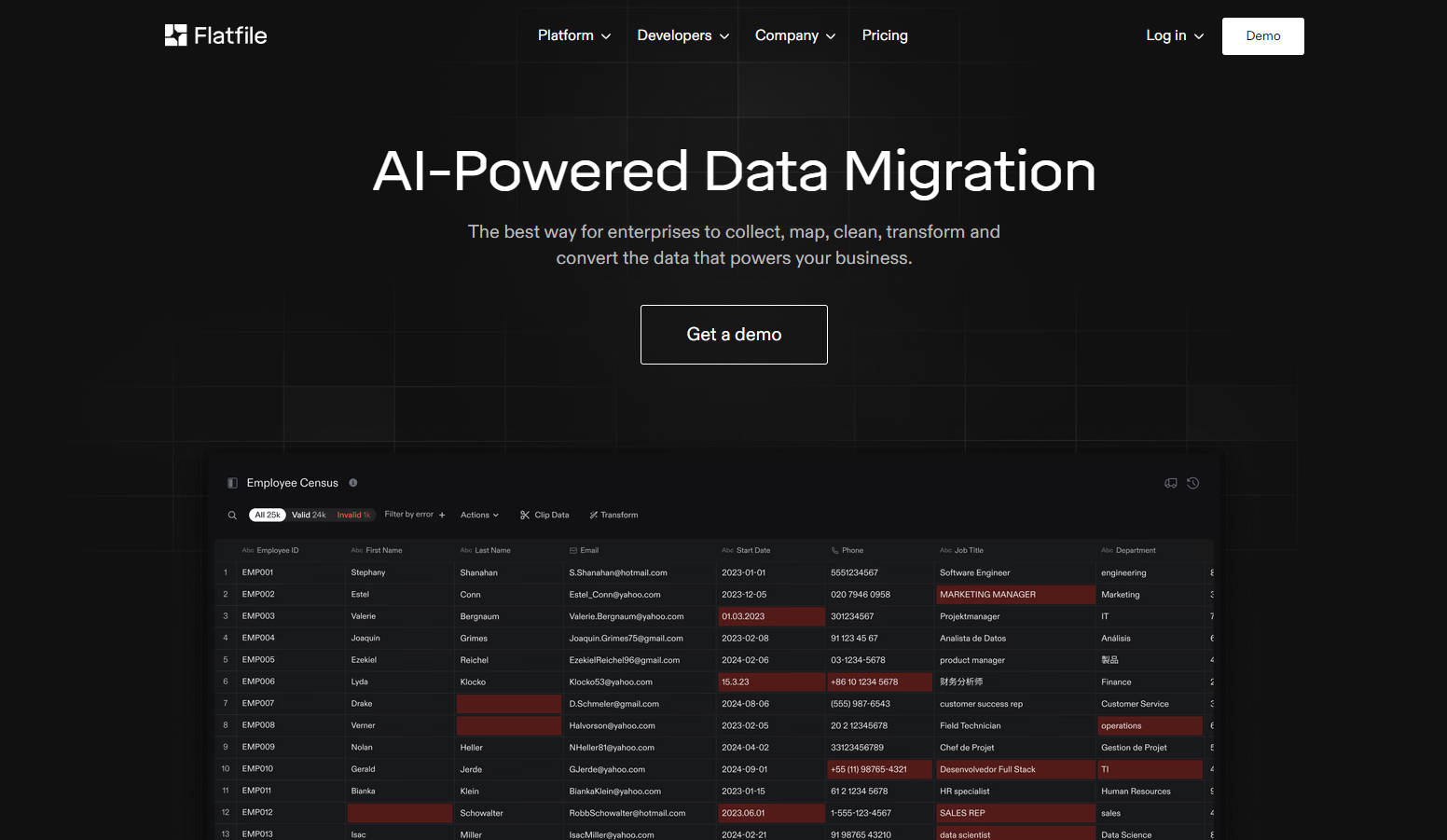
Flatfile offers a robust platform for businesses to streamline data onboarding and migration. With support for various file types like CSV, XLS, PDF, and more, Flatfile transforms raw data into API-ready, actionable insights. Powered by AI, it automates data mapping, validation, and transformation, ensuring clean, secure, and efficient data handling. Ideal for enterprises and SaaS applications, Flatfile accelerates data workflows, reduces manual errors, and ensures compliance with top-tier security standards.
Key Features:
🛠️ Smart APIs for Data Import: Built for developers, Flatfile provides a rich library of APIs for seamless file-based data imports, supporting any file type or source.
🤖 AI-Powered Data Handling: Automatically detects and corrects data errors, maps columns, and transforms data using advanced AI algorithms.
🔐 Enterprise-Grade Security: Compliant with SOC 2, HIPAA, and GDPR, Flatfile ensures your data is securely processed and stored using AES-256 encryption.
🌐 Collaborative Workspaces: Enable teams to collaborate on data with shared views, multi-step approvals, and real-time notifications, all within a secure environment.
Use Cases:
HR Data Conversion: A mid-sized company is transitioning to a new HR system. Using Flatfile, they quickly map and convert employee data from old spreadsheets, ensuring accurate and secure data migration without manual clean-up.
Customer Data Onboarding for SaaS: A SaaS platform needs to onboard new customers quickly. With Flatfile, they automate data imports, reducing customer activation time by 20% and ensuring a seamless transition without data errors.
Large-Scale Data Migration for Enterprises: An enterprise needs to migrate terabytes of customer data to a new CRM system. Flatfile's parallel processing and load balancing features allow them to handle large files efficiently, reducing migration time and costs.
Conclusion:
Flatfile revolutionizes data onboarding and migration with its AI-powered, API-first platform. It simplifies complex data workflows, ensures data integrity, and enhances collaboration across teams. By automating tedious tasks and providing enterprise-grade security, Flatfile helps businesses accelerate their data processes, reduce costs, and ensure compliance with industry standards. Whether you're a developer, data analyst, or business leader, Flatfile is your go-to solution for efficient data management.
More information on Flatfile AI
Launched
1999-03
Pricing Model
Contact for Pricing
Starting Price
Global Rank
352996
Follow
Month Visit
99.1K
Tech used
Netlify,Gzip,OpenGraph,Progressive Web App,Webpack,HSTS
Top 5 Countries
21.15%
11.36%
5.24%
3.79%
3.64%
United States
India
Nigeria
Canada
Russia
Traffic Sources
2.84%
0.98%
0.15%
9.56%
47.37%
39.1%
social
paidReferrals
mail
referrals
search
direct
Source: Similarweb (Sep 25, 2025)
Flatfile AI was manually vetted by our editorial team and was first featured on 2024-12-25.
Related Searches
Flatfile AI Alternatives
Load more Alternatives-

-

-

-
Low code enterprise data platform for transformation, embedding and vector database load.
-

Convert ANY file text or website to a dataset/spreadsheet/CRM/ERP/etc. in seconds. No code, no data modeling, no mappings, no IT skills needed.