Grok AI: The Pioneering AI Chatbot from xAI
Grok AI, the latest innovation in artificial intelligence chatbots, marks a significant leap forward in the AI industry. Developed by Elon Musk's startup xAI, Grok AI is set to redefine user interaction with its unique blend of wit, real-time data access, and advanced language capabilities. This comprehensive analysis delves into the features of Grok AI, its comparison with competitors such as ChatGPT and Bard, and its potential impact on the AI landscape.
Understanding Grok AI
The Genesis of Grok
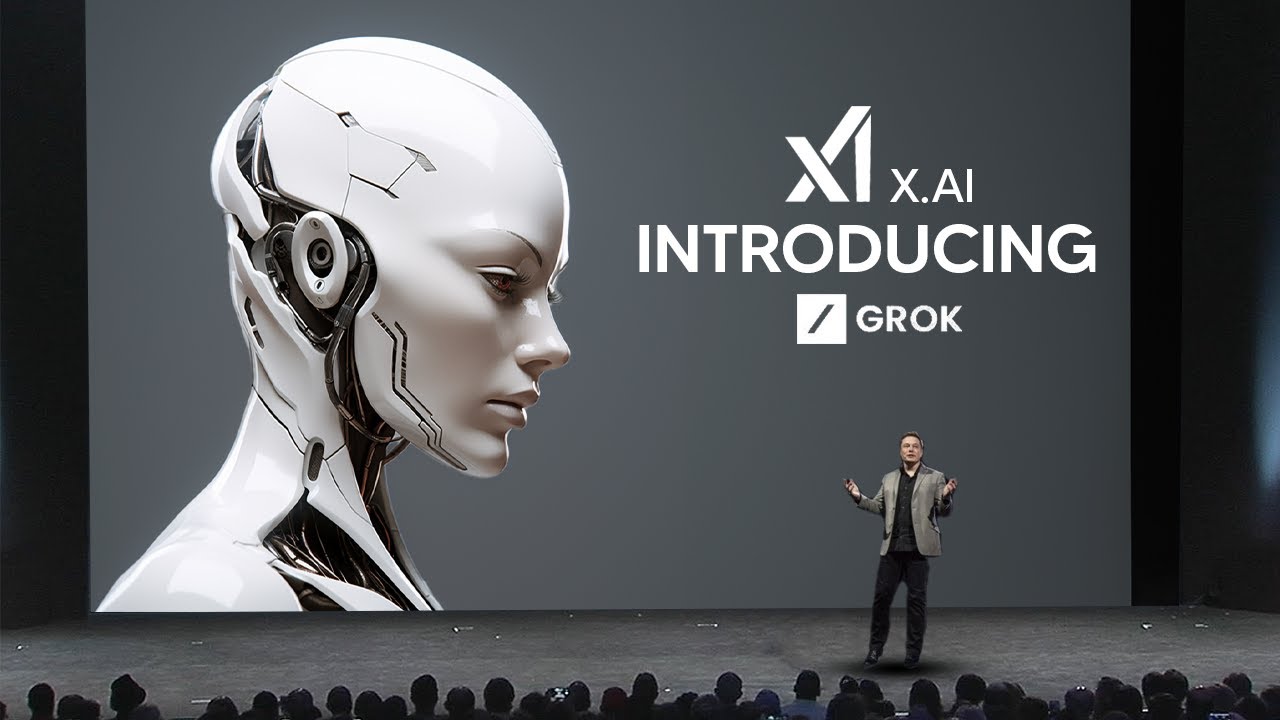
Grok AI, first released to select testers on November 4, is the brainchild of Elon Musk's company xAI, which was founded in March 2023 with a bold aim to unravel the mysteries of the universe. Grok AI distinguishes itself with a personality that leans towards humor and a rebellious streak, a significant shift from the more conventional AI chatbots.
Technical Foundations
Grok AI operates on a language model named Grok-1, partly utilizing real-time data from the X social media platform. This approach positions Grok as a highly current and responsive AI tool, potentially surpassing GPT-3.5 in terms of up-to-date knowledge.
Comparative Analysis: Grok vs. ChatGPT and Bard

Grok, Bard, and ChatGPT are prominent large language models (LLMs) that have undergone extensive training on vast repositories of text and code. This rigorous training empowers these models with remarkable text generation, language translation, diverse creative content writing, and informative question-answering abilities. It is important to note that each of these models possesses distinct strengths and weaknesses, making them suitable for various applications based on their individual capabilities.
Grok
Grok exhibits a meticulous approach when it comes to accomplishing tasks, positioning itself as a formidable contender in the realm of technical performance. Notably, it has consistently surpassed the free version of ChatGPT (GPT-3.5) across various benchmarks, securing the fourth position. Within four key benchmarks, namely GSM8k, MMLU, HumanEval, and MATH, Grok-1, the AI model, has demonstrated superior performance ranging from 0.4% to 15.1%.
Strengths:
Grok stands out for its remarkable proficiency in comprehending and providing comprehensive and informative responses to complex inquiries. Moreover, it exhibits notable prowess in generating an array of creative text formats, including but not limited to poems, code, scripts, and musical compositions.,
Weaknesses:
As an ongoing development, Grok occasionally encounters errors in its operation. Additionally, it is not as proficient in language translation capabilities compared to certain other LLMs.
Google Bard
Google Bard was officially unveiled in 2023 and made its debut in March of that very year. Notably, Bard's PaLM 2 model surpasses Grok-1 in terms of performance, showcasing a superior performance gain ranging from 5% to 17.8%. One of Bard's distinguishing features lies in its aptitude for providing comprehensive answers embedded with contextual information in response to search queries.
Strengths: Bard showcases commendable capabilities in generating text that seamlessly intertwines informative content with artistic flair. Moreover, it displays proficiency in comprehending and effectively addressing natural language queries.
Weaknesses: As an ongoing development, Bard, too, is susceptible to occasional errors. Furthermore, Bard's language translation capabilities are comparatively less robust than certain other LLMs.
ChatGPT
ChatGPT, a language model trained on extensive internet texts, exhibits a notable proficiency in text-based tasks, particularly in generating paragraphs and summaries. With its remarkable conversational abilities, ChatGPT excels in upholding natural and human-like interactions.
Strengths: ChatGPT shines in its capacity to generate text that closely resembles human expression across various formats, encompassing dialogues, scripts, and poems. Additionally, it demonstrates commendable competency in language translation.
Weaknesses: While ChatGPT ordinarily achieves remarkable accuracy, there are instances where it may generate text that deviates from factual accuracy. Furthermore, compared to certain other large language models (LLMs), ChatGPT may not possess the same level of adeptness in comprehending and addressing intricate inquiries.
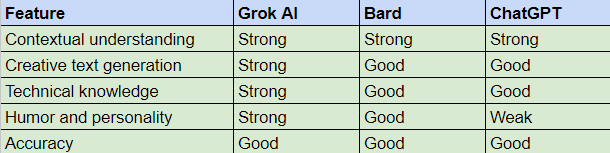
All three of these language models are currently in the developmental stage, continually improving and expanding their capabilities. Each model has acquired proficiency in various task domains. Grok AI stands out for its capacity to elaborate on simple phrases, infusing humor and personality into its responses. Bard, on the other hand, excels in providing comprehensive and informative answers to questions, demonstrating its ability to tackle open-ended, challenging, or peculiar inquiries. Lastly, ChatGPT boasts its aptitude in generating diverse creative text formats. Collectively, these language models exhibit promising potential and versatility in addressing a wide range of text-based tasks.
Here is a table that summarizes the key differences between Grok AI, Bard, and ChatGPT:
Accessing and Using Grok AI
Availability and Subscription
Grok AI is currently available to X Premium+ subscribers, with its release closely tied to X Corp (formerly Twitter) and integration with other Musk projects like Tesla. X Premium+ subscription is priced at $16 per month, offering features like ad reduction and a Creator Hub.
Conclusion: The Future of Grok AI
Grok AI represents a significant advancement in the AI chatbot domain, with its unique personality, real-time data access, and multilingual capabilities. Its integration with X and the wider Musk ecosystem indicates a promising future for this innovative AI tool. As Grok continues to evolve, it is poised to challenge existing perceptions of AI interactions and redefine user engagement in the digital space.