

Click outside to close
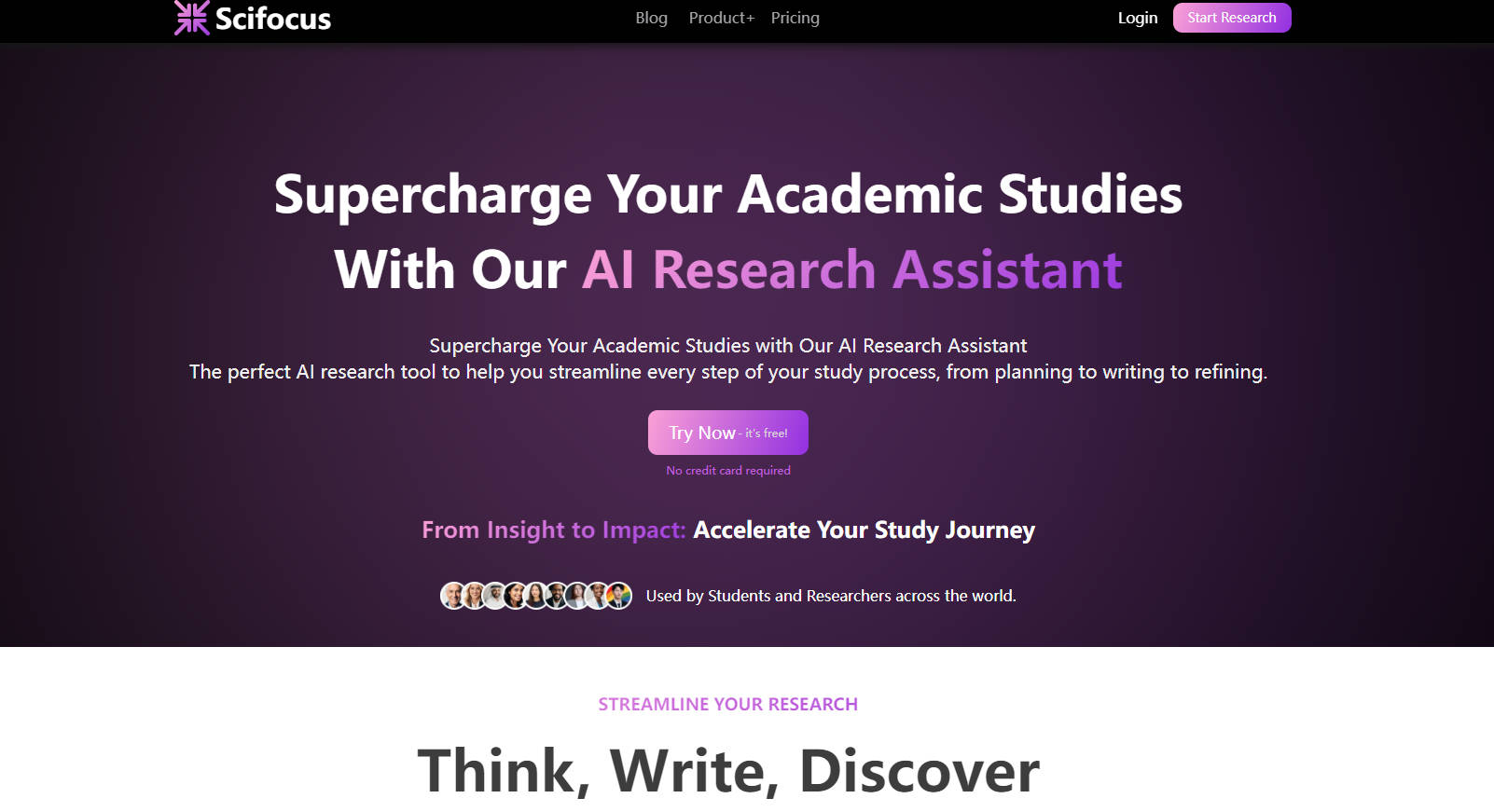
What is Scifocus?
Scifocus is an advanced AI research platform built to optimize the entire scientific workflow, from initial hypothesis generation to publication-ready manuscript preparation. It addresses the core inefficiencies in research, including extensive literature reviews, complex data organization, and the iterative process of manuscript refinement, leveraging state-of-the-art language models and a scientifically grounded architecture.
Key Features
🔍 Automated Literature Review Synthesis: Employ advanced natural language processing (NLP) techniques to rapidly identify, extract, and synthesize key findings from a vast corpus of research literature. Scifocus reduces the time spent on manual literature surveys, providing researchers with a comprehensive overview of the current state of knowledge.
🧠 Semantic Concept Mapping and Knowledge Organization: Utilize graph-based algorithms to create visual representations of research concepts and their interrelationships. This feature enables researchers to explore complex ideas, identify knowledge gaps, and develop innovative research directions.
📝 AI-Assisted Manuscript Generation and Refinement: Generate structured drafts of research papers, essays, and reports. Scifocus leverages its understanding of academic writing conventions and domain-specific terminology to produce high-quality, publication-ready content.
🗣️ Automated Response Generation for Peer Review: Analyze reviewer comments and automatically generate draft responses that address concerns and clarify research findings. This feature streamlines the revision process and facilitates effective communication with journal editors.
🤖 Multi-LLM Architecture: Integrate multiple leading language models (Deepseek, ChatGPT, Claude) with intelligent switching capabilities. Scifocus dynamically selects the optimal model based on the specific task and context, ensuring superior performance and accuracy.
🛡️ Data Security and Privacy: All user data is encrypted both in transit and at rest, adhering to strict data privacy regulations. The platform is equipped with end-to-end encryption, real-time threat detection, and multi-layer firewalls. Your data is never used to train the underlying language models.
Use Cases
Bioinformatics Researcher Analyzing Genomic Data: A bioinformatician can use Scifocus to quickly review the literature on specific gene mutations, generate a report summarizing the findings, and create a visual map of the relevant biological pathways.
Materials Scientist Developing New Alloys: A materials scientist can leverage Scifocus to identify relevant research on alloy composition and properties, generate a draft manuscript outlining their experimental design, and automatically respond to reviewer comments regarding material characterization techniques.
Computer Science Researcher Exploring AI Algorithms: A computer scientist can use Scifocus to explore the latest advancements in machine learning algorithms, create a structured overview of different approaches, and generate a technical report comparing their performance on specific datasets.
Conclusion
Scifocus is a powerful AI-driven platform that significantly enhances research productivity and quality. By automating key tasks, providing intelligent assistance, and leveraging a robust scientific foundation, Scifocus empowers researchers to accelerate their discoveries and make a greater impact in their respective fields.
FAQ
What Large Language Models (LLMs) does Scifocus utilize?
Scifocus integrates Deepseek, ChatGPT, and Claude, dynamically switching between them to optimize performance for various research tasks.
How does Scifocus ensure the accuracy and reliability of its outputs?
Scifocus is built on a foundation of rigorous scientific expertise. Its outputs are data-driven and grounded in established research methodologies, ensuring a high level of reliability.
Can Scifocus handle highly specialized or interdisciplinary research topics?
Yes. Scifocus is designed to handle complex and nuanced research topics. Its multi-LLM architecture and semantic understanding allow it to adapt to a wide range of disciplines.
More information on Scifocus
Top 5 Countries
25.15%
23.55%
15.59%
14.13%
10.28%
United States (25.15%)
Philippines (23.55%)
India (15.59%)
United Kingdom (14.13%)
Australia (10.28%)
Traffic Sources
17.58%
11.57%
26.33%
43.73%
social (17.58%)
paidReferrals (0.71%)
mail (0.05%)
referrals (11.57%)
search (26.33%)
direct (43.73%)
Source: Similarweb (Jan 4, 2026)
Scifocus was manually vetted by our editorial team and was first featured on 2025-03-11.
Scifocus Alternatives
Scifocus Alternatives-
Scite is an AI-powered platform that helps researchers discover and evaluate scientific literature through Smart Citations, showing whether studies support or contradict a claim. Now part of Research Solutions, Scite has indexed 1.4B+ citations, partners with 30+ publishers, and serves 2M users worldwide.
-

SciMaster: Your AI research assistant. Synthesize 1.7 billion scientific papers & web data for clear, verifiable answers and deep insights.
-
SciSpace is a comprehensive platform that uses AI to help you discover, understand, analyze, and write scientific literature. It offers a range of tools, including an AI Copilot for explaining complex text, a Literature Review tool for finding relevant papers, a Paraphraser for improving writing, and a Citation Generator for creating accurate citations.
-
Semantic Scholar: Free AI tools for researchers. Discover & understand academic papers faster and gain key insights.
-

Easily summarize scientific articles with SciSummary. Upload documents or send via email for quick summaries powered by advanced AI models.