

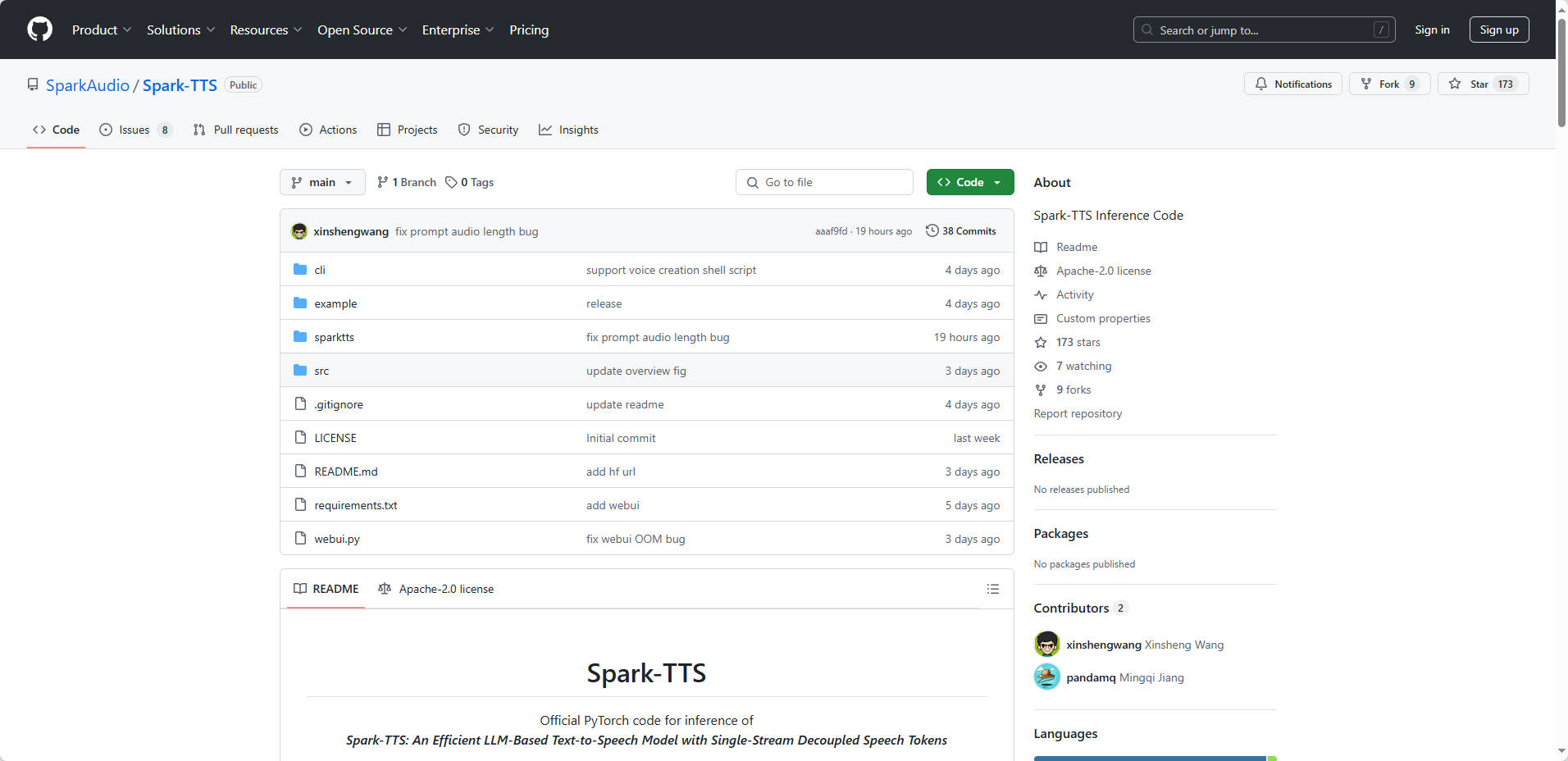
What is Spark-TTS?
Spark-TTS is an advanced text-to-speech (TTS) system that harnesses the capabilities of large language models (LLMs) to deliver high-fidelity and natural-sounding speech synthesis. Unlike traditional TTS systems that rely on multiple, complex models, Spark-TTS simplifies the process by directly reconstructing audio waveforms from codes predicted by its underlying LLM, Qwen2.5. This streamlined architecture reduces complexity, enhances efficiency, and makes Spark-TTS suitable for both research and production environments.
Key Features:
Direct Audio Reconstruction: Spark-TTS eliminates the need for separate acoustic feature generation models. By directly reconstructing audio waveforms from the LLM's output, it simplifies the pipeline and improves overall performance.
High-Quality Zero-Shot Voice Cloning: The system can accurately replicate a speaker's voice without requiring specific training data. This capability excels in cross-lingual and code-switching scenarios, enabling seamless transitions between languages and speakers.
Bilingual Proficiency: Spark-TTS natively supports both Chinese and English. Its zero-shot voice cloning extends to cross-lingual contexts, maintaining high naturalness and accuracy across languages.
Controllable Speech Synthesis: Users can fine-tune parameters such as gender, pitch, and speaking rate to create virtual speakers and generate customized voice outputs. This flexibility allows for diverse and tailored speech synthesis.
Simplified Qwen2.5-Based Architecture: Spark-TTS relies solely on Qwen2.5, removing the need for additional generation models and reducing computational overhead.
Use Cases:
Rapid Prototyping of Voice Applications: Researchers and developers can quickly integrate Spark-TTS into their projects, leveraging its efficient architecture and high-quality output to build and test voice-enabled applications with minimal setup or training.
Cross-Lingual Content Creation: Content creators can generate audio in multiple languages using a single voice clone, ensuring consistency across different linguistic versions of their content. This is particularly useful for global marketing campaigns or multilingual educational materials.
Customized Voice Assistants: Developers can create unique voice personas for virtual assistants by adjusting parameters like pitch and speaking rate, offering a more personalized user experience compared to generic TTS systems.
Conclusion:
Spark-TTS represents a significant step forward in text-to-speech technology. Its streamlined architecture, high-quality voice cloning, and flexible control options make it a powerful tool for developers and researchers seeking efficient and natural-sounding speech synthesis. By directly reconstructing audio, Spark-TTS offers a simpler and more efficient alternative to traditional multi-stage TTS systems.
More information on Spark-TTS
Launched
Pricing Model
Free
Starting Price
Global Rank
Follow
Month Visit
<5k
Tech used
Spark-TTS was manually vetted by our editorial team and was first featured on 2025-03-03.
Related Searches
Spark-TTS Alternatives
Load more Alternatives-
Transform your podcasts & chatbots with FireRedTTS-2: natural, multi-speaker long-form speech. Enjoy ultra-low latency & multilingual voice cloning.
-

-

-
-
