
What is Spec Kit?
Spec Kit is an advanced, open-source toolkit that introduces and operationalizes Spec-Driven Development (SDD), fundamentally changing how you leverage AI for software creation. It solves the pervasive problem of "vibe coding" and unreliable one-shot AI prompts by transforming specifications from disposable documents into executable blueprints that directly generate working implementations. Spec Kit is designed for developers and engineering teams seeking to build high-quality, predictable software faster using their preferred AI coding agents.
Key Features
Spec Kit provides a structured set of commands that guide your AI agent through a predictable, multi-step development process, ensuring alignment between requirements and final code.
🏗️ Structured Development Workflow (Core Commands)
Instead of relying on a single, lengthy prompt, Spec Kit breaks development into five distinct phases, accessible via slash commands within your AI agent. You first define governing principles (/speckit.constitution), then specify the requirements (/speckit.specify), create a technical stack plan (/speckit.plan), generate an actionable task list (/speckit.tasks), and finally, execute the implementation (/speckit.implement). This multi-step refinement ensures the AI builds exactly what you intended, according to established architectural and quality standards.
🤖 Comprehensive AI Agent Interoperability
Spec Kit is technology-independent and supports a wide array of leading AI coding agents, including Claude Code, GitHub Copilot, Gemini CLI, Cursor, Qwen Code, and more. This extensive compatibility allows your team to integrate Spec-Driven Development without being locked into a single vendor, ensuring you can utilize the most powerful models available for specific tasks.
🔍 Quality Assurance and Consistency Tools
Enhance the quality of your specifications before implementation using optional validation commands. Use /speckit.clarify to quickly address underspecified areas in your requirements, or run /speckit.analyze to perform cross-artifact consistency and coverage analysis between your specification, plan, and task list. These checks act as "unit tests for English," dramatically reducing errors before the code generation phase begins.
🔧 Specify CLI for Project Management
The specify command-line interface provides the essential entry point for initializing projects and managing dependencies. You can use specify init to set up a new project directory with templates and configure it for a specific AI assistant (e.g., --ai claude), or use specify check to verify that all necessary prerequisites (like Git, Python, and the chosen agent tool) are correctly installed on your system.
Use Cases
Spec Kit excels at bringing structure and predictability to complex coding projects, whether you are starting fresh or enhancing existing systems.
1. Greenfield Application Generation
When starting a new project, like the photo organization application, you define the desired user experience and constraints (e.g., "group albums by date," "use vanilla HTML/CSS/JS"). Spec Kit uses this specification to generate a robust technical plan, break it into manageable tasks, and execute the code implementation, delivering a production-ready application based on high-level intent, not just raw code snippets.
2. Iterative Feature Enhancement
For existing or "brownfield" projects, Spec Kit supports continuous improvement by integrating new features iteratively. You can define the new feature's specification, plan its integration within the existing architecture, and execute the implementation with confidence, knowing the process is governed by the project's established principles (/speckit.constitution).
3. Architectural and UX Exploration
Spec Kit supports creative exploration by enabling parallel implementations. You can define a single core specification and then use the tool to generate technical plans and implementation tasks for different technology stacks (e.g., one plan using React/Node, another using Vanilla JS/SQLite). This allows you to rapidly experiment with diverse solutions and UX patterns before committing resources to a single path.
Why Choose Spec Kit?
Spec Kit’s core value proposition lies in its unique methodology, which is fundamentally different from typical AI coding workflows, offering measurable gains in quality and efficiency.
Executable Specifications, Not Disposable Scaffolding: Traditional specifications are often discarded once coding begins. Spec Kit flips this script: the specification is the primary artifact, actively interpreted and executed by the AI agent to guarantee implementation fidelity. This means less debugging and fewer requirements gaps down the line.
Intent-Driven Quality: By enforcing a multi-step refinement process—moving from high-level intent to principles, technical plans, and tasks—Spec Kit acts as a crucial set of guardrails. This structure significantly reduces the risk of AI hallucinations and ensures the generated code adheres to defined quality standards, testing requirements, and performance criteria.
Technology Independence & Enterprise Readiness: The methodology is validated to be independent of specific programming languages or frameworks. This focus allows teams to incorporate complex enterprise constraints, use internal design systems, and ensure compliance requirements are built into the specification from the very first step, making it suitable for mission-critical development.
Conclusion
Spec Kit provides the structure, clarity, and predictability necessary to build high-quality software reliably using the power of modern AI agents. By prioritizing clear specification and multi-step refinement, you move beyond unstructured prompting to a professional, intent-driven development process.
Learn more about the complete Spec-Driven Development Methodology and transform your engineering workflow today.
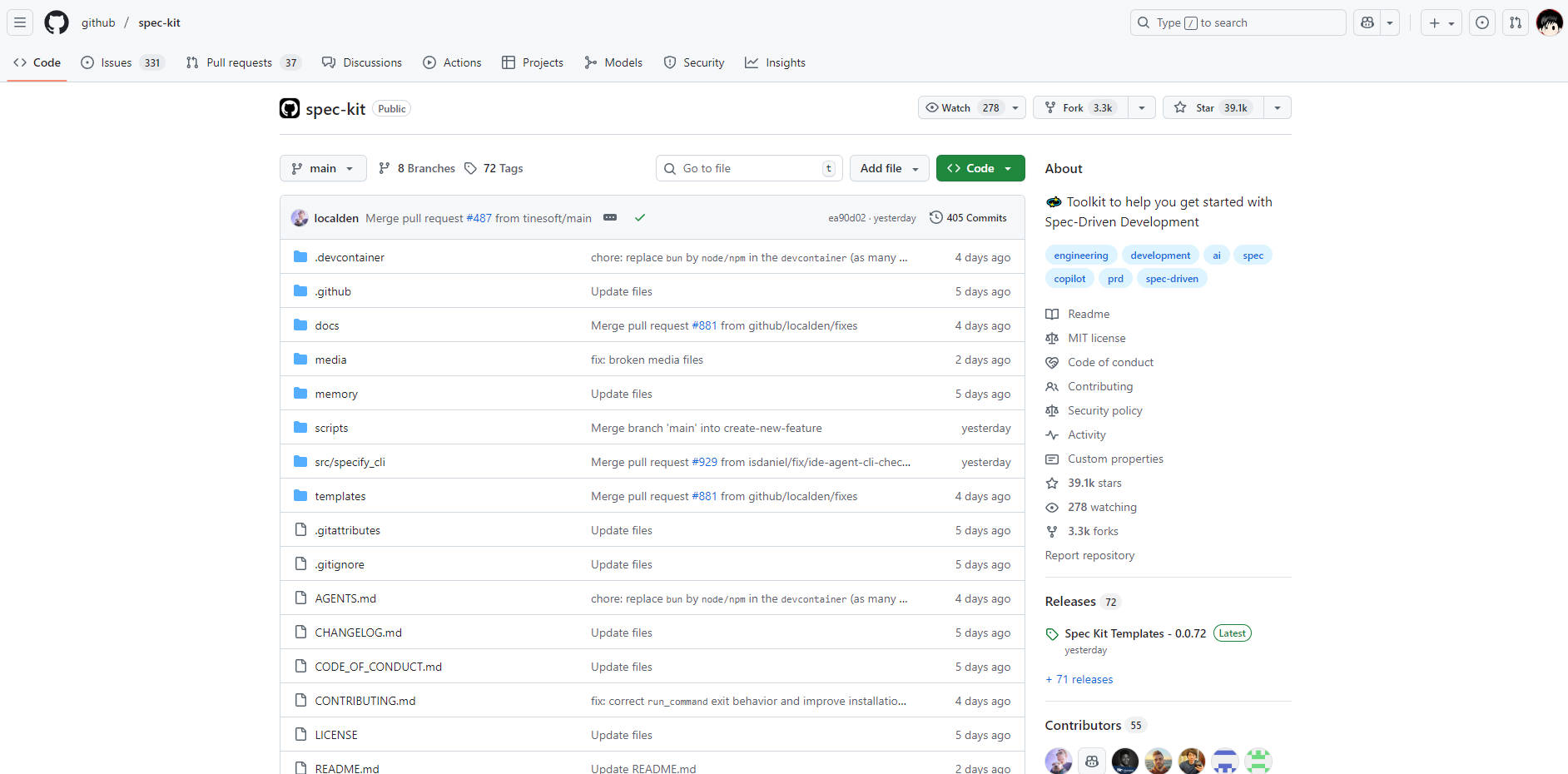
More information on Spec Kit
Launched
Pricing Model
Free
Starting Price
Global Rank
Follow
Month Visit
<5k
Tech used
Spec Kit was manually vetted by our editorial team and was first featured on 2025-10-20.