
What is OpenSpec?
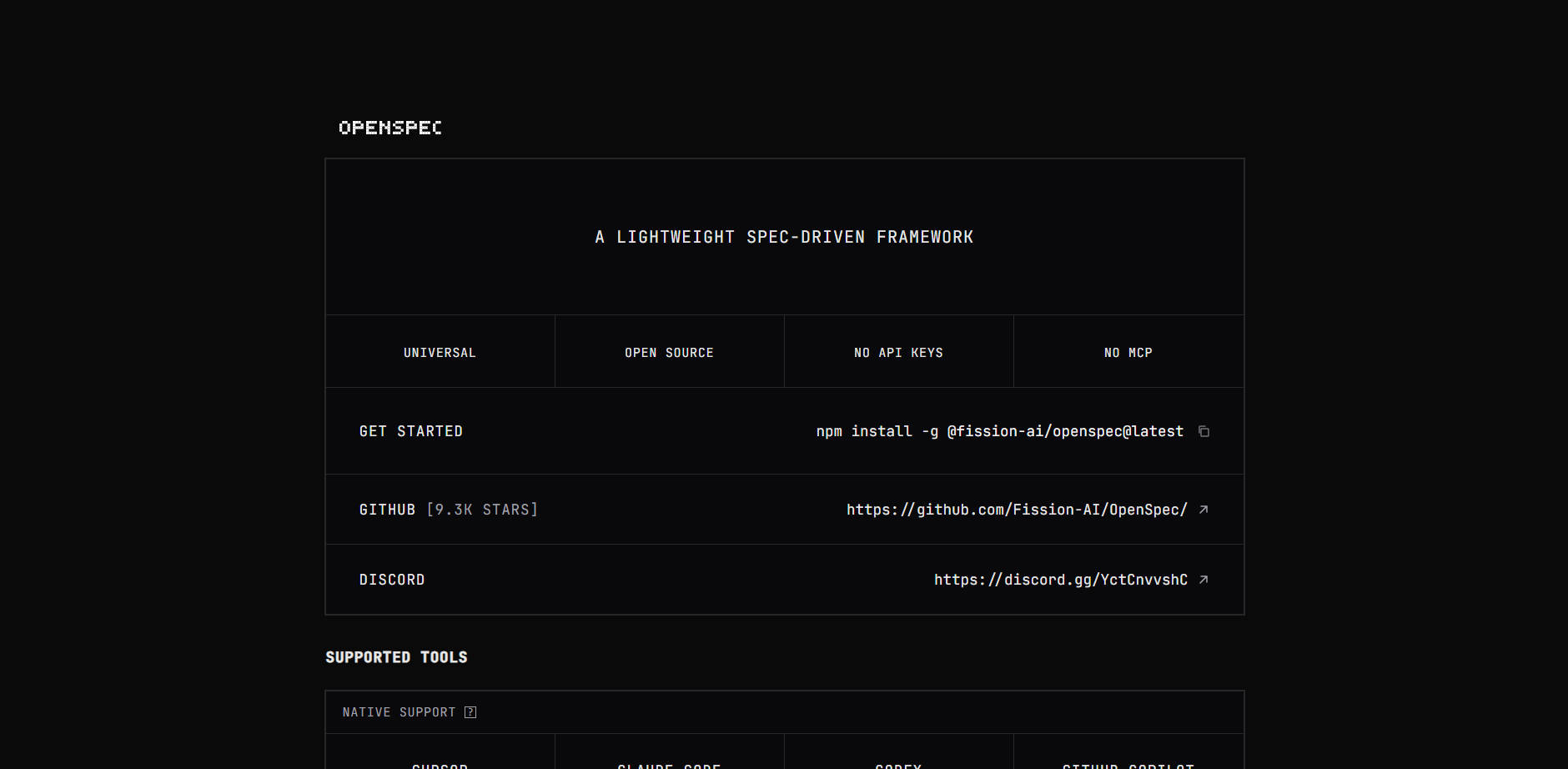
OpenSpec is the essential specification layer that brings discipline and predictability to development teams utilizing AI coding assistants. It solves the critical problem of unpredictable AI outputs by enforcing a lightweight, spec-driven workflow, ensuring human and AI stakeholders agree on project requirements before any implementation begins. Designed for developers and engineering teams, OpenSpec integrates seamlessly into existing projects to deliver deterministic, auditable, and reliable results from your favorite AI tools.
Key Features
OpenSpec delivers structured clarity and control by integrating a formal specification process directly into your AI-assisted workflow.
📝 Intent Locking and Review Cycle
OpenSpec introduces a structured, four-step lifecycle—Draft, Review, Implement, Archive—that locks down intent before code generation. This crucial feedback loop allows you to refine specifications and tasks interactively with your AI assistant until the plan is fully aligned, fundamentally shifting AI from an unpredictable generator to a deterministic executor of agreed-upon requirements.
📂 Structured, Auditable Change Tracking
Every proposed feature or modification is housed in an explicit change folder (openspec/changes/feature-name/), containing the proposal.md, tasks.md, and crucial specification deltas. This structure keeps scope explicit, ensuring all stakeholders have shared visibility into what is proposed, active, or archived, making the entire development history fully auditable.
⚙️ Brownfield-First Architecture for Scale
Unlike tools optimized solely for new projects (0→1), OpenSpec excels at modifying existing, complex systems (1→n). It maintains a clean separation between the source of truth (openspec/specs/) and proposed updates (openspec/changes/), ensuring that when changes span multiple specifications, the resulting diffs are explicit, manageable, and easy to review before merging.
🤝 Universal AI Tool Integration
OpenSpec works natively with a comprehensive list of coding assistants, including Claude Code, Cursor, GitHub Copilot, and Amazon Q Developer, via dedicated slash commands (/openspec:proposal, /openspec:apply, etc.). For all other assistants, OpenSpec automatically configures a managed AGENTS.md hand-off, ensuring compatibility and workflow consistency across your entire team without requiring external API keys.
Use Cases
OpenSpec is designed for real-world development scenarios, ensuring your team maintains velocity and quality regardless of project complexity.
1. Expediting Complex Feature Development
When adding a significant feature, like two-factor authentication, you simply prompt your AI to create an OpenSpec proposal. The AI automatically generates the structured proposal, implementation tasks, and the exact specification delta (the "patch"). You can then review the proposed changes—including the SHALL/MUST requirements and scenarios—before the AI writes a single line of code, drastically reducing the cost of rework and ensuring full requirement coverage.
2. Managing Cross-Spec System Refactoring
Imagine updating an existing system where a change to the user profile affects authentication, logging, and data retrieval specifications. OpenSpec’s architecture allows the proposed change to contain deltas for all affected specs simultaneously within one change folder. This centralized approach ensures you can review and approve a single, unified plan that guarantees consistency across disparate parts of the codebase before implementation begins.
3. Onboarding New Team Members and Tools
New developers or teams adopting a new AI assistant can quickly understand the project's standards and architecture. The project's context (openspec/project.md) and the living specifications (openspec/specs/) serve as reliable documentation. Furthermore, because OpenSpec uses standardized slash commands and the AGENTS.md convention, different teammates can use different AI tools while always adhering to the same structured workflow.
Why Choose OpenSpec?
OpenSpec is built for the realities of professional software development, offering distinct advantages over traditional methods and alternative specification tools.
| Differentiator | OpenSpec Approach | Tangible User Benefit |
|---|---|---|
| Project Fit | Brownfield-First (1→n). Separates source specs from proposed changes (specs/ vs. changes/). | Easily manage complex updates that touch multiple existing features and specifications without friction. |
| Workflow Overhead | Lightweight and No API Keys. Utilizes existing AI integration points (slash commands, AGENTS.md). | Minimal setup and maintenance; your workflow stays fast and focused on requirements, not configuration. |
| Change Auditability | Explicit Change Folders. Proposal, tasks, and spec deltas are grouped together until archived. | Provides clear, auditable history. You know exactly why a change was made and how it modified the system's defined behavior. |
| Compared to No Specs | Deterministic Output. Requirements are agreed upon before code is written. | Eliminates the unpredictable nature of vague prompts, reducing bugs, scope creep, and unexpected feature additions. |
Conclusion
OpenSpec transforms AI coding from a chaotic process into a predictable, structured engineering discipline. By aligning your team and your AI on explicit specifications, you gain unparalleled visibility, control, and auditability over your codebase. Start delivering reliable, high-quality code faster and with greater confidence.
Explore how OpenSpec can help you achieve deterministic results in your next feature release.
More information on OpenSpec
Launched
Pricing Model
Free
Starting Price
Global Rank
Follow
Month Visit
<5k
Tech used
OpenSpec was manually vetted by our editorial team and was first featured on 2025-11-17.