

What is TestRigor?
testRigor is the generative AI-based test automation platform designed to eliminate the massive burden of test maintenance and accelerate deployment velocity. By translating high-level, free-flowing plain English instructions into robust, executable steps, testRigor empowers manual QA professionals and engineers alike to build comprehensive end-to-end coverage up to 100 times faster than traditional scripting methods. If you are struggling with brittle tests, high maintenance overhead, and insufficient coverage, testRigor offers a path to rapid, stable, and scalable quality assurance.
Key Features
testRigor leverages advanced AI and natural language processing (NLP) to shift the focus from debugging code to verifying product functionality, ensuring your tests remain stable even as the underlying UI changes.
💬 Plain English Test Creation
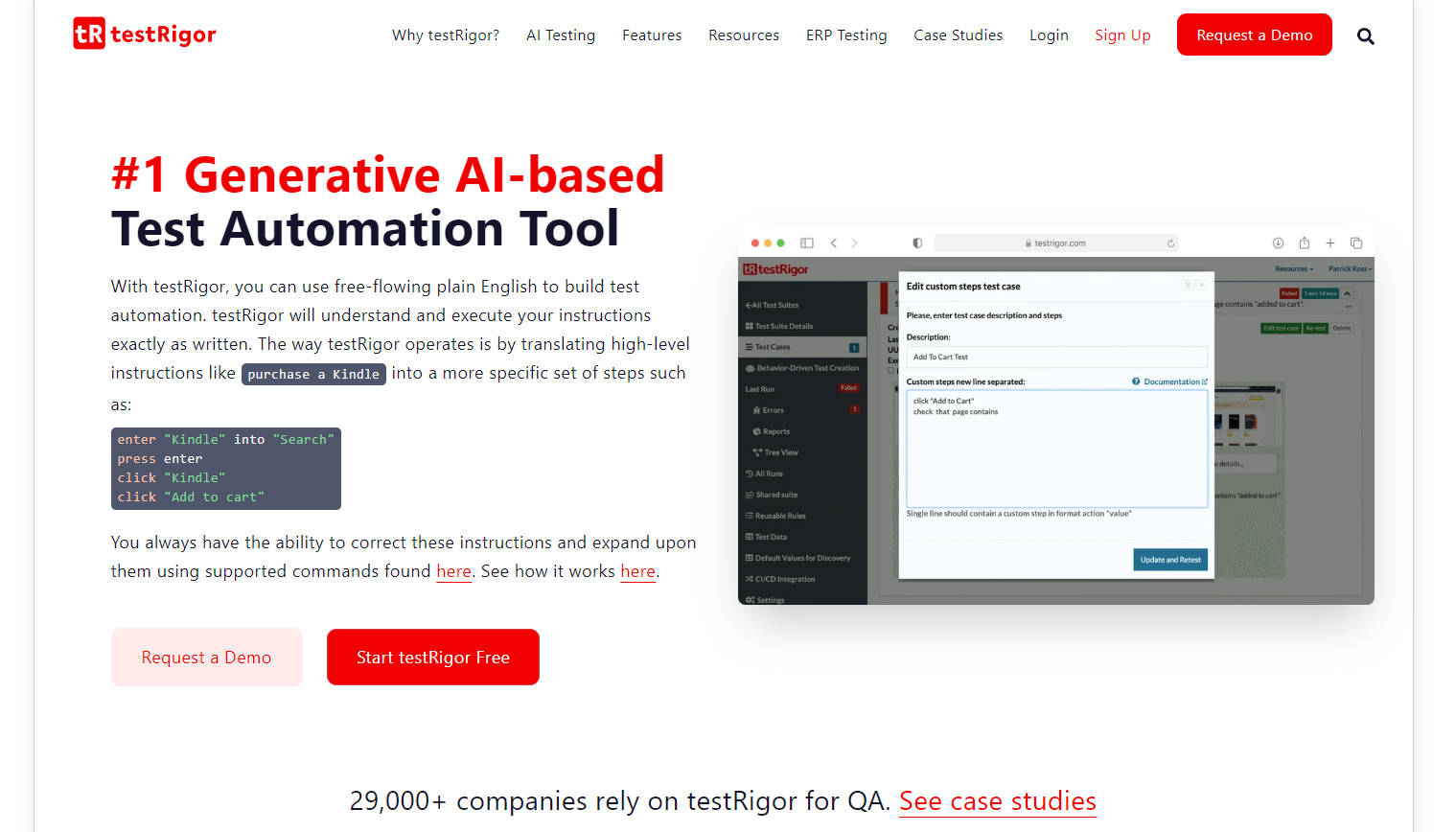
Use simple, intuitive language—just as a real user would describe an action—to define complex test flows. testRigor’s AI understands instructions like purchase a Kindle and automatically translates them into the necessary low-level steps (e.g., entering text, clicking elements). This feature allows non-technical team members to create and maintain automated tests, significantly expanding your team’s capacity and coverage.
🛡️ Ultra-Stable, Locator-Free Tests
Unlike traditional tools that rely on brittle element locators (like XPaths or CSS selectors), testRigor creates tests based on the end-user's perspective. The system identifies elements as they appear on the screen, making the tests highly resistant to minor UI changes, framework updates, or dynamic IDs. This results in 99.5% less test maintenance compared to Selenium, freeing up QA engineers to focus on new coverage.
🌐 Comprehensive End-to-End Coverage
Achieve true end-to-end validation by testing complex, multi-channel scenarios within a single test case. testRigor extends beyond standard web and mobile (native/hybrid iOS and Android) testing to include API calls, email verification, SMS/phone calls (via Twilio integration), Mainframe applications, and two-factor authentication (2FA) flows.
🧠 Behavior-Driven Test Generation
Accelerate test case creation by automatically generating tests that mirror how your real users interact with your application in production. By capturing metadata around user habits, the system autonomously generates and maintains behavior-driven tests for your most frequently used functionality and complex flows, ensuring coverage is always centered on maximum user impact.
Use Cases
testRigor fits seamlessly into modern CI/CD pipelines and agile QA workflows, delivering tangible benefits across various scenarios:
- Enabling Manual QA for Automation: A manual QA team needs to automate regression testing for a critical e-commerce checkout flow. Instead of requiring weeks of specialized development time, the manual team can import their existing test documentation and use plain English commands (enter "credit card number" into "Payment Field") to rapidly build and execute the automated suite. This increases automation coverage from 30% to over 90% in under a year, without needing to hire specialized QA engineers.
- Accelerating CI/CD Deployment: During a rapid development cycle, the engineering team requires a full regression retest before deploying a nightly build. In a traditional setup, this retest might take 12 hours. Using testRigor’s parallel execution capabilities, the entire functional test suite can be completed and validated in under 15 minutes, allowing the team to deploy faster and with greater confidence.
- Validating Multi-Platform User Journeys: A financial application requires a user to log in, receive a one-time password (OTP) via SMS, validate the OTP, and then check an API endpoint to confirm a transaction. testRigor handles this complex journey in one continuous test, invoking the API, integrating with Twilio for SMS validation, and navigating the UI, ensuring all interconnected components function correctly.
Why Choose testRigor?
Organizations rely on testRigor not just for automation, but for the inherent stability and efficiency gains that fundamentally transform the QA function.
| Metric / Comparison | Traditional QA Automation (e.g., Selenium/Appium) | testRigor (Generative AI) | Tangible Benefit |
|---|---|---|---|
| Test Maintenance Time | Most resources tied up in maintenance. | 99.5% Less Maintenance | Free QA engineers to build new features, not debug old tests. |
| Test Creation Speed | Requires expensive developer hours, takes weeks. | 100X Faster | Manual QA can create and maintain automated tests immediately. |
| Test Coverage | On average, organizations achieve 30% coverage due to maintenance burden. | 90%+ Coverage | Quickly achieve full coverage for critical user paths. |
| Full Regression Retest | Takes hours or days. | Under 15 Minutes | Enable true continuous integration and continuous deployment (CI/CD). |
| Stability | Brittle, fails with minor UI changes (XPath dependent). | Ultra-Stable (Survives UI framework changes) | Tests reflect real user interaction and only fail if functionality is broken. |
Conclusion
testRigor transforms software quality assurance from a code-heavy maintenance bottleneck into a fast, flexible, and scalable acceleration engine. By bridging the gap between human specification and automated execution using Generative AI, you empower your entire team to contribute to testing, achieve superior stability, and deploy new functionality with unprecedented speed.
More information on TestRigor
Launched
2016-03
Pricing Model
Paid
Starting Price
Global Rank
207485
Follow
Month Visit
188.1K
Tech used
Google Analytics,Google Tag Manager,HubSpot Analytics,Cloudflare CDN,WordPress,Gzip,JSON Schema,OpenGraph,HSTS,Vimeo
Top 5 Countries
24.97%
18%
3.2%
2.5%
2.49%
India
United States
Germany
Russia
United Kingdom
Traffic Sources
1.97%
0.66%
0.1%
7.44%
47.65%
42.19%
social
paidReferrals
mail
referrals
search
direct
Source: Similarweb (Sep 24, 2025)
TestRigor was manually vetted by our editorial team and was first featured on 2024-08-05.
Related Searches
TestRigor Alternatives
Load more Alternatives-

-

Testomat.io: AI test management for modern QA. Unify automated & manual tests, requirements into one source of truth. Boost quality & speed.
-

-

-

TestDriver revolutionizes software testing by leveraging Agentic User Testing (AUT) to automate and scale the QA process. Unlike traditional testing frameworks that rely on brittle selectors and limited headless browsers, TestDriver employs AI-powered agents that simulate real user interactions, providing comprehensive coverage and reducing maintenance overhead.