

What is Aviator?
If you're a developer or engineering leader working with large codebases, particularly monorepos, you know the pain. Slow code reviews, constant merge conflicts, and the ever-present threat of flaky tests breaking the build can grind productivity to a halt. Aviator is a developer productivity suite designed to address these challenges directly, inspired by the best practices of leading tech companies. It's about getting your code reviewed, tested, and merged faster, with less frustration and more confidence.
Key Features:
⚡️ Accelerate Code Reviews with FlexReview: Aviator intelligently handles code reviews of any size, ensuring faster response times and reducing bottlenecks. No more waiting days for feedback on even small changes.
🚦 Maintain Build Stability with MergeQueue: This highly customizable merge queue is built to handle thousands of pull requests (PRs) simultaneously. It allows you to deploy more frequently while minimizing CI costs. It offers:
Massively parallel dynamic queues, especially beneficial for monorepos.
Built-in fault tolerance to handle those pesky flaky tests.
Priority queuing and predictive batching for optimized workflow.
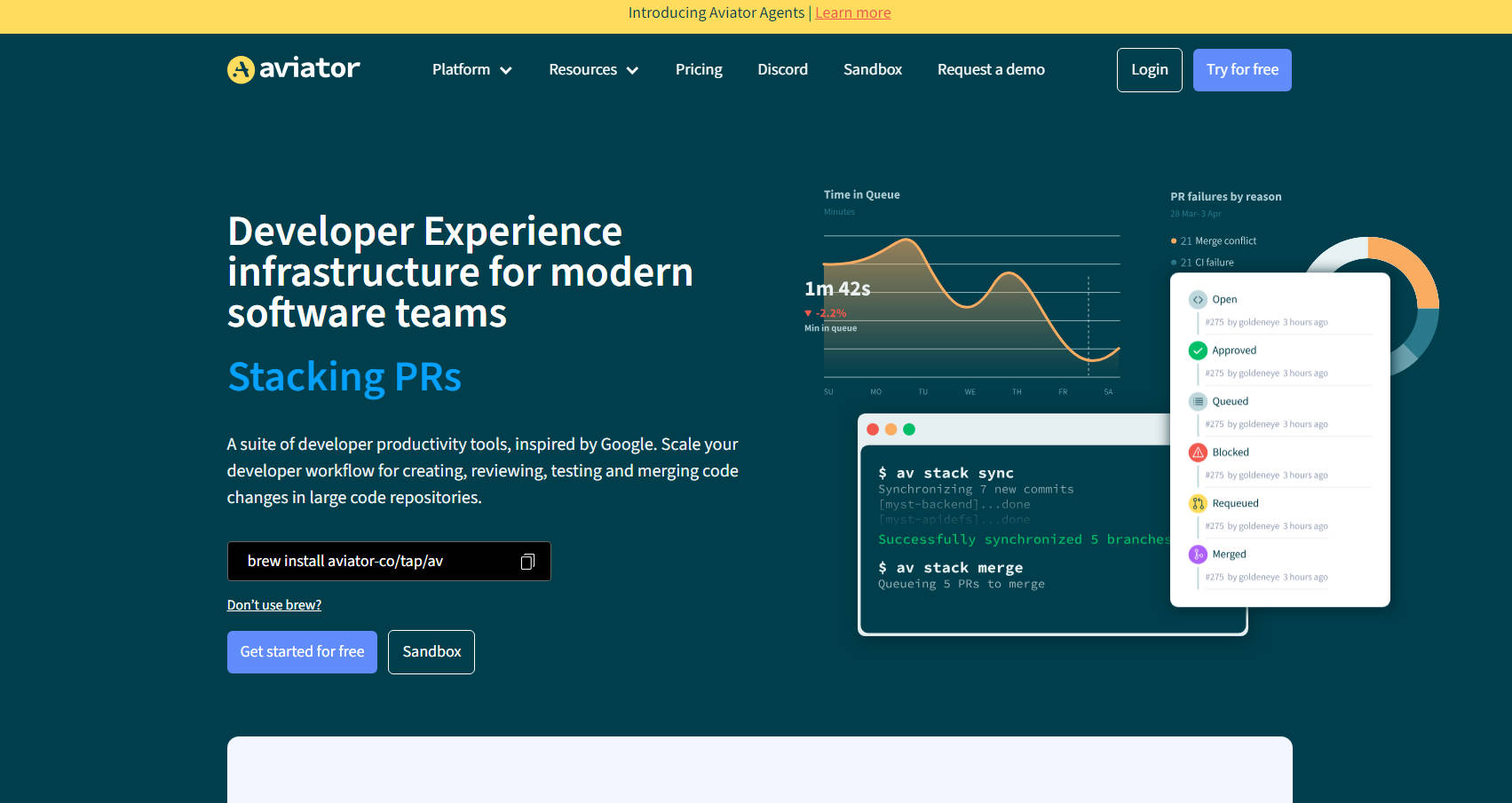
🧩 Simplify Complex Changes with Stacked PRs: Break down large features into smaller, manageable, and interdependent PRs. This makes reviews faster and reduces the risk of introducing bugs. It also helps manage cross-PR dependencies.
🧪 Suppress Flaky Tests with TestDeck: Proactively detect and automatically rerun flaky tests based on preconfigured rules. Gain insights into test health with analytics, identifying the most problematic tests.
🤖 Automate Large-Scale Code Migrations with Aviator Agents (Early Access): This LLM-based agentic framework, integrating directly with GitHub, handles code migrations of any scale. It uses models like OpenAI, Claude, and Llama to:
Find references and documentation.
Understand dependencies.
Break down large code chunks.
Verify build status and iterate for accuracy.
Use Cases:
Scenario: The Monorepo Bottleneck: Imagine a team of 50 developers constantly pushing changes to a massive monorepo. Without Aviator, merges become a nightmare, with constant conflicts and build failures. With MergeQueue, changes are queued intelligently, validations are run efficiently, and developers can merge with confidence, knowing their code won't break the build.
Scenario: The Flaky Test Nightmare: A developer spends hours debugging a test that fails intermittently, only to discover it's a known flaky test unrelated to their changes. With TestDeck, this test would be automatically identified, rerun, and potentially suppressed, saving the developer valuable time and frustration.
Scenario: The Large Feature Dilemma: A developer needs to implement a significant new feature that touches multiple parts of the codebase. Instead of creating one massive, hard-to-review PR, they use Stacked PRs to break it down into smaller, logical units. Reviewers can provide feedback more quickly, and the risk of introducing bugs is significantly reduced.
Conclusion:
Aviator isn't just another tool; it's a comprehensive solution designed to address the core challenges of modern software development, especially in large, complex projects. It's about empowering developers to work smarter, not harder, and enabling engineering teams to ship code faster and with greater confidence. If you're looking to boost your team's productivity and reduce the friction of code reviews and merges, Aviator is worth exploring.
FAQ:
Q: What CI tools does Aviator integrate with?
A: Aviator's MergeQueue is CI-agnostic and integrates seamlessly with any CI platform, including Bazel, NX, Pants, Turborepo, Gradle, and many others.
Q: Is Aviator suitable for small teams?
A: Yes! Aviator is free for teams under 15 developers, making it accessible to startups and smaller organizations.
Q: Does Aviator offer enterprise-level security and support?
A: Absolutely. Aviator is built for enterprise use, with features like real-time Slack support, SOC2 Type II compliance, SAML-based authentication, and on-premise deployment options.
Q: How does Aviator Agents differ from other LLM-based frameworks?
A: Aviator Agents is an end-to-end solution that connects directly with GitHub, eliminating the need for custom environment setups. It emulates human patterns for code migrations, handling everything from finding references to verifying build status.
Q: How can I access Aviator Agents?
A: Aviator Agents is currently in early access. You can sign up on the Aviator website to request access and provide details on your intended use cases.
More information on Aviator
Launched
2010-07
Pricing Model
Free Trial
Starting Price
Global Rank
402230
Follow
Month Visit
88.7K
Tech used
Google Tag Manager,Webflow,Amazon AWS CloudFront,Cloudflare CDN,unpkg,Google Fonts,Google Cloud Platform,jQuery,Gzip,HTTP/3,JSON Schema,OpenGraph,HSTS
Top 5 Countries
8.93%
8.62%
8.01%
5.9%
4.46%
Vietnam
United States
India
Nigeria
Canada
Traffic Sources
3.68%
0.85%
0.42%
14.39%
42.65%
37.85%
social
paidReferrals
mail
referrals
search
direct
Source: Similarweb (Sep 25, 2025)
Aviator was manually vetted by our editorial team and was first featured on 2025-02-28.
Related Searches
Aviator Alternatives
Load more Alternatives-

-

Atlassian Rovo Dev Agent: AI automates dev tasks, code planning & reviews for faster, high-quality software delivery aligned with business goals.
-

Macroscope: AI clarity for engineering leaders & developers. Understand your codebase, automate PRs, detect bugs, & get real-time insights to build faster.
-

-

ReviewForge automatically analyzes your code for bugs, security issues, and performance optimizations, saving developer time and improving quality.