

Click outside to close
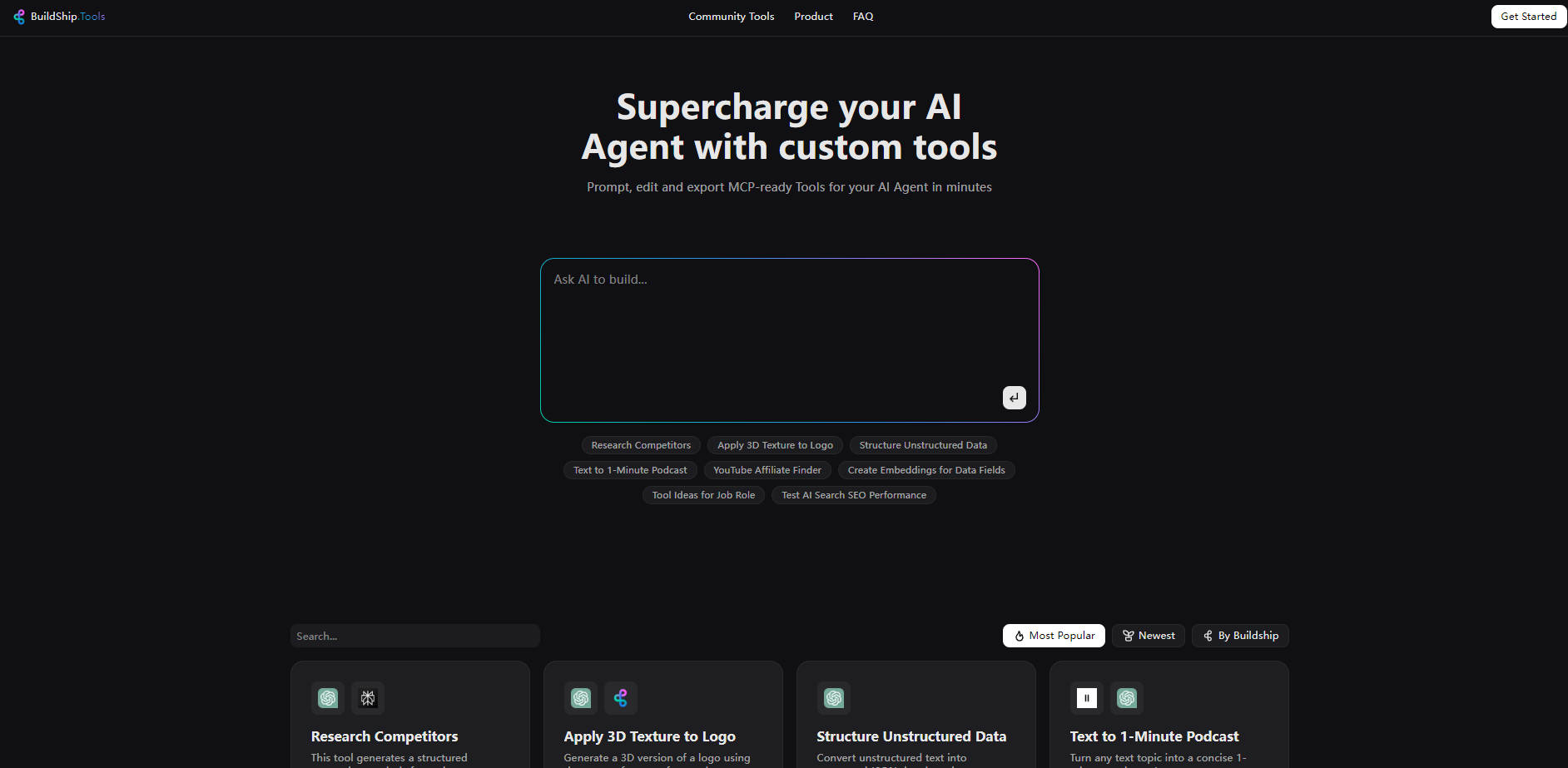
What is BuildShip.Tools?
Building truly capable AI agents often means equipping them with specialized tools to interact with the world beyond their core models. Creating, testing, and deploying these custom functionalities can be a significant hurdle, involving complex coding and infrastructure setup. BuildShip.Tools provides a streamlined, visual environment, supercharged with AI assistance, allowing you to design, build, and deploy the exact tools your AI agents need – faster and with greater flexibility.
Key Features
🤖 Describe Your Idea, Watch AI Build: Use natural language prompts to outline the tool you need. The integrated AI Builder intelligently generates the underlying workflow logic and necessary nodes, giving you a functional starting point in seconds.
✍️ Tweak and Test Visually: Refine the AI-generated flow or build from scratch using an intuitive drag-and-drop canvas. Connect inputs and outputs, browse a library of pre-built nodes, and test your tool's logic iteratively, all without needing to dive deep into code immediately.
🚀 Deploy Your Way: Hosted or Self-Hosted: Choose the deployment option that fits your needs. Opt for instant, secure, and scalable hosting on BuildShip Cloud with simple pay-per-use pricing, or export the complete source code via CLI to run on your own infrastructure for full control and ownership.
🔌 MCP-Ready for Seamless Integration: Export your finished tool with a fully MCP-compatible (Machine-readable Capability Profile) specification. This ensures smooth integration with popular agent frameworks like LangChain, OpenAI function calling, or your own custom-built agent systems.
💻 Full Code Access When You Need It: Enjoy the speed of visual development without sacrificing control. Access and modify the underlying source code for any node directly on the canvas, or export the entire tool's code for advanced customization, debugging, or self-hosting modifications.
🛠️ Combine Tools with Toolsets: Group multiple related tools into a single Toolset. This allows your AI agent to perform more complex, multi-step tasks through a single, efficient call, simplifying agent logic and automating more sophisticated processes.
🔒 Secure and Compliant: Build and deploy with confidence. BuildShip adheres to security and compliance standards including GDPR, HIPAA, SOC 2, and ISO 27001, helping ensure your tools and data are protected.
Use Cases: Bringing Your Agent's Tools to Life
Imagine the possibilities for your AI agents:
Automated Data Structuring: Your agent receives unstructured customer feedback via email. You use BuildShip to create a tool: describe "Extract customer name, email, product mentioned, and overall sentiment from text." The AI builds the initial flow. You visually add a node to format the output as JSON. Test it with sample emails, deploy it on BuildShip Cloud, and your agent can now automatically process and categorize feedback.
Real-Time Information Retrieval: You need your financial analysis agent to fetch current stock prices. In BuildShip, you visually construct a tool: an input node for the stock ticker, an HTTP request node to call a financial data API, a JSON parsing node to extract the price, and an output node. You secure the tool with an API key, export the source code, and deploy it within your company's private cloud for the agent to use securely.
Content Generation Assistance: You want an agent to help create social media posts from blog articles. Prompt BuildShip's AI: "Input blog post URL, extract the main topic and key points, generate three short tweet suggestions." Refine the visual flow, perhaps adding a node to check for character limits or call another service for hashtag suggestions. Deploy the MCP-compatible tool, enabling your agent to draft social media content efficiently.
Conclusion
BuildShip.Tools removes the friction from creating the custom capabilities that make AI agents truly useful. By combining an intuitive visual builder, AI-powered assistance, and flexible deployment options (cloud-hosted or self-hosted), you gain the speed and control needed to rapidly develop and integrate specialized tools. Equip your agents with the precise functionalities they require to tackle complex tasks and interact effectively with external systems.
More information on BuildShip.Tools
Top 5 Countries
23.33%
13.56%
12.59%
11.02%
9.74%
Vietnam (23.33%)
Brazil (13.56%)
United States (12.59%)
India (11.02%)
Mexico (9.74%)
Traffic Sources
22.27%
5.68%
11.97%
22.01%
36.74%
social (22.27%)
paidReferrals (0.9%)
mail (5.68%)
referrals (11.97%)
search (22.01%)
direct (36.74%)
Source: Similarweb (Sep 25, 2025)
BuildShip.Tools was manually vetted by our editorial team and was first featured on 2025-05-13.
BuildShip.Tools Alternatives
BuildShip.Tools Alternatives-

Shipable AI: Build, deploy & scale AI agents with ease, no code needed. Turn ideas into powerful bots for any channel. Integrate tools & knowledge seamlessly.
-
BuildShip: Build visual backends without code using AI. Features include pre-built nodes, serverless APIs, and unlimited cloud storage. Empower your projects now!
-

Toolhouse is a Backend-as-a-Service (BaaS) to build, run, and manage AI agents. Toolhouse simplifies the process of building agents in a local environment and running them in production.
-
Build professional AI apps & online businesses instantly, no coding required. Monetize your expertise and launch in hours!
-
Build powerful AI Agents with Steamship's Python SDK and deploy to the cloud effortlessly. Features include serverless hosting, vector search, and webhooks.