

What is CrateDB?
CrateDB is a high-performance distributed SQL database designed for modern applications that demand instant insights, high ingest capacity, and multi-model data support. It solves the operational complexity of managing separate data systems by unifying real-time analytics, hybrid search, and AI vector workloads into a single, resilient engine. This allows your team to leverage the simplicity and familiarity of SQL while achieving millisecond-level performance on massive, fast-moving datasets.
Key Features
CrateDB provides a flexible, distributed architecture that ensures data-driven actions happen at the speed of your business, from detecting anomalies to optimizing complex workflows.
- ⚡️ Turbocharged Aggregations: Run ad-hoc queries on billions of records in milliseconds, enabling instant exploration of complex data relationships. CrateDB achieves this unprecedented speed by leveraging columnar storage, which dramatically accelerates analytical scans and aggregations required for real-time reporting.
- 🔍 Hybrid Search Powered by Lucene: Perform full-text, geospatial, vector similarity, and complex hybrid searches seamlessly. Built on a fully distributed SQL query engine utilizing Apache Lucene, CrateDB allows you to combine results from diverse data types and complex datasets within a unified query structure.
- 🧠 Seamless AI Model Integration (Vector Store): Effortlessly integrate AI models by storing, searching, and querying vectors directly within the database. This capability facilitates a closed-loop system for continuous optimization, enabling real-time training, predictions, and decision-making within your AI-driven workflows.
- 🔄 Dynamic Schema and Indexing: Adapt instantly to evolving data types and schema changes without interrupting operations or requiring complex manual migrations. Real-time data is immediately available for querying upon ingestion, as the system dynamically optimizes indexing on the fly for uninterrupted, fast performance.
- 🌐 Built for Scale and Resilience: Manage massive data volumes, from millions to billions of records, while guaranteeing high-speed performance and uninterrupted insights. The fault-tolerant, distributed, shared-nothing architecture ensures high availability, automatic failover, and effortless scaling under the heaviest workloads.
Use Cases
CrateDB is engineered to handle the most demanding, real-time data challenges across industries, providing clarity and speed where it matters most.
1. High-Velocity IoT and Time-Series Analysis
When monitoring fleets of devices, you need to ingest millions of metrics per second and query them instantly. CrateDB allows you to ingest over 800,000 metrics per second while running complex SQL aggregations—such as calculating the average battery level per hour for thousands of devices—in sub-second timeframes. This capability is essential for predictive maintenance and real-time operational monitoring.
2. Unified Data Layers for Modern Applications
Eliminate data silos by consolidating relational, time-series, JSON, and vector data into one engine. Instead of synchronizing separate databases for user profiles (relational), application logs (JSON), and product usage history (time-series), you can execute a single SQL query that spans all data models, drastically improving developer productivity and reducing operational overhead.
3. Real-Time Recommendation and Semantic Search Engines
Build sophisticated applications that require combining user behavior with advanced search. Utilize the vector store to power semantic search (finding items based on meaning, not just keywords), and combine those results with full-text search and relational data (like user preferences or inventory status) using standard SQL joins, delivering highly personalized recommendations instantly.
Why Choose CrateDB?
CrateDB is designed to be the definitive platform for developers and architects seeking performance and flexibility without vendor lock-in.
Enhanced Developer Productivity and Compatibility
CrateDB maintains full SQL familiarity, including support for joins, aggregations, and Common Table Expressions (CTEs), allowing teams to leverage existing skills. Crucially, its PostgreSQL compatibility (via the PostgreSQL Wire Protocol) ensures seamless integration with a vast ecosystem of third-party tools, BI platforms, and developer frameworks like LangChain, giving you the freedom to choose your preferred LLM and embedding algorithms.
Operational Efficiency Through Unification
The multi-model approach means you no longer need separate databases for different data types (e.g., a time-series DB, a relational DB, and a vector DB). By managing all data models—including relational, time-series, geospatial, and vector data—in a single, cost-efficient, robust system, CrateDB streamlines operations, reduces infrastructure complexity, and guarantees high availability with automatic failover and recovery mechanisms.
Flexible Deployment and Open Source Freedom
CrateDB offers complete deployment flexibility, supporting DBaaS (on AWS, Azure, GCP), hybrid cloud, and self-managed deployments (Docker, Kubernetes). Furthermore, the open-source licensing model liberates you from vendor lock-in, providing community support and long-term control over your data infrastructure.
Conclusion
CrateDB delivers the unified, high-performance platform necessary for modern, data-intensive applications. Stop managing disparate data silos and start leveraging the power of distributed SQL for instant, actionable insights at any scale.
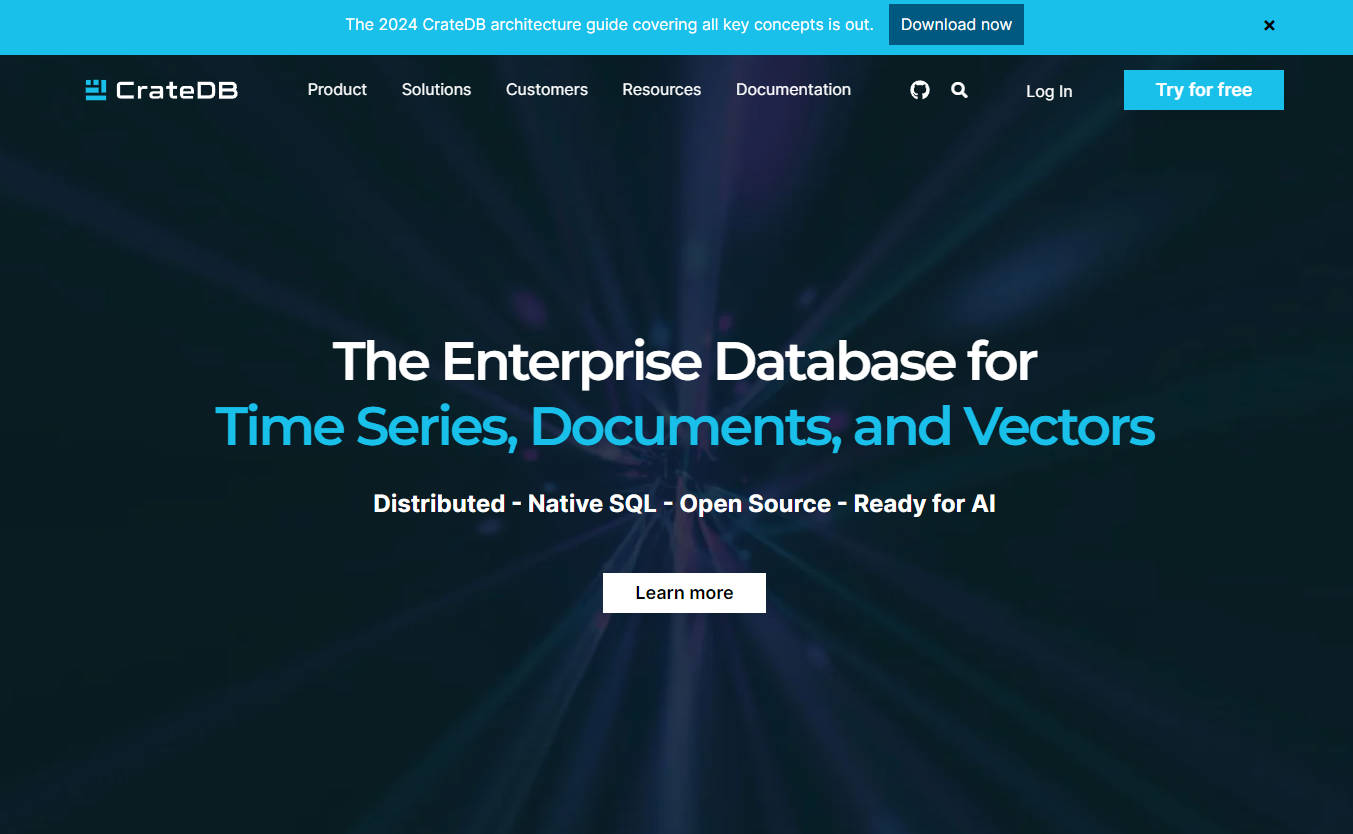
More information on CrateDB
Launched
2016-3
Pricing Model
Free Trial
Starting Price
Global Rank
765438
Follow
Month Visit
43K
Tech used
Google Analytics,Google Tag Manager,Microsoft Clarity,Cloudflare CDN,jQuery,Gzip,OpenGraph,Varnish,HSTS
Top 5 Countries
23.69%
11.4%
7%
5.94%
4.91%
Indonesia
United States
India
Austria
Russia
Traffic Sources
3.81%
0.89%
0.14%
9.88%
47.3%
37.81%
social
paidReferrals
mail
referrals
search
direct
Source: Similarweb (Sep 24, 2025)
CrateDB was manually vetted by our editorial team and was first featured on 2024-03-08.
Related Searches
CrateDB Alternatives
Load more Alternatives-
-
-
-

InfluxDB: High-performance time series data platform. Ingest millions of data points/sec, cut storage costs 90%, and analyze with SQL in real-time.
-

CapybaraDB streamlines data management for AI apps. Built on MongoDB and Pinecone, it offers features like EmbJSON for semantic search, async processing, and native multi - modal support. Simplify AI development, reduce costs, and manage diverse data easily.