
What is LeanSpec?
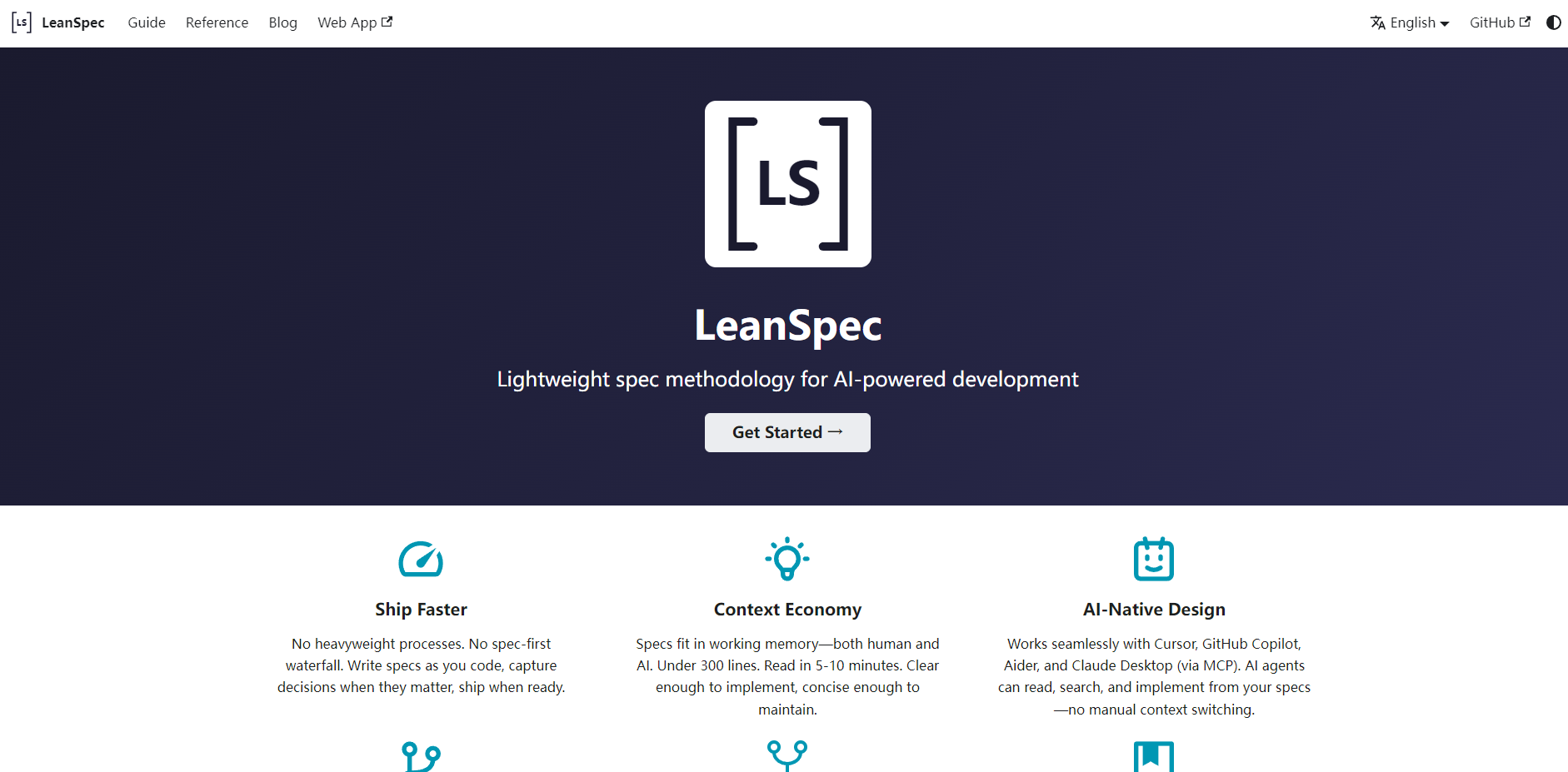
LeanSpec is a lightweight, agile Spec-Driven Development (SDD) methodology and adaptive workflow designed specifically for modern teams utilizing AI coding agents. It fundamentally addresses the problem of documentation overload and "mind burden" by replacing rigid, lengthy specifications with concise, intent-focused documents
Key Features
LeanSpec is built on the philosophy of the Context Economy, ensuring
🧠 Context Economy: Optimized for Human and AI Performance
Specs are intentionally constrained to be short—typically under 300 lines—making them scannable in 5-10 minutes. This controlled length minimizes cognitive load for human reviewers and, crucially, ensures
🤖 AI-Native Design via MCP Server
LeanSpec works seamlessly with leading AI tools, including Cursor, GitHub Copilot, Aider, and Claude Desktop, through the native MCP (Model Communication Protocol) Server. This integration allows AI agents to directly read, search, and implement requirements from your specs without manual context switching, ensuring agents always have clear purpose and concrete scenarios (The Goal, Key Scenarios, Acceptance Criteria) to guide their work.
🚀 Ship Faster with Agile & Adaptive Specs
Unlike traditional "spec-first" waterfall approaches, LeanSpec is inherently adaptive. You write specs as you code and capture decisions when they matter, allowing documentation to evolve alongside the implementation. This agility ensures your documentation remains a living source of truth, avoiding outdated "frozen contracts" and allowing teams to respond to emerging insights faster.
🛠️ Comprehensive Tooling Ecosystem
Manage your workflow directly from your terminal with the Core CLI. This toolchain provides lightweight spec management, allowing you to create, organize, search, and validate specs. Further tooling includes GitHub Actions for CI/CD integration, a VS Code extension, and the ability to track project health using a Kanban board (lean-spec board) and analytics (lean-spec stats).
📈 Progressive Disclosure Structure
The methodology supports gradual scaling, allowing you to Start Simple, Scale Smart. A solo developer can begin with just a README.md and status tracking. Structure is added only when pain is felt (e.g., adding tags, priority, or custom fields for enterprise teams), ensuring the process adapts to your needs rather than constraining them upfront.
Use Cases
LeanSpec enhances team performance and alignment across several critical development scenarios:
1. Rapid Team and AI Alignment
When starting a new feature, a spec containing The Goal, Key Scenarios, and explicit Non-Goals (what you are explicitly not doing) provides unambiguous direction. Instead of spending hours debating scope, the development team and their AI coding assistants start with a shared, concise source of truth, minimizing scope creep and ensuring everyone focuses on the intended outcome.
2. High-Quality Feature Implementation
A developer leveraging a tool like Copilot or Claude can feed the LeanSpec criteria directly to the agent via the MCP server. Because the spec is concise and includes Acceptance Criteria (clear, testable conditions for "done"), the AI agent is guided toward generating higher-quality, testable code
3. Accelerated Onboarding and Context Transfer
When a new team member joins, they don't need to wade through thousands of lines of legacy documentation. By reviewing the short, intent-focused LeanSpecs, they quickly grasp the project's Intent Over Implementation—understanding the "why" behind the code without getting buried in implementation details
Unique Advantages
LeanSpec’s unique positioning is derived from its focus on low cognitive load and high adaptability, setting it apart from more prescriptive SDD alternatives:
| Feature | LeanSpec Advantage | Comparative Benefit |
|---|---|---|
| Context Window | Specs are consistently under 300 lines. | Higher AI performance; avoids context degradation common in frameworks like Spec Kit (longer context) or OpenSpec (long system prompts). |
| Workflow | Flexible, direct editing. No required workflow. | High agility. Unlike Spec Kit's rigid 5-step process or OpenSpec's mandatory proposal → archive steps, LeanSpec adapts to existing team culture. |
| Tooling Flexibility | Editor-agnostic (VS Code, JetBrains, Vim) and works with any AI tool (Copilot, Claude). | Avoids IDE lock-in and subscription costs associated with integrated AI IDEs like Kiro. |
| Access Latency | Specs live locally in your repo. | Instant access via CLI/MCP. Zero API overhead, authentication, or rate limits common when relying solely on Project Management tools (Jira, Linear). |
| Documentation Philosophy | Built on Intent Over Implementation. | Low context rot. Focuses on the stable why (problem/intent) rather than the volatile how (implementation details). |
LeanSpec is the pragmatic bridge, offering the minimal structure necessary to align human and AI efforts, providing 80% of the benefits of traditional specs with 80% of the speed of "vibe coding."
Conclusion
LeanSpec delivers high velocity by treating attention as the scarce resource. By focusing on the Context Economy and maximizing the Signal-to-Noise ratio, you gain alignment and clarity without the heavy documentation burden. If your team seeks a scalable, tool-agnostic methodology
More information on LeanSpec
Launched
Pricing Model
Free
Starting Price
Global Rank
Follow
Month Visit
<5k
Tech used
LeanSpec was manually vetted by our editorial team and was first featured on 2025-11-17.