
What is Lightdash ?
Traditional business intelligence often creates a bottleneck: your data team is buried in Slack requests, while business users struggle with "v3_final" dashboards and inconsistent metrics. Lightdash solves this by connecting directly to your dbt project, allowing you to define your business logic once and deliver instant, reliable insights to your entire organization.
As an AI-first, open-source platform, Lightdash moves beyond static charts. It empowers your team to build "intelligence" through a central semantic layer, ensuring that every department—from sales to product—is looking at the same trusted numbers without needing to write a single line of SQL.
Key Features
- 🤖 Custom AI Data Analysts: Deploy AI agents that understand your specific business logic. By pulling directly from your dbt models, these agents provide accurate, explainable answers to natural language questions, eliminating the risk of "hallucinated" metrics.
- 🏗️ dbt-Native Semantic Layer: Define your metrics and dimensions once in your dbt project. Lightdash automatically syncs these definitions, ensuring that a "net profit" calculation in your warehouse is exactly what your users see in their reports.
- 💻 BI-as-Code Workflows: Ship BI changes with the same rigor as your software. Lightdash integrates with your CI/CD pipeline, allowing you to review, test, and version-control your analytics through GitHub or GitLab before they go live.
- 📊 Spotlight Metrics Catalog: Centralize your KPIs in a searchable library. Users can instantly find, track, and explore key drivers through "Metric Trees" that show how different data points connect and influence high-level business goals.
- 🔌 Embedded Analytics: Deliver insights directly to your customers. Using the React SDK or interactive iFrames, you can embed secure, branded dashboards and charts into your own product, creating new revenue streams and improving user retention.
Use Cases
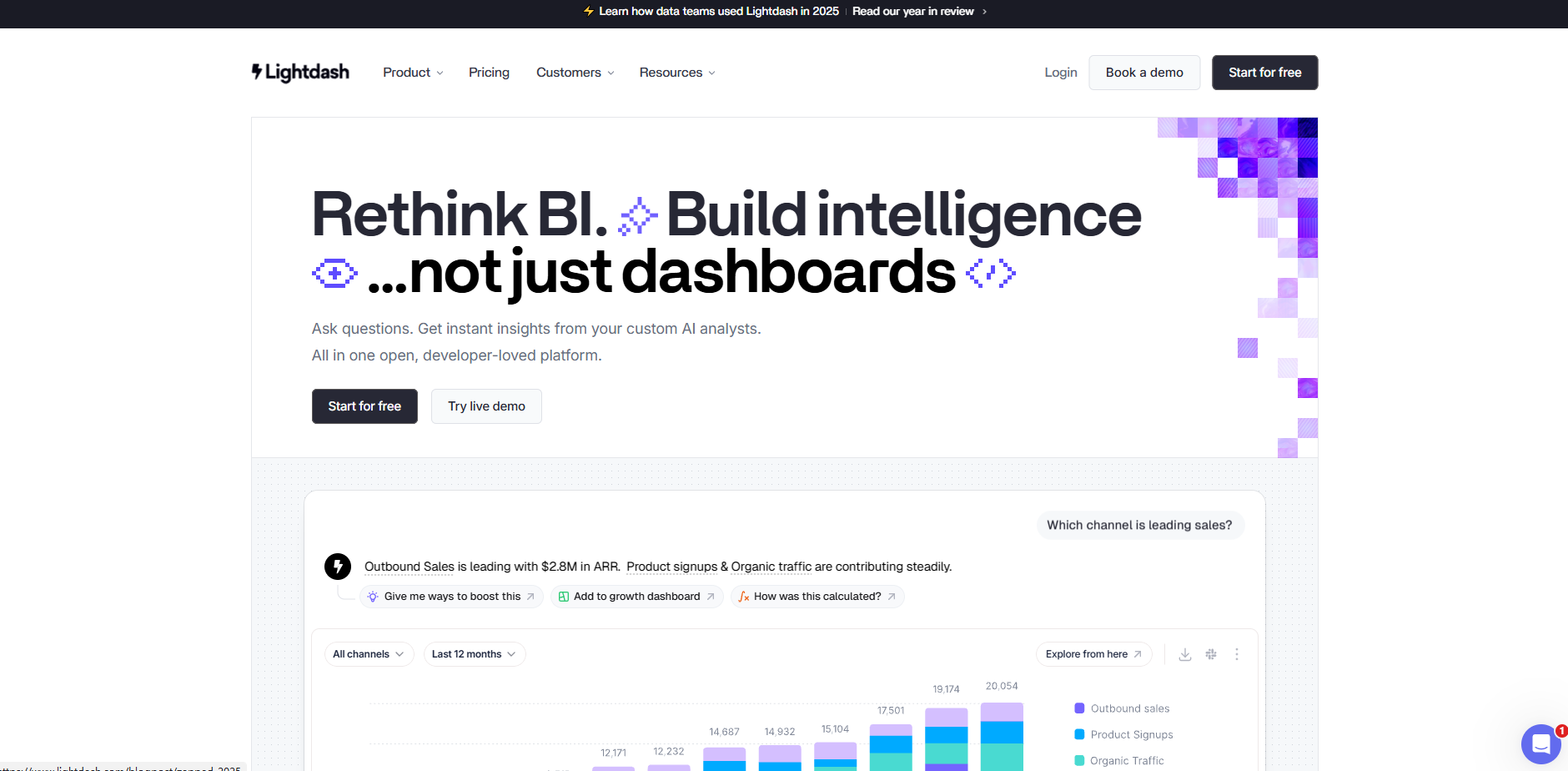
- Self-Serve Sales Reporting: Instead of waiting days for a custom report, a Sales Director can ask the Lightdash AI agent, "Which channel is leading in ARR this quarter?" and receive an instant, verified visualization based on live data.
- Automated Data Governance: Data engineers can use BI-as-code to prevent "dashboard rot." When a dbt model changes, automated testing ensures that downstream charts don't break, maintaining a high level of trust across the company.
- In-App Customer Insights: A SaaS provider can use the Lightdash React SDK to give their users personalized performance dashboards, allowing customers to filter and explore their own data without leaving the application.
Why Choose Lightdash?
Lightdash is built for teams that have outgrown the "chaos" of traditional BI tools. It focuses on functional value and developer experience rather than just visual aesthetics.
- Eliminate Seat-Based Friction: Unlike many legacy BI platforms, Lightdash offers unlimited user seats. This allows you to scale data access across your entire organization without worrying about spiraling viewer license costs.
- The "Meaningful Building Blocks" Approach: Rather than giving users raw data (which leads to errors) or static answers (which creates bottlenecks), Lightdash provides pre-defined metrics. This allows non-technical users to safely combine, segment, and filter data on their own.
- Zero Logic Duplication: Because Lightdash is built on dbt, you don't have to rebuild your business logic inside the BI tool. This "single source of truth" reduces the time spent debating which version of a metric is correct.
Transform Your Data Culture
Lightdash shifts the data team’s role from "report builders" to "intelligence architects." By automating the busy work with AI and treating BI as code, you can reduce delivery times from weeks to days. The result is a more agile organization where everyone has the autonomy to answer their own questions using data you can actually trust.
More information on Lightdash
Launched
Pricing Model
Free Trial
Starting Price
Global Rank
Follow
Month Visit
<5k
Tech used
Lightdash was manually vetted by our editorial team and was first featured on 2026-01-09.