

Click outside to close
What is MONAI.io?
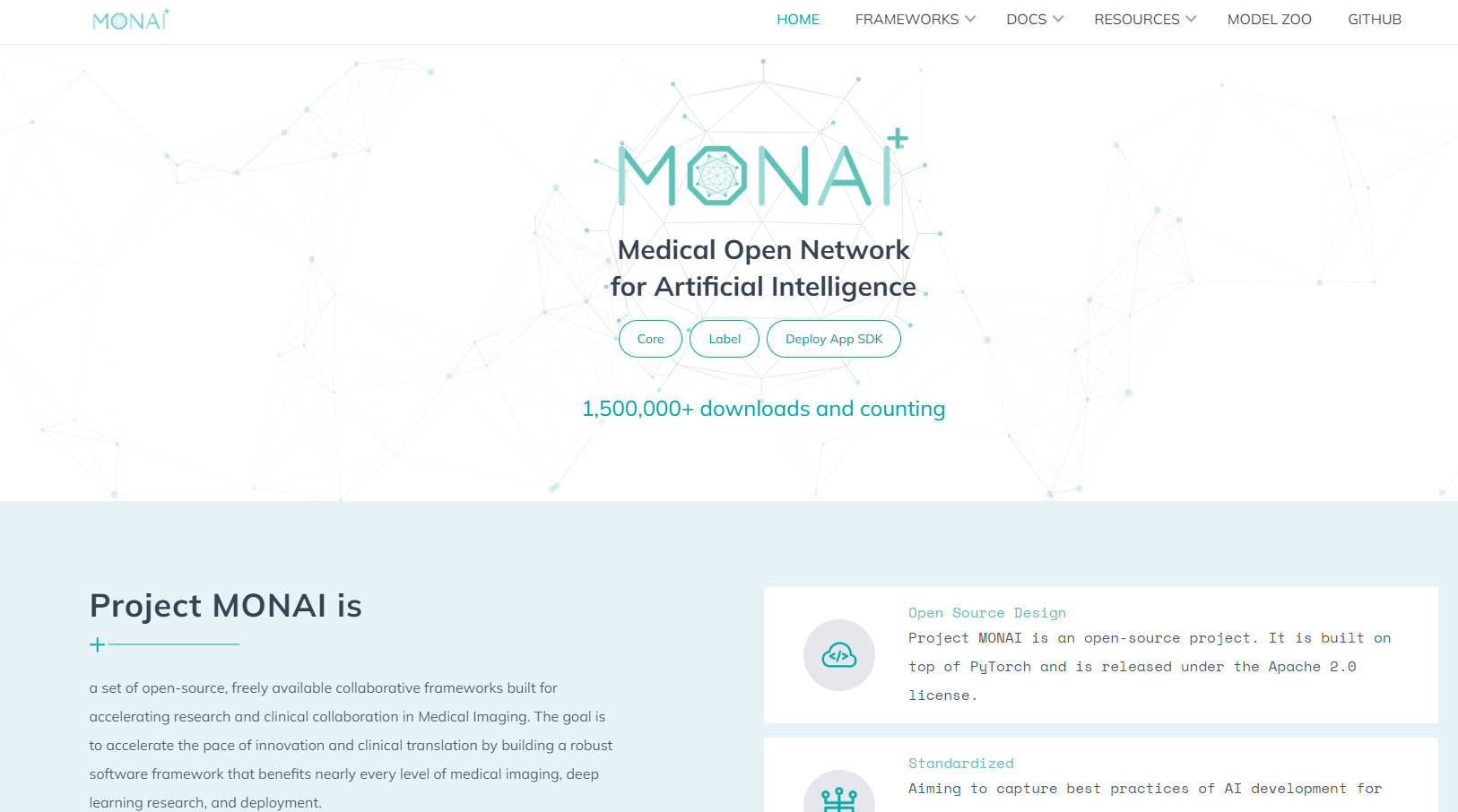
MONAI is a powerful, open-source framework built on PyTorch and integrated into the PyTorch Ecosystem, specifically engineered for deep learning in healthcare imaging. It solves the fragmentation challenge in medical AI development by providing a robust, optimized, and standardized foundation. This framework enables academic, industrial, and clinical researchers to build reliable, reproducible, and standardized end-to-end training workflows.
Key Features
MONAI is designed to accelerate and standardize your medical imaging AI projects, allowing you to focus on innovation rather than infrastructure.
⚙️ Flexible Multi-Dimensional Data Pre-processing
Easily manage and transform complex medical imaging datasets, including high-resolution 3D and 4D volumes (like MRI or CT scans). This dedicated, flexible pre-processing functionality ensures your data is correctly normalized, augmented, and optimized for deep learning models, significantly reducing the manual effort required for data preparation in specialized medical contexts.
🔗 Compositional and Portable APIs
Integrate MONAI seamlessly into your existing research and clinical workflows without extensive refactoring. The modular and portable APIs allow researchers to quickly compose complex training pipelines using standardized components, accelerating development cycles and ensuring high portability across different execution environments.
🧠 Optimized Domain-Specific Implementations
Access a comprehensive library of specialized networks, loss functions, and evaluation metrics explicitly tailored for common medical imaging tasks such as tumor segmentation, organ localization, and registration. This domain focus ensures your models are built upon robust, clinically relevant components, yielding more accurate and meaningful results than general-purpose frameworks.
🚀 Scalable Multi-GPU/Multi-Node Parallelism
Expedite demanding model training and high-throughput experimentation using built-in support for data parallelism across multiple GPUs and computational nodes. This capability is crucial for handling the immense size and complexity of large-scale medical datasets often encountered in clinical trials and industrial deployments.
Use Cases
MONAI streamlines the entire lifecycle of medical AI development, from initial experimentation to clinical deployment readiness.
Accelerating Novel Research: Researchers can quickly prototype and validate new deep learning architectures for tasks like 3D volumetric analysis (e.g., brain MRI segmentation or lung nodule detection). By leveraging MONAI’s standardized components, you spend less time coding boilerplate utilities and more time innovating on the model itself.
Creating Reproducible Clinical Workflows: Industrial partners can utilize the framework’s standardized Model Zoo and the MONAI Bundle format to package fully reproducible models and training pipelines. This ensures that models developed in a research setting can be reliably transferred, validated, and deployed into clinical environments with consistent performance.
Benchmarking and Evaluation: Clinical researchers can rely on MONAI’s domain-specific evaluation metrics to accurately compare the performance of different models on standardized datasets (like MedNIST). This standardization provides a clear, objective measure of model efficacy, essential for regulatory compliance and scientific rigor.
Conclusion
MONAI provides the essential structure, optimization, and domain-specific tools necessary to move medical AI development beyond isolated projects toward standardized, scalable, and reproducible workflows. If your goal is to efficiently build, train, and evaluate deep learning models in healthcare imaging, MONAI offers the robust, open-source foundation you need. Explore the comprehensive documentation and tutorials to begin building your next medical AI solution.
More information on MONAI.io
Top 5 Countries
16.5%
10.32%
6.93%
6.03%
5.07%
United States (16.5%)
India (10.32%)
Vietnam (6.93%)
Italy (6.03%)
Germany (5.07%)
Traffic Sources
8.84%
52.63%
35.11%
social (2.34%)
paidReferrals (0.91%)
mail (0.1%)
referrals (8.84%)
search (52.63%)
direct (35.11%)
Source: Similarweb (Sep 24, 2025)
MONAI.io was manually vetted by our editorial team and was first featured on 2024-02-10.
MONAI.io Alternatives
MONAI.io Alternatives-

MonAI is an AI art generator powered by Stable Diffusion. You can create AI art in seconds just by entering a text prompt. You can also upload your own images, and try your prompts with various AI models and styles to achieve different looks.
-

MedARC aims to build a public community for contributions and develop foundation models for medical AI research.
-

Unlock Your Learning Potential with Monic AI - A Powerful Tool Utilizing AI Models. Personalized Learning, Simulated Assessments & Advanced Techniques. Try Now!
-

Monitr is a cloud-based data visualization and analytics platform that breaks down data silos, providing a unified view of multiple sources.
-

Deploy high-performance, private AI on-device with Mirai. Slash cloud costs, boost speed, and ensure absolute user data privacy.