
What is OpenBioLLM-Llama3-8B?
OpenBioLLM-8B is a powerful open-source biomedical language model developed by Saama AI Labs. Designed to excel in the medical and life sciences domains, this state-of-the-art model leverages cutting-edge AI techniques to achieve superior performance on a wide range of biomedical tasks, outpacing even larger proprietary and open-source models.
Key Features
🏥 Biomedical Specialization: OpenBioLLM-8B is tailored for the unique language and knowledge requirements of the medical and life sciences fields, fine-tuned on a vast corpus of high-quality biomedical data.
🎓 Superior Performance: With 8 billion parameters, OpenBioLLM-8B outperforms other open-source biomedical language models, demonstrating better results than larger models like GPT-3.5 and Meditron-70B on key biomedical benchmarks.
🧠 Advanced Training Techniques: The model incorporates cutting-edge techniques like Direct Preference Optimization and custom medical instruction datasets, enabling it to align with the capabilities and preferences required for biomedical applications.
Use Cases
🔬 Summarize Clinical Notes: OpenBioLLM-8B can efficiently analyze and summarize complex clinical notes, EHR data, and discharge summaries, extracting key information and generating concise, structured summaries.
💊 Answer Medical Questions: The model can provide accurate answers to a wide range of medical questions, leveraging its deep understanding of medical terminology and context.
🧬 Biomarker Extraction and Classification: OpenBioLLM-8B can perform advanced biomedical classification tasks, such as disease prediction, sentiment analysis, and medical document categorization.
Conclusion
OpenBioLLM-8B represents a significant advancement in democratizing access to state-of-the-art language AI for the biomedical community. By combining specialized domain knowledge with cutting-edge training techniques, this powerful open-source model can accelerate innovation and discovery in healthcare and the life sciences. We invite researchers and developers to explore the model's capabilities and unlock new possibilities in biomedical applications.
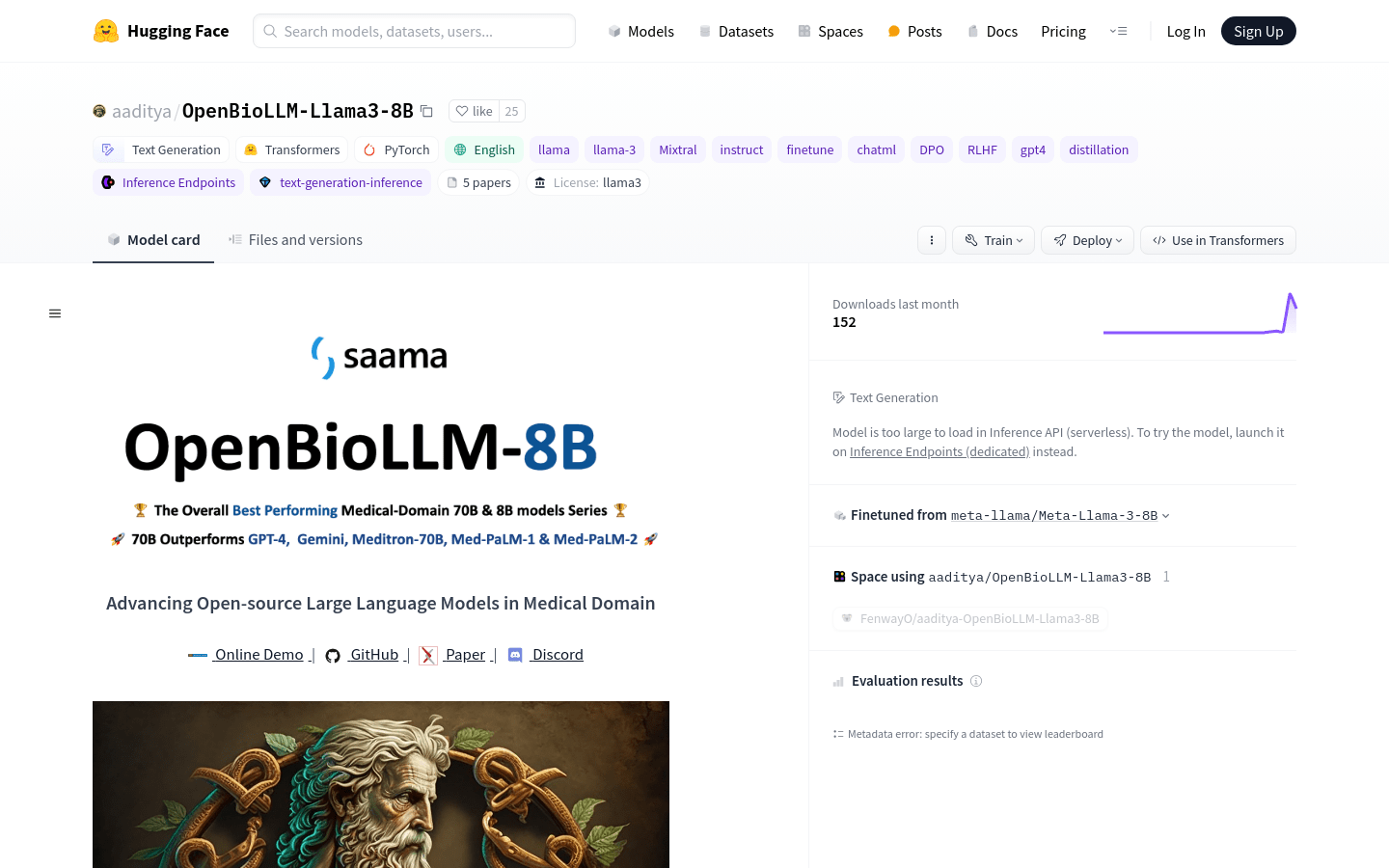
More information on OpenBioLLM-Llama3-8B
Launched
Pricing Model
Free
Starting Price
Global Rank
Follow
Month Visit
<5k
Tech used
OpenBioLLM-Llama3-8B was manually vetted by our editorial team and was first featured on 2024-04-29.
Related Searches
OpenBioLLM-Llama3-8B Alternatives
Load more Alternatives-
-

OLMo 2 32B: Open-source LLM rivals GPT-3.5! Free code, data & weights. Research, customize, & build smarter AI.
-
-
-