

Click outside to close
What is Reverb?
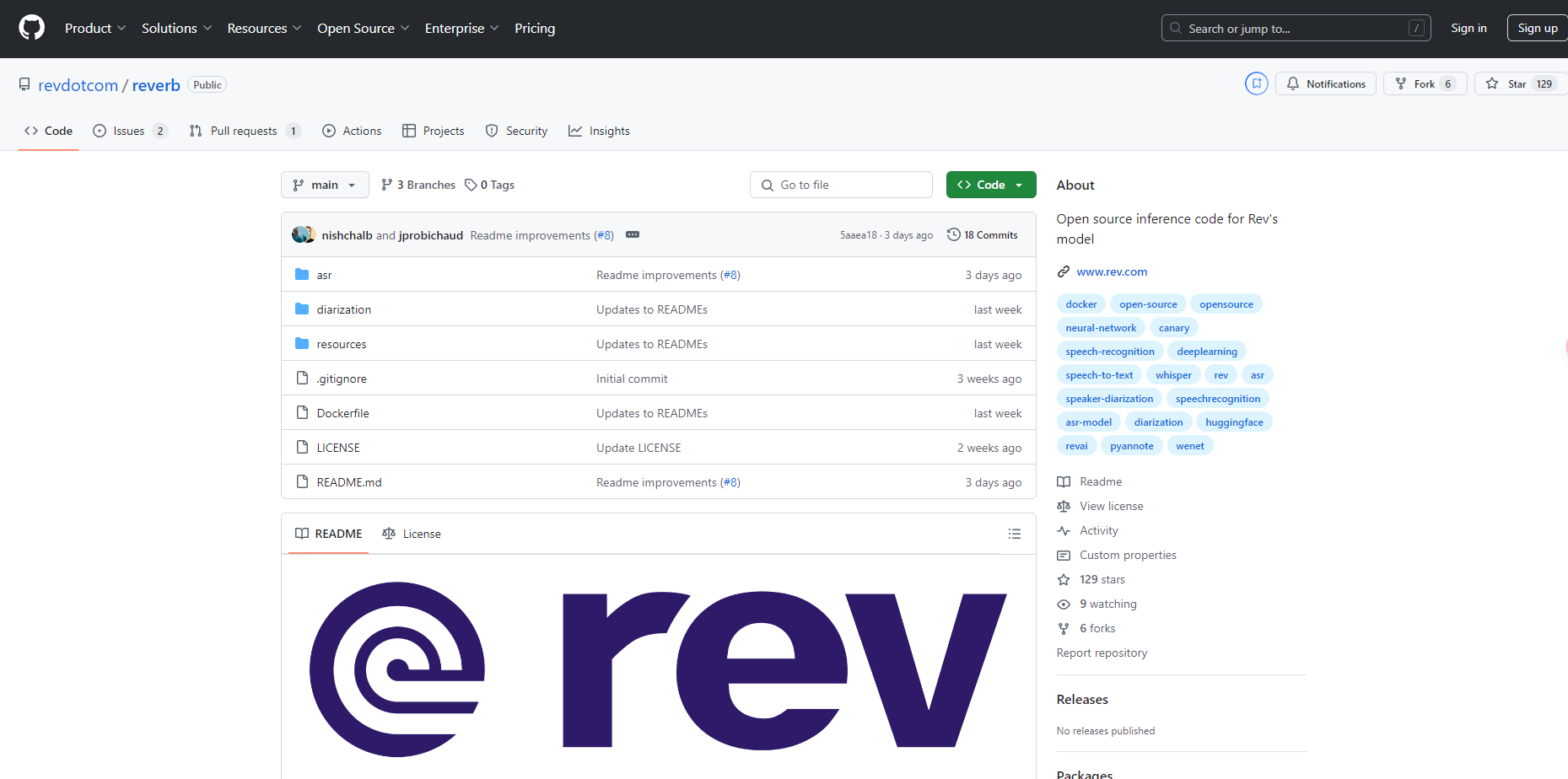
Reverb introduces a cutting-edge suite of open-source speech recognition (ASR) and diarization models developed by Rev. Leveraging the WeNet and Pyannote frameworks, Reverb ASR excels in long-form speech recognition, while Reverb Diarization accurately pinpoints speaker changes. These models are trained on the largest human-transcribed English speech dataset and optimized for both accuracy and efficiency, suitable for a variety of applications from transcription to voice technology research.
Key Features:
🌟 High-Accuracy ASR- Utilizes WeNet with a joint CTC/attention architecture for precise speech-to-text conversion.
🎙️ Speaker Diarization- Based on Pyannote, effectively identifies and segments speech by different speakers.
🎛️ Verbatimicity Control- Offers adjustable transcription output from fully verbatim to non-verbatim, catering to diverse needs.
🚀 Speed and Memory Efficiency- Int8 quantized ASR model for rapid inference with minimal resource usage.
🧩 Full Production Pipeline- Complete system for developers, including ASR and diarization, formatted output, and post-processing.
Use Cases:
🎙️ Podcast Transcription- Automatically transcribe and segment podcasts with high accuracy and speaker attribution.
📢 Meeting Minutes- Generate detailed and readable transcripts from business meetings, identifying each speaker.
🎥 Video Captioning- Create accurate captions that match the spoken words and the speaker, enhancing accessibility.
Conclusion:
Reverb redefines the benchmark for open-source speech technology, delivering unparalleled accuracy in ASR and diarization. Its versatility makes it an ideal choice for developers and researchers seeking to incorporate advanced voice recognition capabilities into their projects. With the ability to fine-tune the verbatimicity of transcripts and its superior performance on long-form audio, Reverb stands out as a leader in speech recognition innovation.
More information on Reverb
Launched
Pricing Model
Free
Starting Price
Global Rank
Follow
Month Visit
<5k
Reverb was manually vetted by our editorial team and was first featured on 2024-10-07.
Reverb Alternatives
Reverb Alternatives-
Rev AI: The Most Accurate API for Transcripts - Unlock accurate and reliable transcription with Rev AI. Easy integration and diverse use cases for developers and businesses.
-

Unlock audio/video potential with Rev's secure speech-to-text & AI insights. Get 99%+ accurate transcripts, analyze data 92% faster, and ensure compliance for professionals.
-

Whisper is an ASR model developed by OpenAI, trained on a large dataset of diverse audio.
-

Speakr is a personal, self-hosted web application designed for transcribing audio recordings (like meetings), generating concise summaries and titles, and interacting with the content through a chat interface.
-
Effortless, accurate, and unlimited speech-to-text transcription with Reppi. Perfect for educational settings, business meetings, and more. Try it now!