
What is MemoryGraph ?
MemoryGraph provides the crucial persistent memory layer that transforms stateless AI assistants into intelligent, continuously learning agents. If you are developing sophisticated AI applications using the Model Context Protocol (MCP), MemoryGraph ensures your agents remember conversations, learn complex patterns, and apply historical context across every session. It’s the essential foundation for building AI that truly grows smarter over time.
Key Features
MemoryGraph leverages a knowledge graph structure to give your AI agents context, causality, and depth beyond simple vector matching.
🧠 Relational Knowledge Graph Architecture
Unlike traditional vector databases that treat memories as isolated points, MemoryGraph uses graph technology (powered by FalkorDB, Neo4j, or SQLite) to preserve the relationships between solutions, problems, and decisions. This allows your AI to ask, "What solves X?" or "What caused this error?"—not just "What is similar to this?"
⚙️ Automatic and Explicit Memory Capture
Give your AI the power to learn passively and actively.
- Automatic Memory: Automatically store code patterns, successful implementations, and key context variables when an agent commits a change or reaches a decision, ensuring no valuable learning is lost.
- Explicit Storage: Agents can be directed to store critical solutions, fixes, or complex trade-offs with specific titles and tags, building a curated, searchable knowledge base.
🔎 Semantic Search and Graph Traversal
Retrieve memories using fuzzy semantic search for high relevance, even with imprecise queries. Crucially, the system supports graph traversal via get_related_memories(), allowing the AI to follow causal links (e.g., finding the related solution to a known problem ID) for deep contextual understanding.
🔄 Unprecedented Data Portability and Control
MemoryGraph is built local-first and ensures zero vendor lock-in. Migrate your entire knowledge graph—including all memories and relationships—between supported backends (SQLite, FalkorDB, Neo4j, etc.) with a single command. Automated verification and safe rollback mechanisms protect your data during every transfer.
Use Cases
MemoryGraph provides tangible value by making AI agents more reliable, consistent, and effective in complex development environments.
1. Consistent Code Pattern Application
When tackling a new task, such as implementing rate limiting on a new endpoint, your AI assistant can query its memory for similar past solutions. By recalling the exact Redis-based pattern used previously in another service, the agent ensures architectural consistency and avoids reinventing solutions, significantly speeding up development time while maintaining quality.
2. Accelerated Debugging and Root Cause Analysis
Instead of relying solely on current context, developers can instruct the AI to traverse the knowledge graph to understand causality. If a memory is flagged as an "Effect," the agent can use get_related_memories() to find the linked "Cause" or "Solution," quickly revealing historical decisions or known patterns that led to the current state.
3. Shared Organizational Knowledge
For development teams, MemoryGraph Cloud Sync enables shared workspaces where all team members’ AI agents contribute to and recall from a single, centralized knowledge graph. This ensures that valuable solutions implemented by one developer are immediately available as context for every other team member, accelerating onboarding and preventing the repetition of known mistakes.
MemoryGraph is specifically designed to overcome the limitations inherent in traditional memory solutions for AI agents.
| Feature | MemoryGraph Approach | Traditional Vector Stores |
|---|---|---|
| Data Structure | Knowledge Graph (Preserves Relationships) | Flat Vector List (Isolated Data Points) |
| Contextual Retrieval | Causal and Contextual (e.g., "What Solves X?") | Similarity Matching (e.g., "What is Similar to X?") |
| Persistence | Persistent, Multi-Backend, Migratable | Often Session-Bound or Single-Backend Locked |
| Deployment | Local-First Default (SQLite/FalkorDBLite) | Often Requires External Server/Cloud Service |
By focusing on the structural relationships between pieces of information, MemoryGraph enables AI agents to move beyond simple recall toward genuine, informed reasoning based on project history and established patterns.
Conclusion
MemoryGraph delivers the persistent intelligence required to scale modern AI assistants. By providing a secure, flexible, and powerful memory system built on robust knowledge graph technology, you empower your agents to learn, adapt, and provide consistent, contextual assistance across all environments.
Start building smarter AI today. Explore the local-first setup or learn more about MemoryGraph Cloud Sync to manage shared team knowledge.
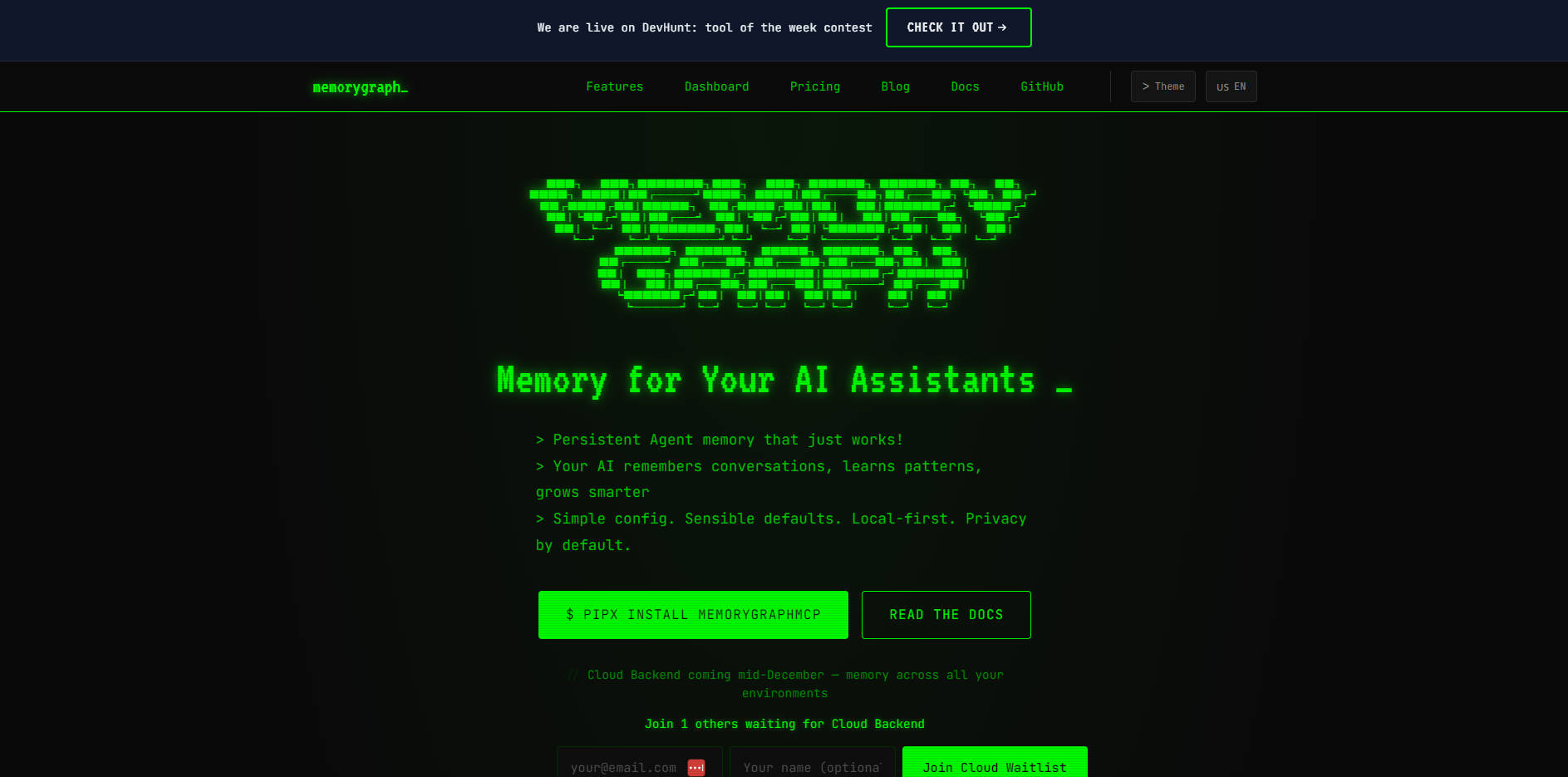
More information on MemoryGraph
Launched
Pricing Model
Freemium
Starting Price
$5 /month
Global Rank
Follow
Month Visit
<5k
Tech used
MemoryGraph was manually vetted by our editorial team and was first featured on 2025-12-14.