

What is TaskingAI?
TaskingAI is a powerful Backend as a Service (BaaS) platform engineered specifically for the development, deployment, and scaling of production-ready LLM-based agents. It solves the critical infrastructure challenge of managing complex, stateful AI applications by unifying access to hundreds of LLM models and providing a dedicated, modular backend for functional components like tools, RAG systems, and conversation history. For developers and teams aiming to move beyond prototyping frameworks into scalable, multi-tenant solutions, TaskingAI provides the essential production environment.
Key Features
TaskingAI delivers a comprehensive set of features designed to streamline the entire LLM application lifecycle, from console testing to high-performance deployment.
🛠️ All-In-One Unified Model Access
You gain immediate access to hundreds of LLM models from major providers (like OpenAI and Anthropic) and locally hosted models (via Ollama, LM Studio, and Local AI) through a single, unified API. This eliminates the need to manage disparate SDKs or rewrite backend logic when switching providers, ensuring maximum flexibility and resilience against vendor lock-in.
⚙️ Decoupled Modular Management
The platform fundamentally decouples core AI functionalities—such as tools, RAG systems, and language models—from the agent itself. This crucial separation allows you to freely combine and reuse these modules across multiple agents and applications, drastically simplifying configuration management and enabling true multi-tenant support without tying integrations to a single assistant instance.
🚀 BaaS-Inspired Workflow for Production
TaskingAI provides a clear, secure pathway from initial concept to deployment. By separating the complex AI logic (server-side, managed by TaskingAI) from client-side product development, you can prototype quickly in the intuitive UI Console and then scale effortlessly using robust RESTful APIs and client SDKs (e.g., Python SDK), ensuring a smooth transition to production.
⚡ Asynchronous Efficiency and Scalability
Built on Python's FastAPI framework, TaskingAI natively supports asynchronous processing, ensuring high-performance, concurrent computation. This architectural choice enhances the responsiveness and scalability of your deployed AI agents, allowing them to handle high volumes of simultaneous requests efficiently.
🌐 Abundant Enhancement and Custom Tooling
Enhance agent performance using built-in, customizable tools like Google search, website readers, and stock market retrieval. Furthermore, the platform allows you to create and integrate custom tools tailored precisely to your application’s domain, dramatically expanding the functional scope and utility of your agents.
Use Cases
TaskingAI is built for real-world deployment, enabling teams to tackle complex challenges that require stateful, high-performance AI integration.
Building Multi-Tenant AI-Native Applications: If you are developing a SaaS product where each customer requires their own dedicated, customized AI assistant, TaskingAI's decoupled architecture and multi-tenant support allow you to manage tools, RAG sources, and model configurations centrally while serving thousands of individual customer agents securely and efficiently.
Deploying Enterprise Productivity Agents: Implement sophisticated internal agents that require persistent memory and access to multiple proprietary data sources. TaskingAI manages the session history (statefulness) and integrates custom RAG systems, allowing agents to provide precise, context-aware answers to complex queries across large enterprise knowledge bases.
Creating Interactive Application Demos and Prototypes: Leverage the Intuitive UI Console to quickly assemble and test agent workflows using various models and tools. The Console allows you to validate complex AI logic rapidly before committing to client-side development, significantly reducing the time spent on initial prototyping.
Conclusion
TaskingAI delivers the robust, unified backend infrastructure essential for developing and deploying scalable LLM agents. By solving the core challenges of model unification, state management, and modular architecture, it allows your team to focus exclusively on agent intelligence and product value, not on managing complex dependencies.
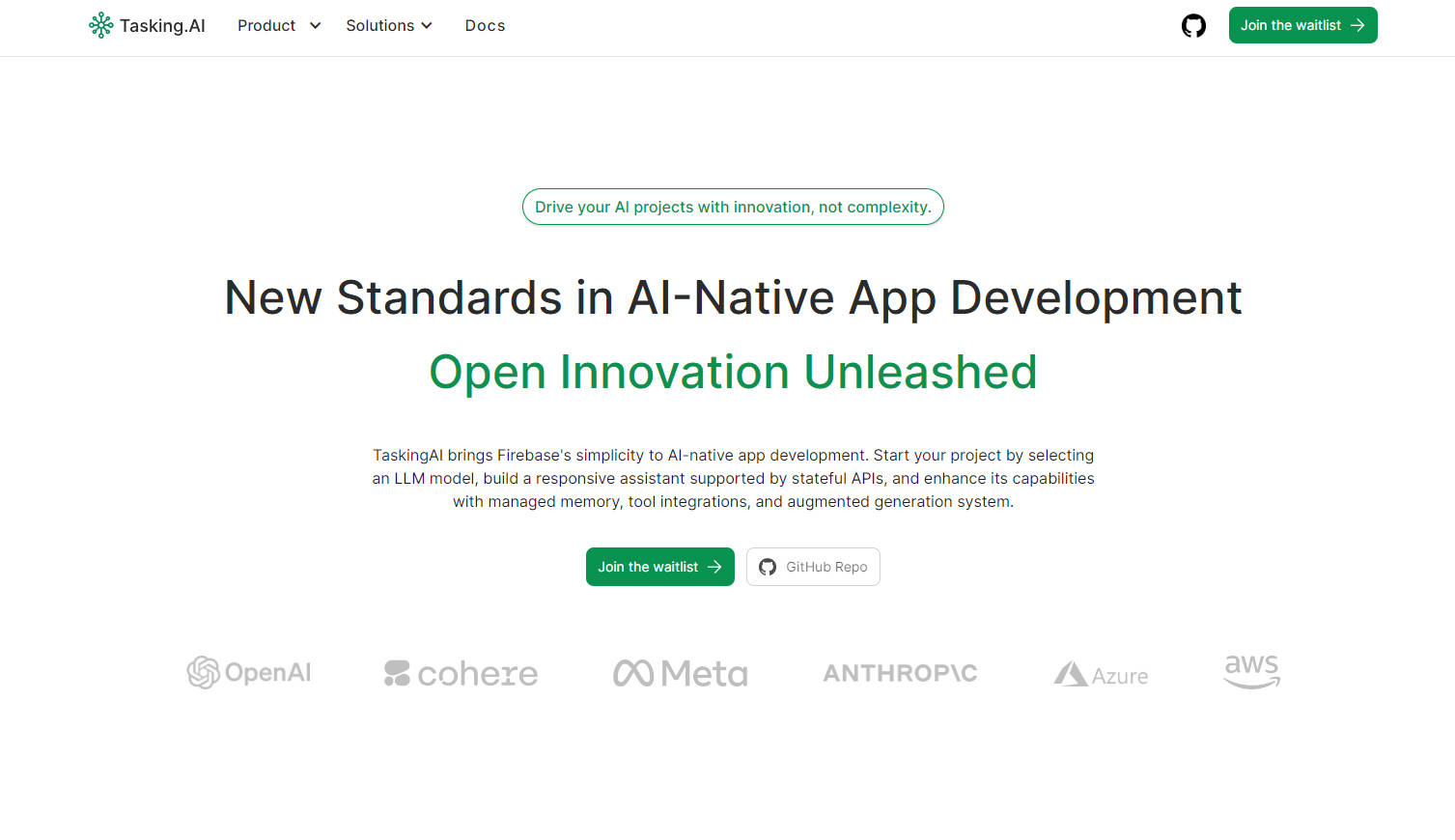
More information on TaskingAI
Top 5 Countries
41.59%
34.98%
23.43%
India
United States
Germany
Traffic Sources
6.33%
1.31%
0.08%
18.08%
33.68%
40.44%
social
paidReferrals
mail
referrals
search
direct
Source: Similarweb (Sep 24, 2025)
TaskingAI was manually vetted by our editorial team and was first featured on 2024-02-09.
Related Searches
TaskingAI Alternatives
Load more Alternatives-

-

-

-

-

MultitaskAI is a powerful browser-based chat interface that transforms how you interact with AI. Connect directly to leading models from OpenAI, Anthropic, and Google using your own API keys—ensuring complete privacy and control over your data.