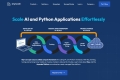

What is Aana?
Moving your machine learning prototypes from experiments to robust, scalable applications often presents significant hurdles. Deploying models efficiently, integrating diverse data types, and managing infrastructure can slow down development and increase complexity. Aana SDK is a Python framework designed specifically for developers like you, streamlining the process of building and deploying AI-enabled multimodal applications that handle vision, audio, and language data. Built upon the Ray distributed computing framework, Aana provides the tools to manage large-scale ML model deployment and construct sophisticated systems like search engines, recommendation platforms, or data insight tools with greater ease.
The framework focuses on simplifying the operational challenges, allowing you to concentrate on the core logic of your AI application. Whether you're working with Retrieval-Augmented Generation (RAG) systems or combining multiple specialized models, Aana offers a structured approach grounded in reliability, scalability, and developer experience.
Key Features
Aana SDK incorporates several features designed to accelerate development and ensure robust deployment:
⚙️ Flexible Model Deployment: Deploy your machine learning models seamlessly on a single machine for development or scale them effortlessly across a cluster using Ray for production workloads. Configure replicas and resource allocation (like GPUs) to match your needs.
🔌 Automatic API Generation: Define your application's endpoints using simple Python classes and type annotations. Aana automatically generates the corresponding API, complete with input/output validation, saving you significant boilerplate code.
🌊 Built-in Streaming Support: Enable real-time data processing by streaming output from your endpoints as it's generated. This is particularly useful for applications involving Large Language Models (LLMs) or live data feeds.
⏱️ Effortless Task Queues: Run any defined endpoint as a background task without modifying your core endpoint code. This simplifies handling long-running processes or managing workloads asynchronously.
🧩 Rich Integrations: Leverage pre-built integrations with popular ML models and libraries, including Whisper for ASR, vLLM for optimized LLM serving, Hugging Face Transformers, and Deepset Haystack for RAG pipelines. More integrations are continuously being added.
📄 Automated Documentation: Generate API documentation automatically from your endpoint definitions, ensuring your application's interface is always clearly documented and accessible via tools like Swagger UI.
🧱 Predefined Data Types: Utilize ready-made types for common multimodal data like images and videos, simplifying data handling and validation within your API endpoints.
Use Cases
Here are a few scenarios where Aana SDK can significantly simplify development:
Building a Video Analysis Pipeline: Imagine you need to transcribe and summarize videos. With Aana, you can define a deployment for an ASR model (like the integrated Whisper) and another for a summarization LLM. An endpoint can then orchestrate the process: receiving a video input, extracting audio, sending it to the ASR deployment, and passing the transcription to the LLM deployment for summarization, potentially streaming results back. The example code shows just how straightforward transcribing a video can be.
Creating an Interactive Multimodal Chat Application: Consider the "Chat with Video" example. Aana enables you to deploy models for analyzing video frames (vision) and audio tracks. An endpoint can receive user questions alongside a video upload. It then interacts with the deployed models to extract relevant information from both modalities (e.g., identifying objects or spoken keywords) and potentially uses an LLM or RAG system to generate a contextual answer based on the combined information.
Deploying a Scalable RAG System for Search: If you're building a semantic search engine over documents, Aana can manage the deployment of embedding models and vector databases (via integrations like Haystack). An endpoint can handle user queries, retrieve relevant document chunks using the RAG pipeline deployed via Aana, and potentially use an LLM deployment to synthesize a final answer. Aana's scalability ensures the system can handle a growing number of documents and user queries efficiently.
Conclusion
Aana SDK directly addresses the common pain points developers face when transitioning AI models from prototype to production, especially for complex multimodal applications. By providing a reliable, scalable framework built on Ray, and automating key aspects like API generation, documentation, and deployment configuration, Aana allows you to build and iterate faster. Its focus on modularity and integrations makes it a practical choice for developing sophisticated AI systems. While still under active development, Aana offers a promising foundation for your next generation of AI-powered applications.
FAQ
1. What exactly is Aana SDK? Aana SDK is a Python framework designed to simplify the development and large-scale deployment of AI applications that work with multiple data types (like text, images, audio, video), often referred to as multimodal applications. It helps manage ML models and build the surrounding application logic.
2. Who is the target audience for Aana SDK? It's primarily aimed at Python developers who are building applications incorporating machine learning models, especially those dealing with multimodal data or needing to deploy models reliably at scale. If you find deploying and integrating ML models challenging, Aana might be for you.
3. How does Aana SDK achieve scalability? Aana SDK is built on top of Ray (ray.io), an open-source framework for distributed computing. This allows Aana applications and their underlying model deployments to be scaled horizontally across multiple machines in a cluster, handling increased load and larger datasets efficiently.
4. What kinds of machine learning models can I deploy with Aana? You can deploy a wide range of models, particularly those dealing with vision, audio, and language. Aana has specific integrations for popular models/libraries like Whisper (ASR), vLLM (LLMs), and Hugging Face Transformers. It also supports building Retrieval-Augmented Generation (RAG) systems. You can also define custom deployments for other models.
5. Is Aana SDK ready for production use? The SDK is currently under active development, meaning some features might be evolving or not yet fully implemented. However, it provides core functionality for deployment and application building. The documentation suggests using Serve Config Files for production deployments, indicating a path towards stable production use. As with any actively developed framework, thorough testing is recommended for production scenarios.
6. How do I get started with Aana SDK? You can install it via pip (pip install aana). The documentation provides a "Getting Started" guide, code examples (like the video transcription app), and an application template on GitHub (Aana App Template) to help you structure your first project quickly. Exploring the example applications is also a great way to see Aana in action.
More information on Aana
Launched
2005-08
Pricing Model
Free
Starting Price
Global Rank
6068397
Follow
Month Visit
<5k
Tech used
Google Analytics,Google Tag Manager,Webflow,Amazon AWS CloudFront,Cloudflare CDN,JSDelivr,Google Fonts,jQuery,Gzip,HTTP/3,OpenGraph,HSTS,reCaptcha,YouTube
Top 5 Countries
71.29%
28.71%
United States
Germany
Traffic Sources
11.53%
1.31%
0.09%
10.55%
37.95%
38.56%
social
paidReferrals
mail
referrals
search
direct
Source: Similarweb (Sep 25, 2025)
Aana was manually vetted by our editorial team and was first featured on 2025-03-26.
Related Searches
Aana Alternatives
Load more Alternatives-
-
-
Athina AI is an essential tool for developers looking to create robust, error-free LLM applications. With its advanced monitoring and error detection capabilities, Athina streamlines the development process and ensures the reliability of your applications. Perfect for any developer looking to enhance the quality of their LLM projects.
-

-