

What is Archon?
Archon is a groundbreaking AI agent, an "Agenteer," designed to autonomously build, refine, and optimize other AI agents. It's not just a tool; it's a practical demonstration of advanced agentic coding workflows and framework knowledge integration. If you're struggling with the complexities of manually crafting and managing AI agents, Archon provides a powerful solution by automating the entire process, from initial design to iterative improvement.
Key Features:
🤖 Automated Agent Generation: Create AI agents using an advanced agentic coding workflow. Archon handles the complexities of agent creation, letting you focus on defining the agent's purpose and capabilities. Technical Detail: Currently supports Pydantic AI agents, with future expansion to LangGraph and other frameworks.
🧠 Agentic Reasoning: Employs planning, iterative feedback, and self-evaluation to overcome limitations of reactive systems. Technical Detail: Utilizes a multi-agent system (in later versions) with separate reasoning and execution agents, orchestrated by LangGraph.
📚 Domain Knowledge Integration: Seamlessly embeds knowledge of frameworks like Pydantic AI and LangGraph (future) within autonomous workflows. Technical Detail: Uses a Supabase vector database to store and retrieve framework documentation, enabling Retrieval-Augmented Generation (RAG) during agent creation.
🏗️ Scalable Architecture: Built with a modular design that supports maintainability, cost optimization, and ethical AI practices. Technical Detail: Leverages Docker for containerization, FastAPI for service endpoints, and Streamlit for a comprehensive user interface.
🔄 Iterative Development: Archon is constantly evolving, showcasing the progression of agentic systems. Technical Detail: From a basic Pydantic AI agent (V1) to a full agentic workflow using LangGraph (V2), and now with a comprehensive Streamlit UI (V4), Archon demonstrates best practices in AI development.
🔌 AI IDE Integration (MCP Support): Connects with AI IDEs like Windsurf and Cursor for streamlined development. Technical Detail: Implements the Model Context Protocol (MCP) via a dedicated server, allowing for automated file creation and dependency management.
Use Cases:
Rapid Prototyping: Quickly build and test new AI agent concepts without getting bogged down in boilerplate code. Instead of manually setting up a Pydantic AI agent, use Archon to generate the foundational code, configure the environment, and even integrate relevant documentation, all through a guided process.
Framework Learning: Explore the capabilities of frameworks like Pydantic AI by having Archon build example agents. Examine the generated code to understand how the framework is used in practice. This provides a hands-on learning experience.
Automated Agent Refinement: Leverage Archon's future self-feedback and execution capabilities (V8, V9) to automatically validate, test, and iterate on your agents. This reduces manual debugging and optimization efforts, leading to more robust and reliable agents.
Conclusion:
Archon represents a significant step forward in AI agent development. It offers a powerful, automated, and educational approach to creating and managing AI agents, freeing developers to focus on innovation rather than implementation details. Its iterative development and open-source nature make it a valuable resource for anyone working with or learning about agentic systems.
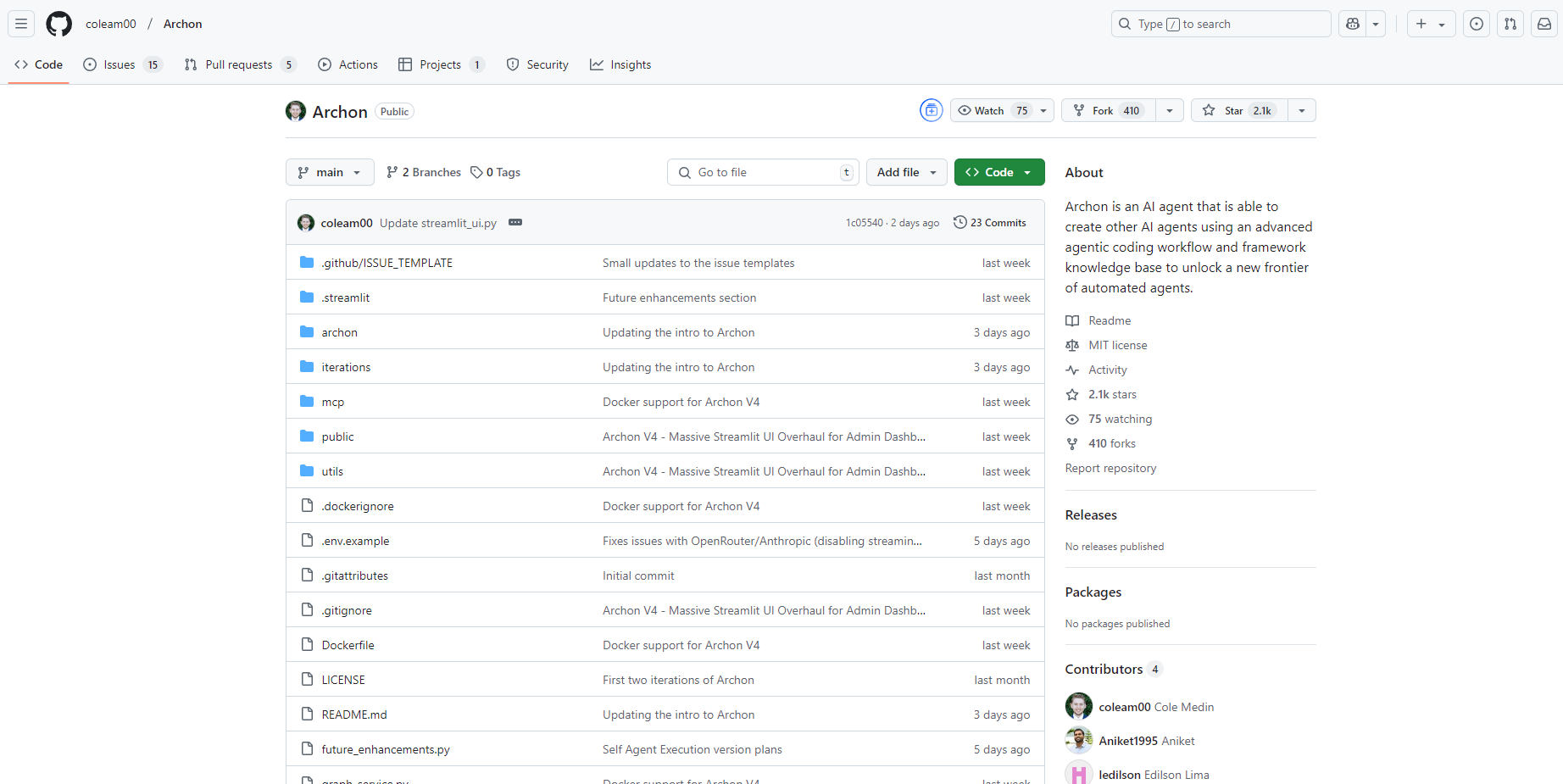
More information on Archon
Launched
Pricing Model
Free
Starting Price
Global Rank
Follow
Month Visit
<5k
Tech used
Archon was manually vetted by our editorial team and was first featured on 2025-03-06.
Related Searches
Archon Alternatives
Load more Alternatives-

-

-

-

OpenAI Agents SDK: Python for production AI apps. Build agents, tools, guardrails, tracing.
-
