

What is OpenAI Agents SDK?
The OpenAI Agents SDK provides a streamlined and efficient way to develop sophisticated, agent-based AI applications. It offers a lightweight, production-ready framework built upon core primitives, minimizing complexity while maximizing flexibility. If you're looking to move beyond experimental AI agents and into real-world deployment, this SDK provides the tools and structure you need. The SDK addresses the core challenge of orchestrating multiple AI agents, tools, and validation checks in a maintainable and debuggable way.
Key Features:
🌟 Simplify Agent Creation
Define agents with instructions, tools, and models in just a few lines of code.
Use Python functions as tools with automatic schema generation and validation powered by Pydantic.
🔄 Orchestrate Multi-Agent Workflows
Delegate tasks between agents using handoffs, enabling seamless coordination for specialized sub-tasks.
Customize handoff behavior with tool overrides, input filters, and callbacks.
🔒 Validate Inputs with Guardrails
Run input validations in parallel to your agents, stopping malicious or irrelevant queries before they reach your main logic.
Implement tripwires to halt execution when specific conditions are met.
🔍 Debug and Optimize with Tracing
Visualize agent workflows, debug issues, and evaluate performance with built-in tracing capabilities.
Fine-tune models based on real-world usage data to improve accuracy over time.
⚙️ Customizable and Extensible
Clone agents to reuse configurations while tweaking properties for different use cases.
Hook into agent lifecycle events to log actions, prefetch data, or trigger external processes.
Use Cases:
Customer Support Automation
Imagine building a customer support system where one agent handles FAQs, another manages order status inquiries, and a third escalates complex issues. Using handoffs, you can route conversations dynamically, ensuring each query reaches the right specialist. Meanwhile, guardrails prevent misuse, such as users trying to exploit the system for unrelated tasks like solving math problems.Event Extraction from Text
Need to parse calendar events from emails or documents? Create an agent that extracts structured data (e.g., event names, dates, participants) using Pydantic models. The SDK’s output_type feature ensures the agent produces consistent, machine-readable results every time.Dynamic Content Generation
Suppose you want an agent that generates content tailored to individual users. By passing contextual information (like user preferences or subscription status) through the context object, you can dynamically adjust the agent’s behavior. For instance, a “Pirate” agent could be cloned into a “Robot” agent with updated instructions, producing entirely different outputs without duplicating effort.
Conclusion:
The OpenAI Agents SDK strikes the perfect balance between simplicity and power. Its minimalistic design philosophy ensures you spend less time wrestling with abstractions and more time building impactful AI applications. Whether you’re a seasoned developer or just starting out, this toolkit empowers you to bring your ideas to life with confidence.
Ready to dive in? Install the SDK today:
<BASH>pip install openai-agents
FAQ:
Q: What makes the Agents SDK different from other AI frameworks?
A: Unlike many frameworks that overwhelm users with complexity, the Agents SDK focuses on providing only the essential primitives—agents, handoffs, and guardrails—while remaining highly customizable. It also integrates seamlessly with Python, leveraging native language features for orchestration.
Q: Can I use the SDK for non-Python projects?
A: Currently, the SDK is designed with Python-first principles, meaning it relies heavily on Python’s ecosystem and syntax. While theoretically possible to adapt parts of it for other languages, full compatibility would require significant modifications.
Q: How does tracing work, and why is it useful?
A: Tracing lets you visualize the flow of data and decisions within your application. This is particularly helpful for debugging complex workflows involving multiple agents or identifying bottlenecks in performance.
Q: Are there any limitations to what types of outputs agents can produce?
A: Agents can generate plain text by default, but you can specify structured output types using Pydantic models or other compatible formats. This flexibility allows you to tailor outputs to your application’s needs.
Q: Is the SDK suitable for beginners?
A: Yes! The SDK’s intuitive design and reliance on Python make it approachable for newcomers. However, some familiarity with AI concepts and Python programming will enhance your experience.
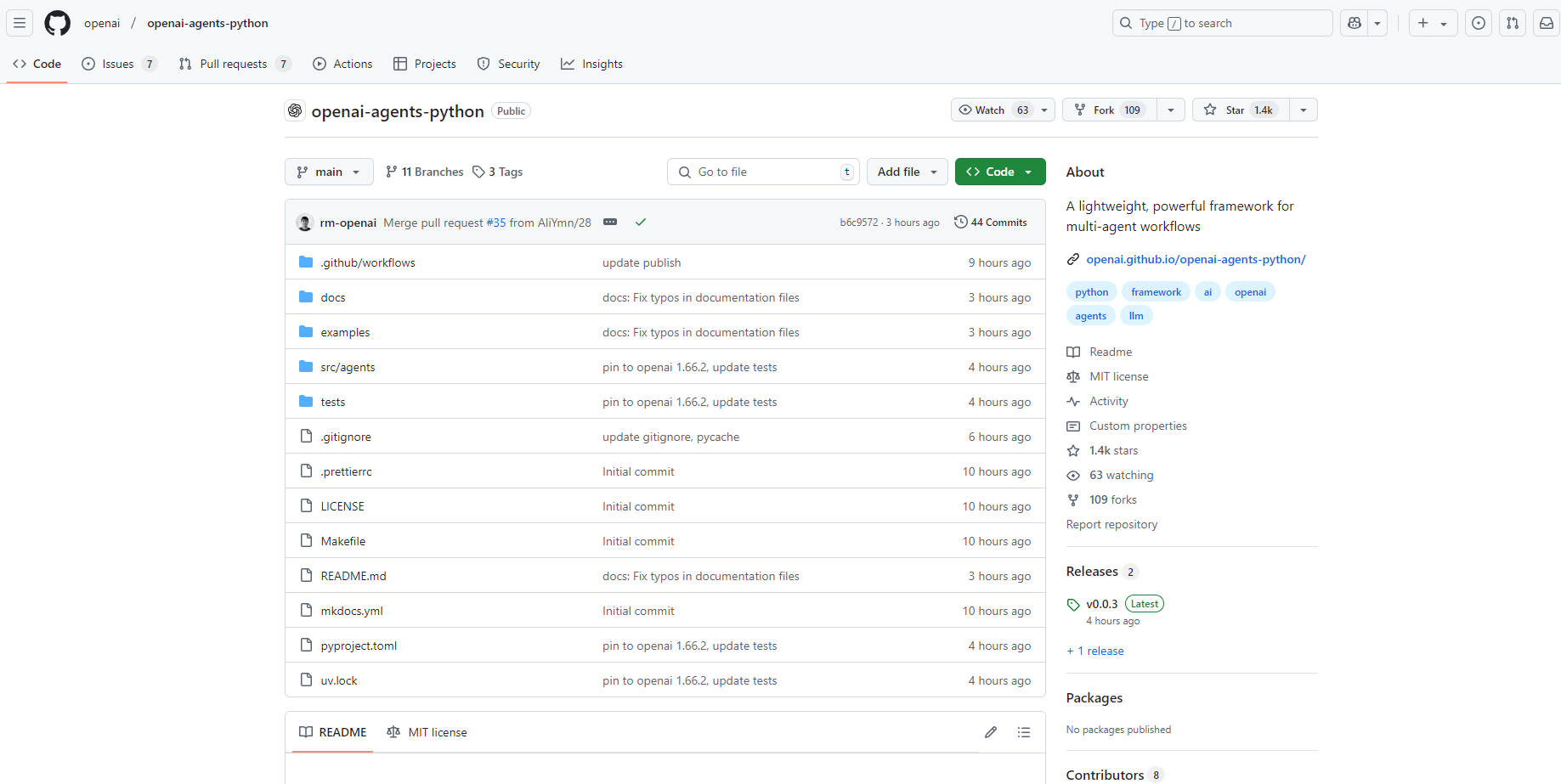
More information on OpenAI Agents SDK
Launched
Pricing Model
Free
Starting Price
Global Rank
Follow
Month Visit
<5k
Tech used
OpenAI Agents SDK was manually vetted by our editorial team and was first featured on 2025-03-12.
OpenAI Agents SDK Alternatives
Load more Alternatives-

Build custom AI agents fast with Open Agent Kit! Open-source, flexible, & deployable anywhere. Connect LLMs & extend with plugins.
-
OpenAgents: Deploy & use practical AI agents to analyze data, automate tasks, & control your browser for peak productivity. Open-source for all.
-

-
OpenAgents is an open-source project for building Agent Networks and connecting AI Agents at scale. Developers use OpenAgents to launch and join networks with thousands of agents to collaborate, tackle complex challenges, learn and grow in one community.
-

Agent Squad: Open-source framework to orchestrate AI agent teams for complex conversations. Python & TS support, flexible context & routing.