

What is Canonical AI?
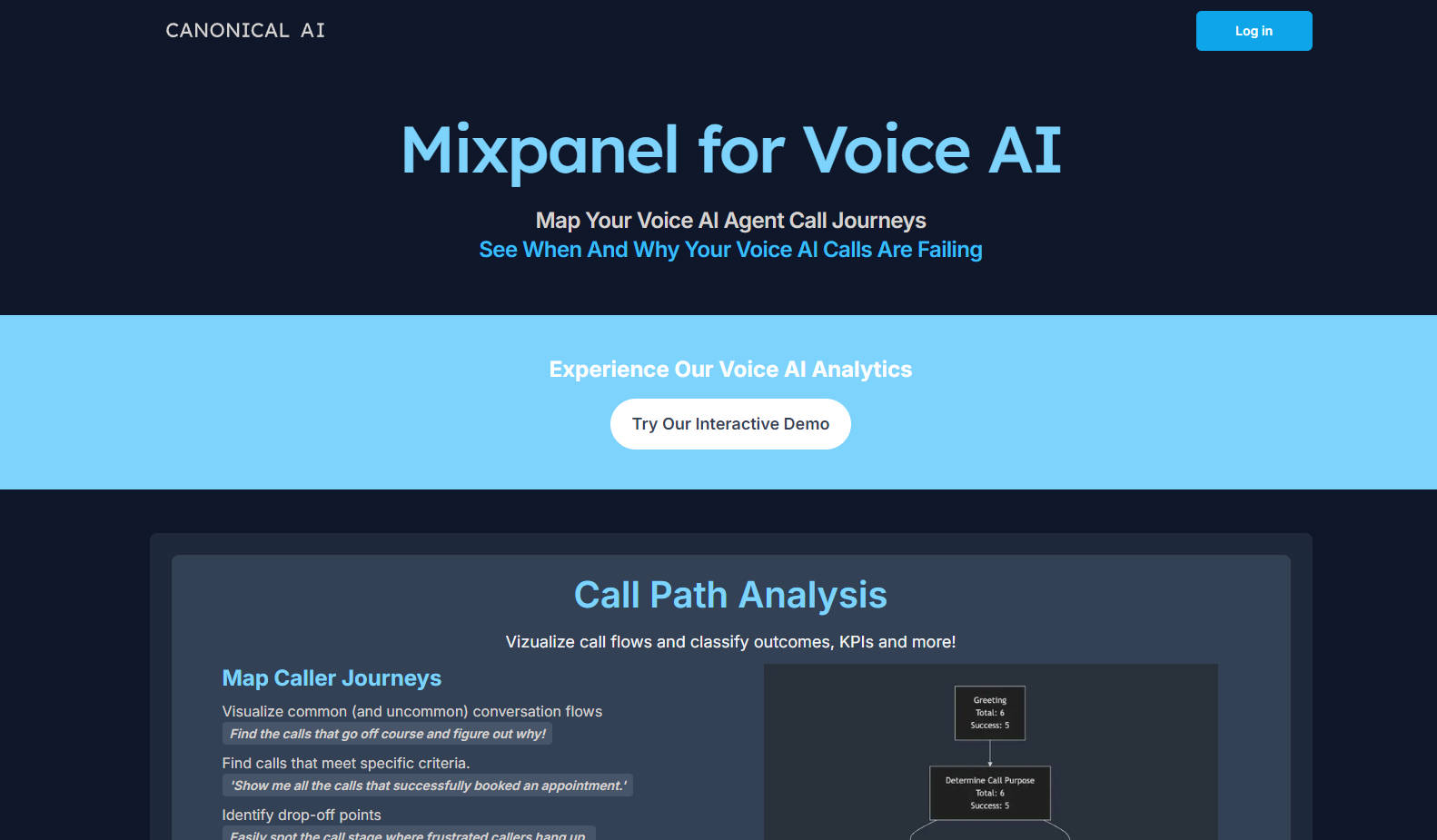
Canonical AI is a powerful analytics platform designed to help developers improve the performance and user experience of their Voice AI agents. By providing detailed call journey maps, insightful metrics, and sad path analysis, Canonical AI empowers developers to pinpoint areas of improvement, reduce drop-off rates, and enhance the overall effectiveness of their Voice AI applications.
Key Features:
Call Journey Mapping🗺️: Visualize the entire caller journey, identify friction points, and understand where and why callers abandon the interaction. This allows developers to optimize conversation flows and improve user engagement.
Sad Path Analysis🤕: Isolate and analyze calls that deviate from the intended path, revealing unexpected user behavior and areas where the agent struggles. Developers can then refine dialogue design and address common pain points.
Audio & Conversational Metrics📊: Gain deep insights into call quality with audio metrics like latency and silence, as well as conversational metrics like user intent and sentiment. This data-driven approach enables targeted improvements and enhances the user experience.
Use Cases:
A telecommunications company uses Canonical AI to analyze customer service calls handled by their Voice AI agent, identifying areas where callers experience frustration and improving call completion rates.
An e-commerce business leverages Canonical AI to optimize their Voice AI-powered ordering system, reducing order errors and increasing customer satisfaction.
A healthcare provider utilizes Canonical AI to analyze patient interactions with their Voice AI appointment scheduling system, identifying bottlenecks and streamlining the booking process.
Conclusion:
Canonical AI provides Voice AI developers with the tools they need to move beyond manual call analysis and gain a comprehensive understanding of agent performance. By leveraging its powerful features, developers can create more effective, user-friendly, and successful Voice AI applications that deliver exceptional user experiences.
More information on Canonical AI
Launched
2023-08
Pricing Model
Free Trial
Starting Price
$0.025/min
Global Rank
Follow
Month Visit
<5k
Tech used
Next.js,Vercel,Gzip,Webpack,HSTS
Top 5 Countries
100%
United States
Traffic Sources
9.69%
1.36%
0.19%
12.73%
33.38%
41.8%
social
paidReferrals
mail
referrals
search
direct
Source: Similarweb (Sep 24, 2025)
Canonical AI was manually vetted by our editorial team and was first featured on 2024-10-28.
Related Searches
Canonical AI Alternatives
Load more Alternatives-

-

-

-

SoundHound AI: Pioneer in Voice AI agents for enterprise. Deliver best-in-class customer service, automate operations & unlock new revenue opportunities.
-