 OpenRAG
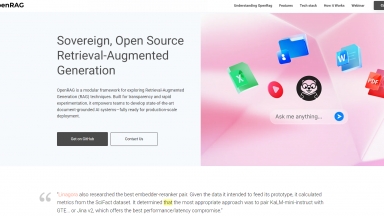
 RAGFlow

OpenRAG
| Launched | 2025-07 |
| Pricing Model | Free |
| Starting Price | |
| Tech used | |
| Tag |
RAGFlow
| Launched | 2024-02 |
| Pricing Model | Free |
| Starting Price | |
| Tech used | Vercel,Atom,Gzip,OpenGraph,RSS,HSTS |
| Tag | Knowledge Management,Question Answering,Data Extraction |
OpenRAG Rank/Visit
| Global Rank | |
| Country | |
| Month Visit |
Top 5 Countries
Traffic Sources
RAGFlow Rank/Visit
| Global Rank | 144118 |
| Country | China |
| Month Visit | 231017 |
Top 5 Countries
Traffic Sources
Estimated traffic data from Similarweb
What are some alternatives?
R2R - SoTA production-ready AI retrieval system. Agentic Retrieval-Augmented Generation (RAG) with a RESTful API.
ApeRAG - ApeRAG: Production-ready GraphRAG for intelligent AI agents. Unlock deep context & reliable reasoning from all your multi-modal enterprise data.
UltraRAG - UltraRAG 2.0: Build complex RAG pipelines with low-code. Accelerate AI research, simplify development, and ensure reproducible results.
HelloRAG.ai - HelloRAG is a no-code, easy-to-use and scalable solution to ingest human and machine generated multi-modal data for LLM-powered applications