

What is OpenRAG?
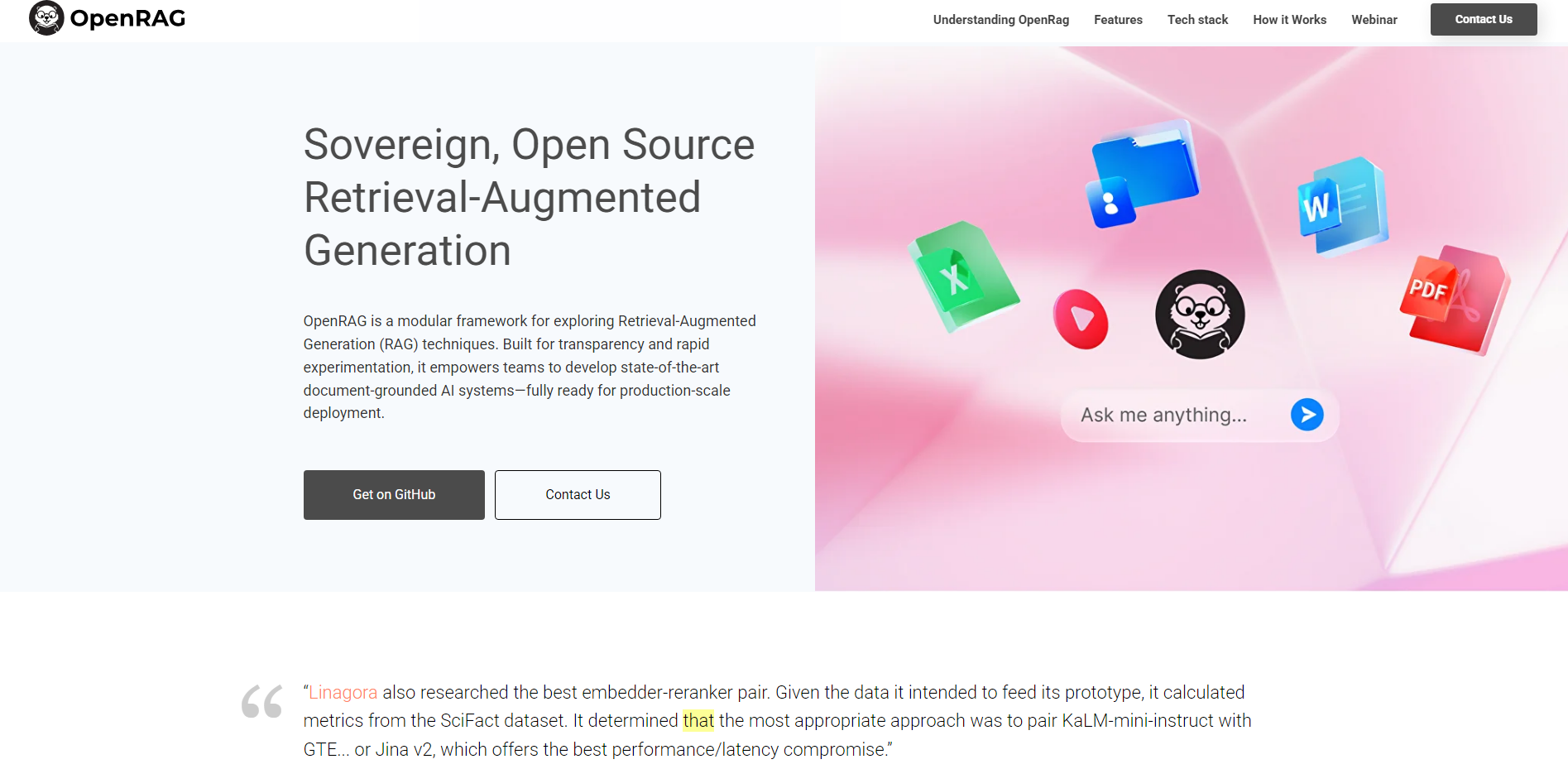
OpenRag is a lightweight, modular, and extensible Retrieval-Augmented Generation (RAG) framework built specifically for developers and researchers pushing the boundaries of RAG technology. It directly addresses the challenge of building, testing, and scaling advanced RAG techniques without proprietary constraints, offering a powerful, 100% open-source foundation. Engineered by Linagora, OpenRag provides a sovereign-by-design alternative focused on flexibility, performance, and seamless integration into existing production workflows.
Key Features
OpenRag delivers a robust set of features designed to maximize processing speed, data versatility, and integration efficiency for serious RAG development.
⚡️ Parallelized Processing with Ray
OpenRag leverages the Ray framework to execute chunking, embedding, and ingestion tasks in parallel across available CPUs and GPUs. This architecture ensures fast, scalable processing of massive document sets, significantly reducing the time required to build and update large knowledge bases and enabling efficient deployment into distributed, production-grade environments like Kubernetes.
📚 Intelligent Multi-Format Ingestion
Go beyond simple text files. OpenRag supports a comprehensive range of file types, including standard documents (PDF, DOCX), audio files (MP3, WAV, AAC), and images (PNG, JPEG). Crucially, it uses advanced parsing (including OCR for scanned documents) and Vision Language Models (VLMs) for image captioning, intelligently converting all input into a unified Markdown format for consistent, high-quality content extraction.
🔗 Seamless OpenAI API Compatibility
The OpenRag API is meticulously tailored to be compatible with the standard OpenAI API format. This critical design choice allows you to integrate your deployed RAG system seamlessly into popular frontends and workflow tools—such as OpenWebUI, LangChain, and N8N—without the need for custom adapters or complex integration layers.
🧠 Advanced Retrieval and Reranking Techniques
To ensure superior answer accuracy, OpenRag implements state-of-the-art retrieval mechanisms. It features Hybrid Search, which combines the precision of BM25 keyword matching with the nuance of semantic similarity, and incorporates advanced contextual retrieval techniques. Furthermore, it includes multilingual reranking capabilities (using models like Alibaba-NLP/gte-multilingual-reranker-base) to optimize chunk relevance regardless of the source language.
🖥️ Native Web-Based Indexer UI
Manage your knowledge base efficiently using the built-in, intuitive web interface. This UI simplifies document management, ingestion, and indexing, allowing you to easily organize collections using the partition-based architecture, which supports multi-tenancy for isolating different document sets.
Use Cases
OpenRag is engineered to move RAG projects from the lab to production with speed and reliability.
Accelerating RAG Research and Experimentation: Use the modular framework to quickly test new RAG methods, compare embedding models, and develop robust evaluation metrics. OpenRag’s focus on experimentation ensures that researchers can rapidly iterate on advanced techniques like Agentic RAG (coming soon) and Tool Calling.
Deploying Scalable, Distributed Workloads: For enterprises needing to process petabytes of proprietary data, OpenRag’s distributed Ray deployment capabilities enable scaling across multiple machines and GPUs. This allows for fast, production-grade indexing and retrieval of large document sets, including complex formats like high-volume scanned PDFs and transcribed audio archives.
Integrating RAG into Existing Enterprise Workflows: Leverage OpenRag’s OpenAI API compatibility to instantly plug RAG functionalities into your existing business automation tools (like N8N) or customer-facing chat interfaces (like OpenWebUI), minimizing deployment friction and maximizing adoption.
Unique Advantages
OpenRag is not just another RAG library; it is a full-featured, scalable development and deployment environment designed with core principles that ensure flexibility and performance.
100% Open Source and Sovereignty: OpenRag is designed for the community, prioritizing experimentation and avoiding vendor lock-in. Its sovereign-by-design approach ensures developers maintain full control over their data, models, and infrastructure, offering a transparent alternative to mainstream proprietary stacks.
True Production Scalability via Ray: Unlike frameworks that rely solely on single-machine processing, OpenRag utilizes Ray, enabling inherent parallelism across chunking, embedding, and ingestion stages. This architectural choice is essential for handling truly large datasets and deploying high-performance RAG pipelines on distributed systems like Kubernetes.
Unified Multi-Modal Data Handling: The intelligent conversion pipeline—which transforms complex documents, images (via VLM captioning), and audio (via transcription) into consistent Markdown—solves the critical challenge of normalizing diverse data sources, ensuring reliable and accurate retrieval across your entire knowledge base.
Conclusion
OpenRag offers the performance, flexibility, and architectural openness required to build, evaluate, and scale advanced RAG applications efficiently. Whether you are a researcher focused on novel retrieval methods or an engineer building mission-critical knowledge systems, OpenRag provides the robust, sovereign, and scalable platform you need.
More information on OpenRAG
Launched
2025-07
Pricing Model
Free
Starting Price
Global Rank
Follow
Month Visit
<5k
Tech used
OpenRAG was manually vetted by our editorial team and was first featured on 2025-11-11.
OpenRAG Alternatives
Load more Alternatives-
-
-
-
-
HelloRAG is a no-code, easy-to-use and scalable solution to ingest human and machine generated multi-modal data for LLM-powered applications