
What is Dabarqus?
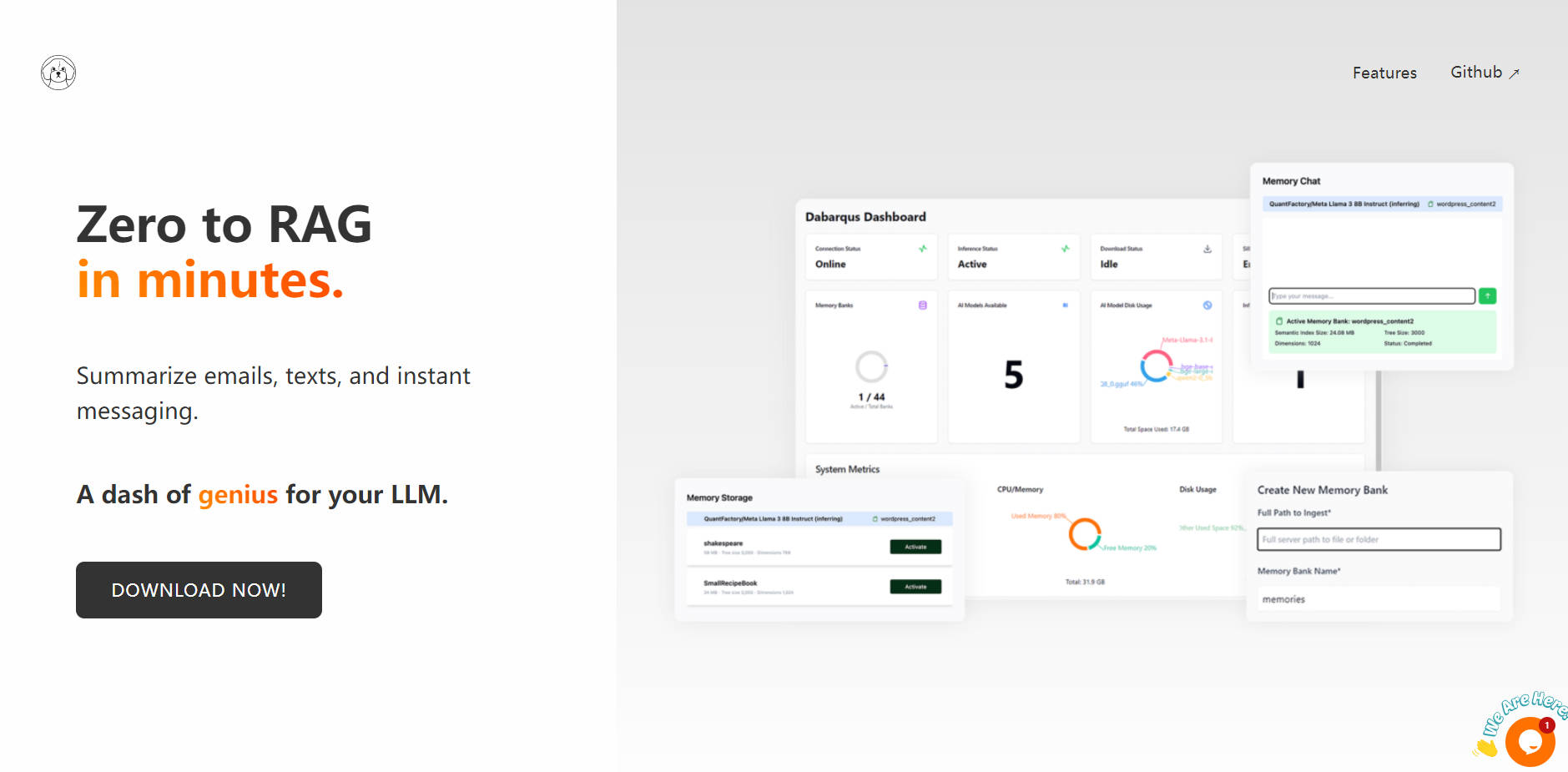
Dabarqus is a powerful tool that simplifies the process of adding Retrieval Augmented Generation (RAG) to your applications. With Dabarqus, you can easily connect your Large Language Models (LLMs) to diverse data sources like PDFs, emails, databases, and APIs. This allows your LLMs to access and process information from these sources in real-time, enhancing their capabilities and enabling new possibilities for applications like chatbots, question answering systems, and more. Dabarqus offers an intuitive interface and requires minimal coding, making it accessible to both developers and non-developers alike.
Key Features:
Diverse Data Ingestion📥 : Integrate various data sources, including PDFs, emails, and databases, allowing your LLM to access a wide range of information.
LLM-Style Prompting💬 : Interact with your data using natural language prompts, just as you would with an LLM, eliminating the need for complex query languages.
Multiple Semantic Indexes🧠: Organize your data into separate, portable "memory banks" for efficient management and retrieval based on specific topics or categories.
REST API & SDKs🔗 : Leverage the comprehensive REST API or native Python and Javascript SDKs for seamless integration with your existing projects and workflows.
LLM-Friendly Output⚡️ : Dabarqus provides output that's readily compatible with popular LLMs like ChatGPT and Ollama, ensuring smooth integration.
Use Cases:
Summarize customer service interactions from email threads to quickly understand common issues.
Build a chatbot that can access information from company documents to answer employee questions.
Create a research tool that analyzes academic papers and provides insights based on user queries.
Conclusion:
Dabarqus empowers you to unlock the full potential of your LLMs by connecting them to your private data. Its ease of use, diverse features, and compatibility with various LLMs make it an invaluable tool for developers and anyone seeking to enhance their AI applications with RAG capabilities. Dabarqus helps you bridge the gap between your data and your LLMs, enabling smarter, more insightful applications.
More information on Dabarqus
Launched
2024-08
Pricing Model
Free
Starting Price
Global Rank
Follow
Month Visit
<5k
Tech used
Google Analytics,Google Tag Manager,WordPress,jQuery,Gzip,JSON Schema,OpenGraph,RSS,Apache
Dabarqus was manually vetted by our editorial team and was first featured on 2024-10-31.
Related Searches
Dabarqus Alternatives
Load more Alternatives-

-

-
-

LlamaIndex builds intelligent AI agents over your enterprise data. Power LLMs with advanced RAG, turning complex documents into reliable, actionable insights.
-