

What is DGi?
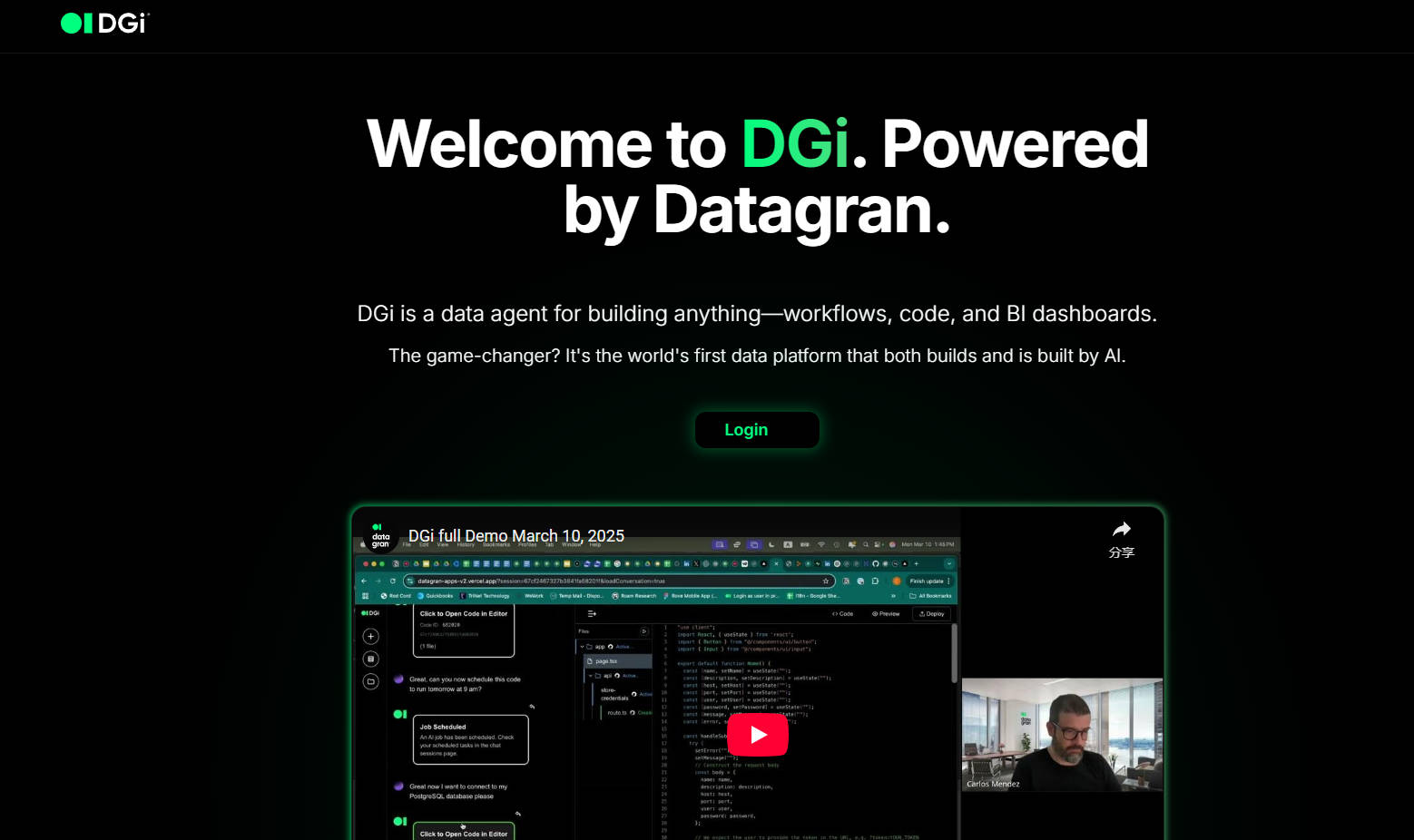
Managing complex data tasks often involves juggling multiple tools, writing intricate code, and navigating complex interfaces. DGi, powered by Datagran, offers a fundamentally different approach. It's an AI data agent designed to simplify how you build data workflows, generate code, and create business intelligence dashboards, all through conversational instructions.
What makes DGi distinct is its core architecture: it's the first data platform conceived as a Meta Programmable System Generator. This means DGi doesn't just use AI; the entire system, including necessary interfaces, is dynamically generated by AI based on your requests. There's no traditional backend or frontend; just a powerful AI ready to build what you need. While currently experimental, DGi provides a glimpse into the future of data interaction.
Key Capabilities
🧠 AI-Driven Construction: Interact via chat, and DGi dynamically generates the required UI elements and underlying logic for your tasks. It builds the system components needed on the fly.
📊 Specialized Data Focus: DGi excels at data-centric operations. Ask it to connect to databases, process complex datasets, schedule recurring jobs, or build interactive dashboards – it understands the context of data work.
⚙️ Meta System Flexibility: Operating as a meta system means DGi works at a higher level of abstraction. This gives it the versatility to tackle a wide array of data challenges beyond pre-defined functions. You define the task, and DGi works to construct the solution.
🔌 Dynamic Integrations & Destinations: Need to connect to a specific database like Google BigQuery or send alerts to Slack? Instruct DGi. It attempts to create the necessary integrations and data destinations as you request them, rather than relying on a fixed list.
🔒 Secure Credential Handling: DGi securely stores your database credentials in its metadata store and makes them accessible as environment variables when needed for connections, without replicating your actual database content.
Practical Use Cases
Automate Your Data Pipeline: You need to pull daily sales data from your PostgreSQL database, filter it to show only transactions over $1000 from the European region, and then load the results into a summary table. You simply instruct DGi: "Connect to my PostgreSQL database using these credentials. Then, filter the 'sales' table for transactions where 'amount' > 1000 and 'region' = 'Europe'. Schedule this process to run every day at 6 AM UTC and save the output to the 'daily_high_value_sales' table." DGi generates the workflow, handles the connection, executes the query, and sets up the schedule.
Build and Share Insights Quickly: Your marketing team needs a dashboard showing key campaign metrics: user sign-ups, conversion rates, and cost per acquisition, updated daily from a specific data source. You describe the required charts and data points to DGi: "Create a dashboard named 'Marketing Campaign Performance'. Include a line chart for daily sign-ups, a bar chart for conversion rate by channel, and a KPI card for overall CPA. Use the data from the 'marketing_metrics' table. Make the dashboard shareable." DGi builds the dashboard, connects it to the data, and provides a way to deploy and share it with your team.
Set Up Proactive Monitoring: You want to be notified immediately whenever a critical error occurs in your web application logs, which are stored in a specific database table. You tell DGi: "Monitor the 'app_logs' table in my database. If any new row contains 'level' = 'ERROR', send an alert immediately to my email address [your email] with the error message." DGi sets up the monitoring task and the notification trigger.
Conclusion
DGi represents a novel direction for data platforms. By leveraging AI not just for analysis but for the construction of the platform itself, it offers remarkable flexibility. Its specialization in data workflows, combined with the power of a meta system and dynamic interface generation, allows you to tackle complex data connection, processing, scheduling, and visualization tasks through simple instructions. If you're looking for a forward-thinking way to interact with your data infrastructure, DGi provides a powerful, AI-driven alternative.
More information on DGi
Launched
2025-03
Pricing Model
Free
Starting Price
Global Rank
4490119
Follow
Month Visit
<5k
Tech used
Next.js,Vercel,Gzip,Webpack,HSTS,YouTube
Top 5 Countries
64.98%
13.66%
13.29%
8.06%
Spain
France
Japan
Ireland
Traffic Sources
68.67%
0.05%
0.01%
0.2%
0.2%
30.86%
social
paidReferrals
mail
referrals
search
direct
Source: Similarweb (Sep 25, 2025)
DGi was manually vetted by our editorial team and was first featured on 2025-04-03.
Related Searches
DGi Alternatives
Load more Alternatives-

-
-
Low code enterprise data platform for transformation, embedding and vector database load.
-

-