

What is Hopeless API?
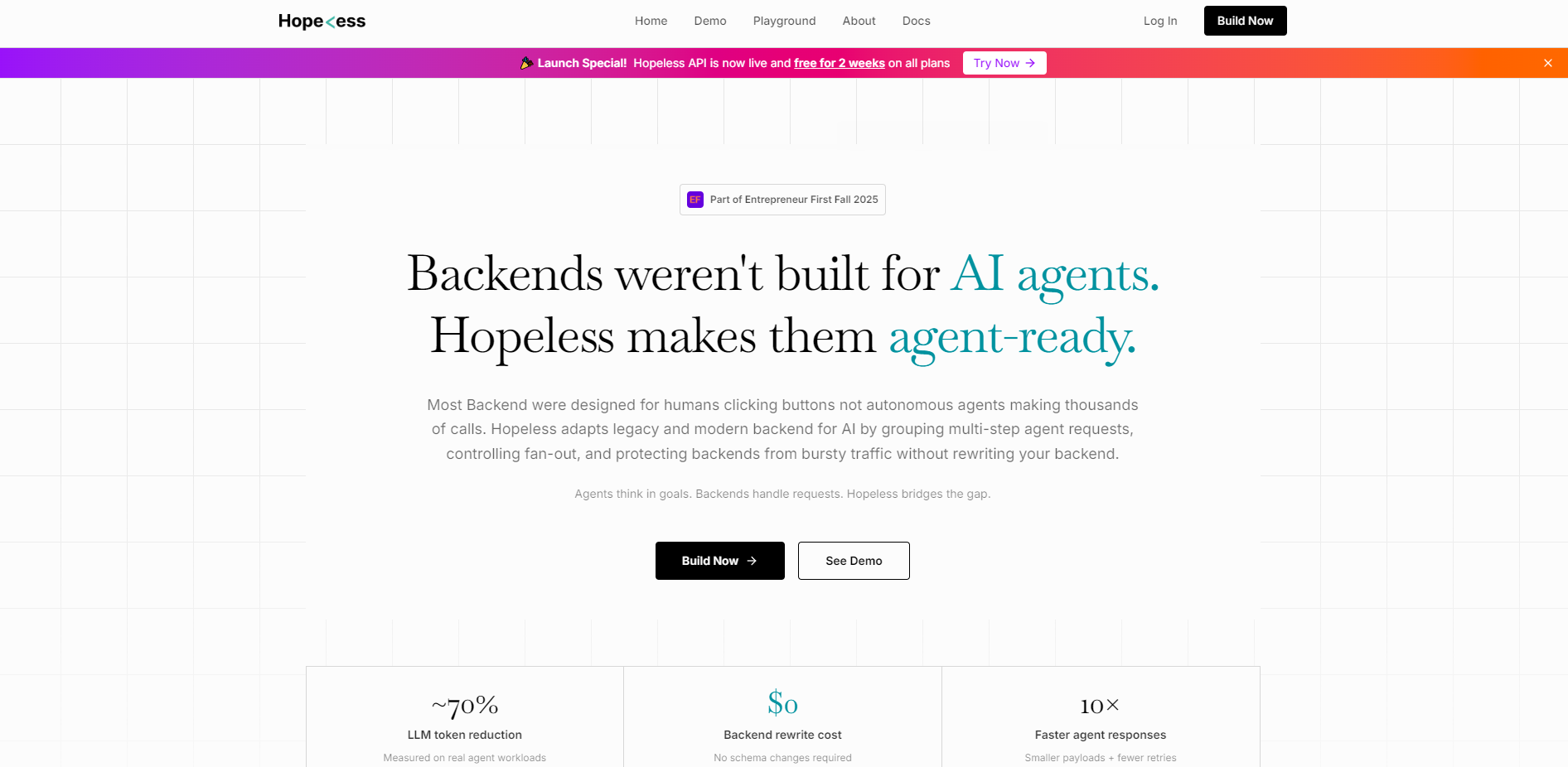
Most backends were designed for humans clicking buttons, not autonomous agents making thousands of concurrent calls. Hopeless bridges this gap by adapting legacy and modern backends for AI use, protecting your infrastructure from bursty traffic and "fan-out" attacks. It allows you to deploy production-grade agents that interact with your existing APIs efficiently and safely.
Key Features
- 🎯 Goal-Based Request Grouping Hopeless groups dozens of low-level API calls triggered by an agent into a single "goal"—a logical unit of work the backend can reason about. This transforms fragmented agent activity into structured operations, reducing complexity and improving execution reliability.
- 🛡️ Fan-Out Prevention & Cost Control Protect your backend from runaway agents by setting strict limits on fan-out, retries, and execution time. By automatically blocking excessive requests (e.g., limiting an agent to 10 product lookups when it attempts 20), you can reduce API and LLM costs by up to 50% while maintaining system stability.
- 📊 Smart Payload Optimization Legacy API responses are often bloated with metadata that agents don't need, wasting expensive LLM tokens. Hopeless intelligently filters JSON and SOAP payloads before they reach your model, reducing token usage by up to 70% and delivering only the essential data.
- ⚡ Dynamic Execution Control Tailor how your agent interacts with your data using Parallel, Sequential, or Batched execution modes. Whether you need maximum speed for a dashboard or cautious sequencing for rate-limited legacy APIs, Hopeless manages the concurrency so you don't have to.
- 🌐 Universal API Proxy Integrate with any external service—including REST, GraphQL, SOAP, gRPC, or WebSockets—without any configuration changes. Hopeless acts as a secure intermediary, encrypting credentials and providing a unified interface for all your agent's tool calls.
Use Cases
- Building Real-Time Dashboards: Instead of an agent making five separate calls for users, products, and inventory, you can group these into one "Dashboard Goal." This ensures the data arrives together, resulting in 10x faster agent responses and a more seamless user experience.
- Preventing "Runaway" Agent Costs: If an autonomous agent attempts to scrape 100 pages of data, Hopeless can enforce a max_requests limit of 10. This prevents accidental outages and ensures your API costs remain predictable even when agent behavior is not.
- Modernizing Legacy SOAP Services: You can point an AI agent at an old SOAP backend and let Hopeless reshape the 5,000-token XML response into a concise 120-token JSON object. This allows you to use modern AI with "un-rewritable" legacy systems at a fraction of the token cost.
Conclusion
Hopeless provides the necessary infrastructure to make AI agents safe, fast, and cost-effective for production environments. By grouping requests and optimizing payloads, you can leverage your existing backend as a powerful toolset for AI without the risk of system instability or spiraling costs.
More information on Hopeless API
Launched
2025-12
Pricing Model
Free Trial
Starting Price
Global Rank
Follow
Month Visit
<5k
Tech used
Hopeless API was manually vetted by our editorial team and was first featured on 2025-12-24.
Hopeless API Alternativas
Más Alternativas-

-
TaskingAI aporta la simplicidad de Firebase al desarrollo de aplicaciones nativas de IA. Inicia tu proyecto seleccionando un modelo LLM, desarrolla un asistente responsivo respaldado por APIs con estado, y potencia sus capacidades con memoria gestionada, integraciones de herramientas y un sistema de generación aumentada.
-

-

-