

What is MCP Fabric?
Building AI applications that leverage your existing services often means writing complex integration code, leading to technical debt and slower development cycles. MCP Fabric addresses this challenge by providing a streamlined way to connect your RESTful APIs directly to Large Language Models (LLMs), transforming them into AI-ready tools in minutes, all without writing custom glue code.
MCP Fabric acts as a bridge, giving your AI instant context and capabilities from your backend services. It simplifies the process of making your valuable API data and functionalities accessible and understandable for AI models, allowing your team to focus on building core AI logic rather than wrestling with integration layers.
Key Features
⚙️ Instant API Integration: Transform any REST API endpoint into a tool consumable by LLMs rapidly. This eliminates the need for complex, custom integration code.
✨ Intelligent Parameter Parsing: Automatically structure parameters (path, query, headers, JSON bodies) from API requests into formats LLMs can easily understand and utilize.
📄 Automatic OpenAPI Parsing: Provide your OpenAPI specification, and MCP Fabric can automatically generate the necessary configurations to expose your APIs to AI.
📝 Customizable Context: Add detailed descriptions and summaries to your API routes. This provides LLMs with the essential context needed to correctly interpret and interact with your endpoints.
🔒 Comprehensive Authentication Support: Connect securely using standard methods including Basic, Query Parameter, API Key, Bearer Token, and OAuth 2.0.
📊 Advanced Telemetry: Gain visibility into API usage and performance with detailed metrics like request counts, success rates, latency, and full request/response logs.
⚡️ Ultra-Low Latency: Optimized for performance, MCP Fabric adds only approximately 3ms to the typical API call, ensuring responsive AI interactions.
Use Cases
Empowering AI Agents with Real-Time Data: Connect your internal APIs that provide access to databases or external services (like weather feeds, stock prices, or internal system status) via MCP Fabric. This allows an AI agent to fetch current, accurate information directly from the source in response to user queries, enhancing the AI's utility and relevance.
Enabling AI-Driven Actions via Existing Services: Integrate APIs that perform actions within your system (e.g., creating a ticket, updating a user profile, initiating a workflow). An AI assistant can then execute these complex operations on behalf of the user by calling the appropriate API endpoint through MCP Fabric, automating tasks previously requiring manual intervention or custom AI-to-API logic.
Accelerating AI Application Prototyping: Rapidly connect various internal or external APIs needed for a new AI feature or application. By leveraging MCP Fabric's no-code integration, development teams can quickly test and iterate on AI capabilities that rely on backend services, significantly reducing the time spent on integration plumbing and accelerating the prototyping phase.
MCP Fabric simplifies the crucial step of connecting AI models to the wealth of functionality available in your existing APIs. By eliminating the need for custom integration code and providing essential tools for context and monitoring, it allows developers to build smarter, more capable AI applications faster and with less technical overhead.
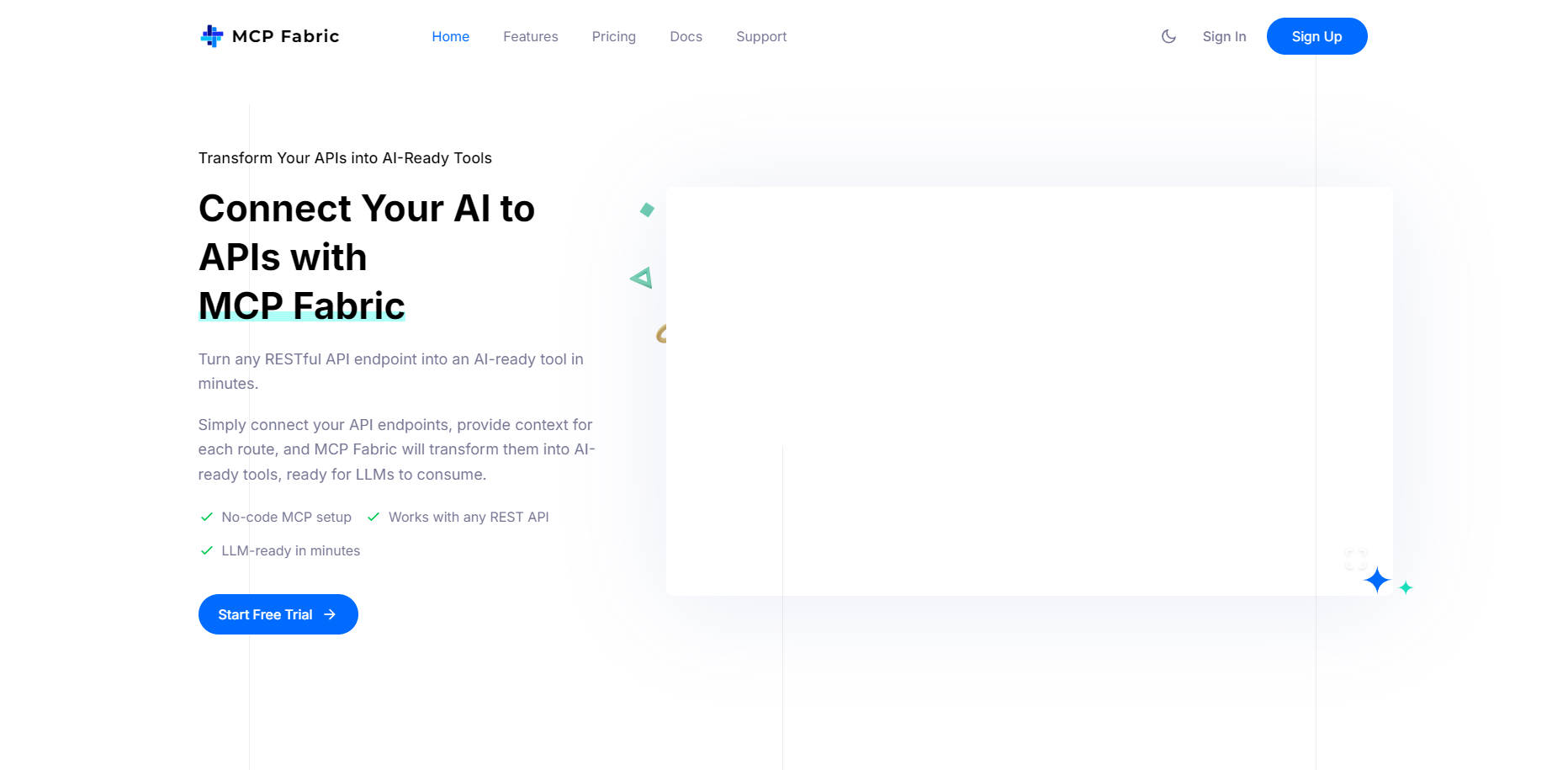
More information on MCP Fabric
Launched
2025-04
Pricing Model
Free Trial
Starting Price
$10 /month
Global Rank
Follow
Month Visit
<5k
Tech used
Cloudflare CDN,Next.js,Gzip,HTTP/3,OpenGraph,Webpack
MCP Fabric was manually vetted by our editorial team and was first featured on 2025-05-25.
MCP Fabric Alternatives
Load more Alternatives-
-

-

-

-

FastAPI-MCP: Expose your FastAPI endpoints as secure tools for AI agents. Integrate with MCP effortlessly, leveraging existing auth & native efficiency.