
What is Obot?
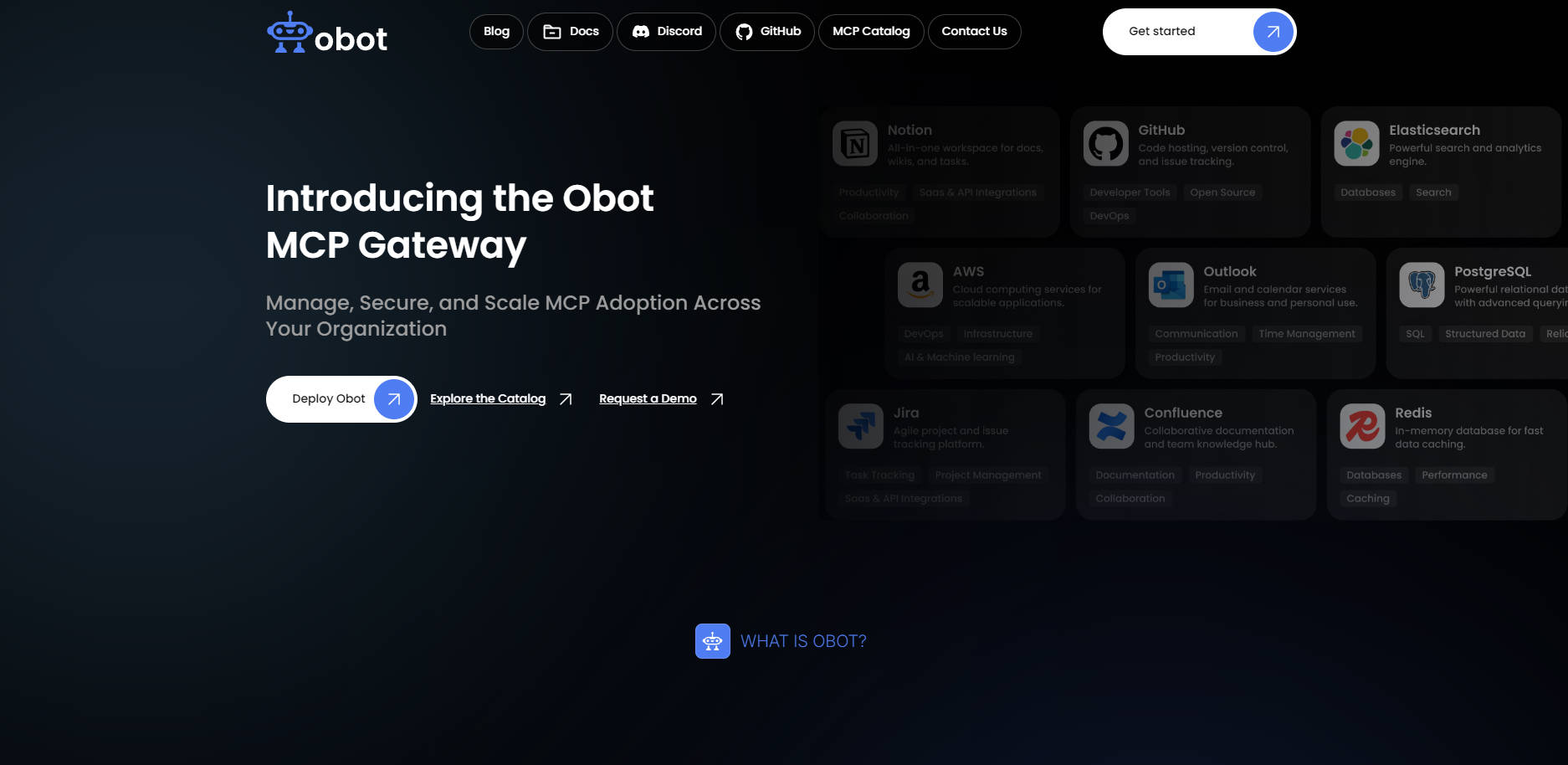
As AI tools become essential for productivity, managing their connections (MCP servers) across your organization can quickly become chaotic and insecure. Obot MCP Gateway is an open-source platform designed for IT teams to bring order to this complexity. It provides a central control plane to securely manage, govern, and scale MCP adoption, ensuring your developers and employees can safely connect AI to the data and apps they need.
Key Features
Centralized IT Control Plane Define granular access policies, onboard new MCPs, and monitor usage from a single, modern interface or a GitOps workflow. This gives your IT team complete visibility and governance over how AI tools access internal systems, preventing shadow infrastructure and ensuring compliance.
Unified Discovery Catalog Provide your users with a searchable, self-service directory of available and IT-verified MCPs. Each entry includes clear documentation and trust levels, so developers and business users can confidently find and connect to the right tools without guesswork or support tickets.
Secure Connection Proxy & Hosting Obot intelligently routes all traffic through a secure proxy, enforcing access policies on every request. It supports remote third-party MCPs and can also deploy and host your internal MCPs on-demand within your Kubernetes cluster, giving you a flexible and secure architecture that adapts to your needs.
Instant, Authenticated Connections Users can generate unique, secure connection URLs with a single click. These URLs integrate seamlessly with their favorite AI clients—like Claude, Cursor, or VSCode—and are authenticated through your organization's identity provider (e.g., Google, Okta, Microsoft Entra), simplifying access while upholding security standards.
Use Cases
Obot MCP Gateway translates complex governance needs into simple, powerful workflows for everyone in your organization.
For IT Administrators: Enforcing Secure Access An IT admin needs to grant the data science team access to a new internal analytics database via an AI agent, while keeping it restricted from other departments. Using Obot, they add the new MCP to the catalog, create a policy that limits access to the "Data Science" user group, and can now audit every query made through the gateway, ensuring both compliance and security.
For Developers: Accelerating Development A developer needs to connect their AI coding assistant to the company's internal GitHub and Jira instances. Instead of manually configuring authentication tokens and permissions, they simply log in to the Obot catalog, find the IT-approved MCPs, and generate a secure connection URL. This reduces setup time from hours to minutes and ensures they're using compliant tools.
For Business Users: Safe Self-Service AI A marketing manager wants to use an enterprise chat tool to analyze recent customer feedback from a Slack channel. They access the Obot Chat interface, which provides a curated list of approved connections. By selecting the Slack MCP, they can interact with company data in a secure, pre-configured environment without needing technical assistance or creating potential data leaks.
Why Choose Obot MCP Gateway?
As AI integration deepens, the protocol connecting models to your internal systems—the Model Context Protocol (MCP)—is becoming critical infrastructure. Obot provides the essential control layer to manage it effectively.
Move from Chaos to Control: Without a gateway, the rapid adoption of MCPs leads to shadow IT, inconsistent security, and potential data leaks. Obot provides the centralized visibility and policy enforcement needed to manage this new infrastructure layer before the chaos spreads.
Accelerate Secure AI Adoption: Obot doesn't block innovation; it enables it safely. By providing a trusted catalog of tools, you empower employees to leverage AI for their work while ensuring that all connections adhere to your organization's security and compliance standards.
Built on an Open Standard: Obot is open-source and built on the open Model Context Protocol (MCP), ensuring maximum interoperability and preventing vendor lock-in. You can deploy it on your own infrastructure for complete control over your data and your AI ecosystem.
Conclusion
Obot MCP Gateway bridges the critical gap between the rapid innovation of AI and the foundational enterprise need for security, governance, and control. It transforms a potential source of risk into a well-managed, scalable asset for your organization.
Explore the documentation or deploy Obot to see how you can accelerate AI adoption with confidence!
More information on Obot
Launched
2023-03
Pricing Model
Free
Starting Price
Global Rank
Follow
Month Visit
<5k
Tech used
Top 5 Countries
100%
United States
Traffic Sources
5.69%
1.21%
6.85%
5.51%
5.69%
75.05%
social
paidReferrals
mail
referrals
search
direct
Source: Similarweb (Sep 25, 2025)
Obot was manually vetted by our editorial team and was first featured on 2025-08-18.
Related Searches
Obot Alternatives
Load more Alternatives-
Build & deploy secure, no-code MCP tools. Connect your data/APIs to AI assistants (ChatGPT) for real-time context & automation.
-

-
-
Transform your existing APIs into AI-agent ready MCP servers in under 1 minute — without writing a single line of code, hiring developers, or risking your current systems
-
