

What is Octelium?
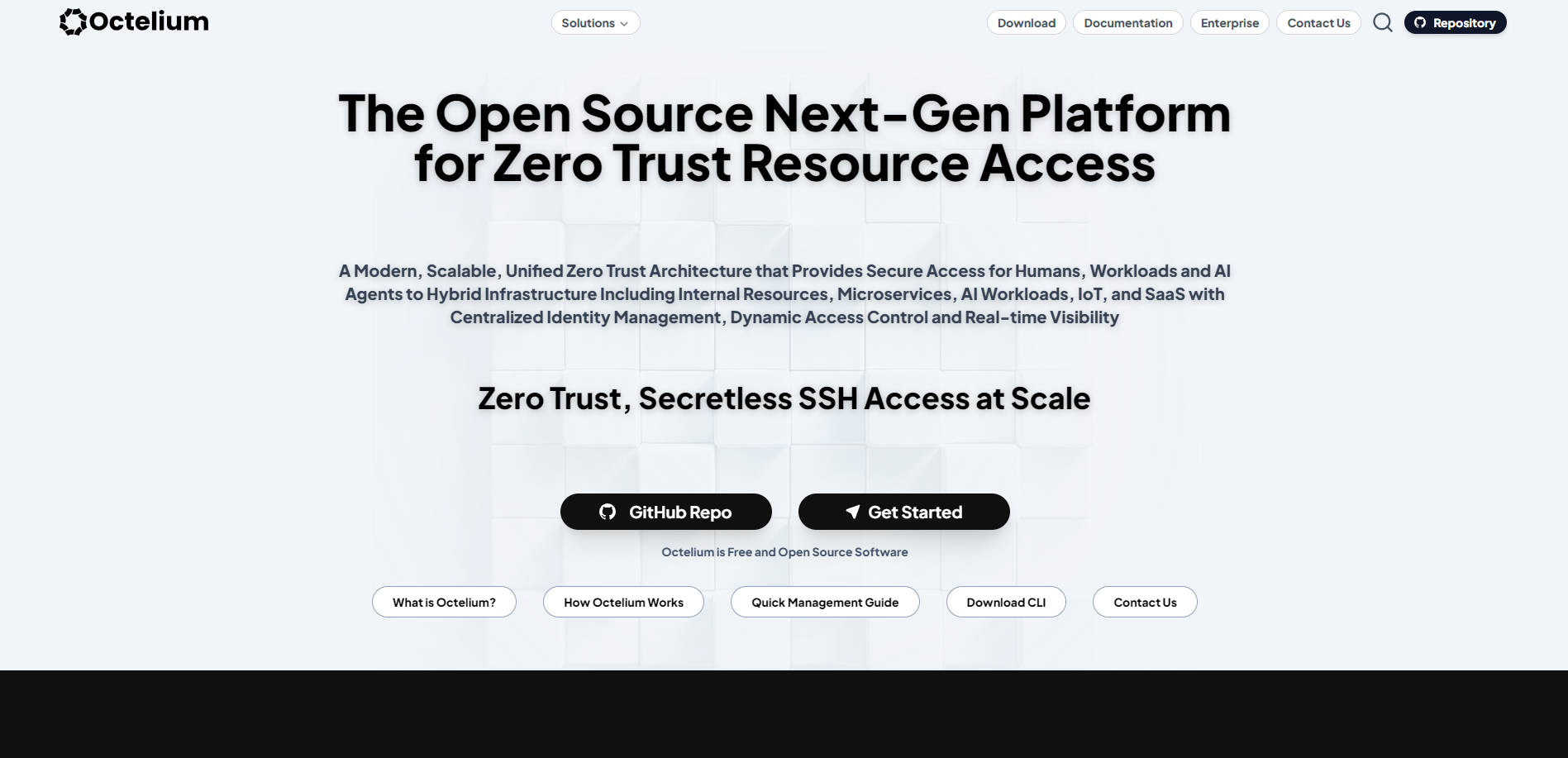
Octelium is the next-generation, open-source platform designed for Zero Trust Resource Access. It provides a modern, scalable, and unified architecture to secure access for Humans, Workloads, and emerging AI Agents across complex hybrid infrastructure, including internal resources, microservices, IoT, and SaaS. By leveraging centralized identity management and dynamic access control built on identity-aware proxies, Octelium eliminates reliance on outdated security perimeters and traditional VPN routing.
Key Features
Octelium delivers robust security and operational flexibility by unifying access methods and controls at the application layer.
🛡️ Dynamic Secretless Access
Octelium’s Layer 7 (application-layer) awareness allows Users and Workloads to seamlessly access protected resources without exposing, managing, or sharing long-lived application credentials like HTTP API keys, SSH private keys, or database passwords. This significantly reduces the attack surface associated with credential sprawl and simplifies access management for protocols including HTTP, gRPC, SSH, PostgreSQL, and MySQL.
⚖️ Context-Aware Policy-as-Code
Implement highly granular and dynamic access control on a per-request basis. Octelium provides a centralized, scalable Attribute-Based Access Control (ABAC) system, allowing you to define modular policies using Policy-as-Code (via CEL and OPA). This ensures access decisions are always context-aware, incorporating factors like identity, time, device status, and application layer data.
🔐 Zero-Standing Privileges Architecture
Unlike traditional systems, Octelium intentionally operates without any concept of a global "admin" or "superuser." All permissions, even those governing the API Server, are strictly controlled by Policies and can be dynamically limited by time and context. This architectural constraint dramatically minimizes the potential blast radius of a compromised account.
📡 Unified Private and Clientless Access
Octelium unifies two essential Zero Trust methods: Private Access and Public Clientless Access. It provides zero-config, client-based ZTNA over high-performance WireGuard/QUIC tunnels for internal resources, eliminating traditional VPN routing problems. Simultaneously, it supports clientless BeyondCorp access for human users via browsers and workloads using standard OAuth2 flows for protected public resources like SaaS APIs.
📊 Real-Time, L7-Aware Auditing and Visibility
Gain deep insight into every access request. Octelium is natively OpenTelemetry-ready, exporting real-time, identity-aware, and application-layer aware logs to OTLP receivers and SIEM tools. This robust auditing capability ensures continuous visibility and simplifies compliance reporting by detailing exactly who, what, when, and how resources were accessed.
Use Cases
Octelium’s flexible architecture allows it to serve multiple critical roles within your security and deployment landscape:
- Modernizing Remote Access and VPN Replacement: Replace complex and often insecure traditional corporate VPNs (like OpenVPN Access Server) with a zero-trust, layer-7 aware alternative. Octelium provides a unified, secure remote access solution for employees, contractors, and devices, eliminating the routing complexity and inherent trust issues of legacy network-centric VPNs.
- Securing and Scaling AI/LLM Workloads: Use Octelium as a scalable AI Gateway. Control and audit identity-based access, implement dynamic routing, and ensure secretless communication for your AI agents interacting with various LLM providers. This provides the necessary security and visibility required for emerging Agent2Agent (A2A) and Model Context Protocol (MCP) architectures.
- Kubernetes Ingress and PaaS-like Deployment: Leverage Octelium's foundation on Kubernetes to effortlessly deploy, manage, and scale containerized applications. It acts as an advanced, policy-driven alternative to standard Kubernetes ingress controllers, providing secure client-based private access, public clientless BeyondCorp access, and public anonymous access all through a single, declarative platform.
Why Choose Octelium?
Octelium offers significant architectural and operational advantages over legacy access solutions, driving both security improvement and efficiency gains.
- Open Source Commitment and Flexibility: Octelium is Free and Open Source Software, designed for single-tenant self-hosting. This eliminates vendor lock-in and avoids the limitations often found in "crippled" open-source versions of proprietary SaaS products, giving you full control over your data and infrastructure.
- Seamless Infrastructure Integration: Octelium requires no changes to your existing upstream resources. Your applications, databases, or services can remain listening on private networks or even localhost, as Octelium handles all public and private connectivity, eliminating the need to open firewall ports or reconfigure internal networking.
- Elimination of VPN Routing Issues: By representing each resource as a Service with a stable, private IP address within a unified dual-stack range, Octelium’s client-based private networking mode bypasses the common networking and routing complexities (like NAT64) that plague traditional VPNs at scale.
- Built for Cloud-Native Scale: Built directly on top of Kubernetes, Octelium provides seamless automatic horizontal scalability and high availability, ensuring the platform can grow reliably with your enterprise needs.
Conclusion
Octelium provides a powerful, unified, and highly flexible solution to the complex challenge of secure resource access in modern hybrid environments. By prioritizing identity, context, and application-layer control, you gain superior security posture, eliminate secret management overhead, and achieve unparalleled visibility.
More information on Octelium
Launched
2022-09
Pricing Model
Free
Starting Price
Global Rank
7444192
Follow
Month Visit
<5k
Tech used
Top 5 Countries
100%
United States
Traffic Sources
7.81%
1.3%
0.16%
10.08%
25.94%
54.03%
social
paidReferrals
mail
referrals
search
direct
Source: Similarweb (Nov 13, 2025)
Octelium was manually vetted by our editorial team and was first featured on 2025-11-13.