
What is UltraRAG ?
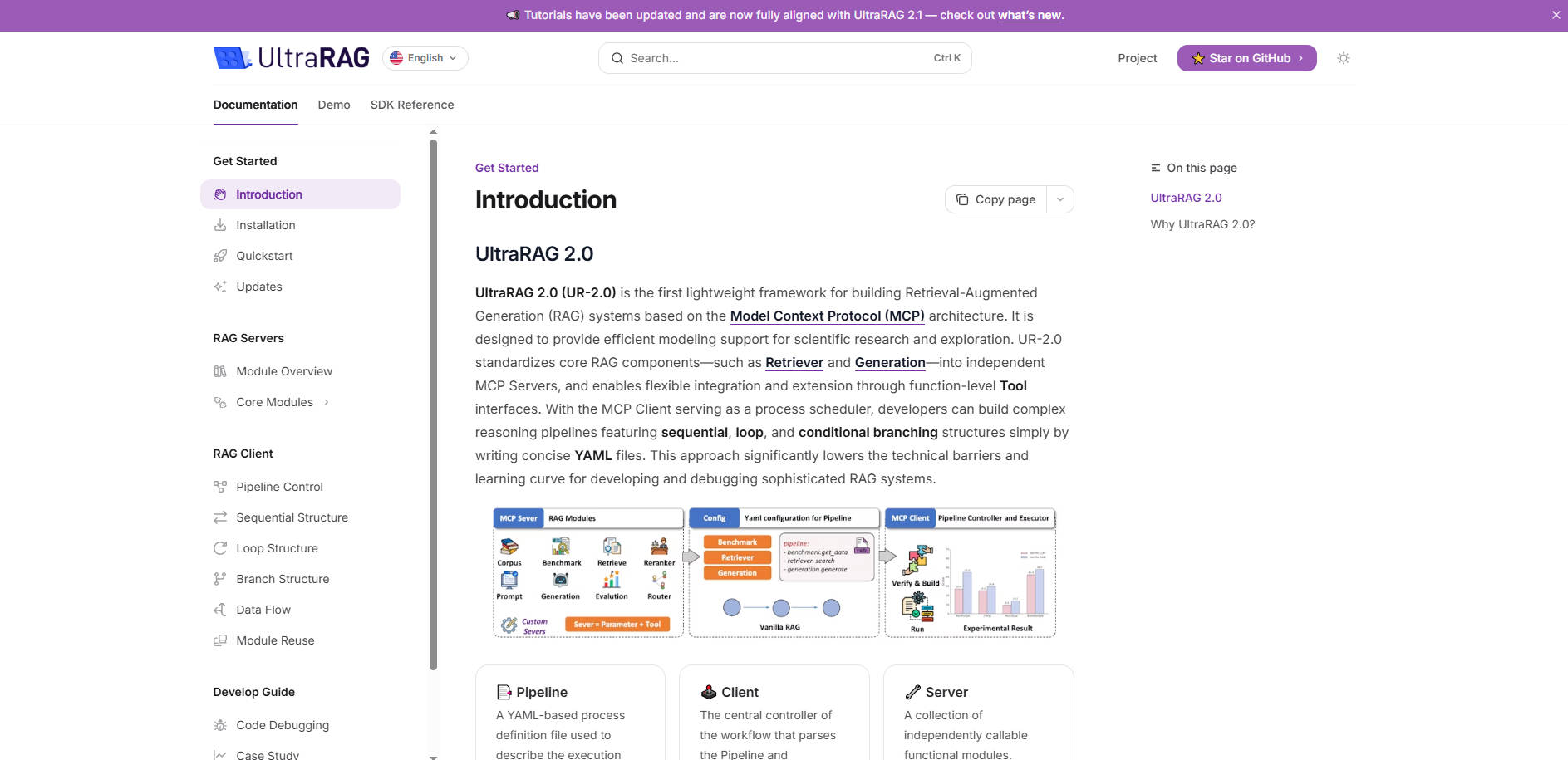
UltraRAG 2.0 (UR-2.0) is the first low-code RAG framework designed around the innovative Model Context Protocol (MCP) architecture. It directly addresses the high engineering cost and technical fragmentation researchers face when developing sophisticated, multi-stage Retrieval-Augmented Generation systems. By transforming core RAG components into standardized, reusable services, UR-2.0 provides an efficient modeling environment that significantly lowers the barrier to building complex pipelines and ensures high experimental reproducibility.
Key Features
UltraRAG 2.0 fundamentally changes how you design and deploy RAG systems, shifting the focus from boilerplate code to algorithmic innovation.
🚀 Declarative Low-Code Pipeline Orchestration
Instead of writing extensive procedural code, you define complex inference logic using concise YAML files. The framework natively supports advanced control flow structures—including serial steps, loops, and conditional branches—allowing researchers to implement sophisticated iterative RAG systems (like Search-o1) with just dozens of lines of configuration, drastically reducing development time.
🔧 MCP-Based Component Modularization
Core RAG functions (Retriever, Generator, etc.) are encapsulated as independent, standardized MCP Servers. This architecture ensures complete decoupling, meaning modules are truly reusable across different projects. New functionalities are exposed via a function-level Tool interface, allowing developers to add new features or customize existing servers without intrusive changes to the core system.
🕹️ Centralized Flow Scheduling via Client
The MCP Client acts as the central process scheduler, parsing your declarative YAML Pipeline and coordinating the execution order and invocation of Tools across various Servers. This clear separation of control logic (Client) from functional modules (Server) enhances system stability, simplifies debugging, and enables rapid prototyping of new research ideas.
📊 Integrated, Unified Evaluation Ecosystem
UltraRAG 2.0 features a standardized evaluation pipeline and metric management system. It provides out-of-the-box support for 17 mainstream scientific research benchmarks and integrates high-quality baseline implementations (such as Vanilla RAG, IRCoT, and Search-o1). This unified system ensures systematic comparison, increases experimental efficiency, and guarantees high result reproducibility.
Use Cases
UltraRAG 2.0 is specifically engineered to accelerate research and development in advanced RAG methodologies.
Rapidly Implement Iterative RAG Models: If you are developing a multi-step reasoning system that requires dynamic retrieval based on intermediate generation results, you can use the native loop and conditional branch structures in the YAML pipeline. This allows you to quickly replicate, modify, and test complex iterative algorithms (e.g., Search-o1 or IterRetGen) without the heavy engineering lift traditionally required.
Benchmark New Algorithms Systematically: Utilize the built-in support for 17 benchmarks and integrated baselines to instantly compare a novel retrieval algorithm or generation model against the current state-of-the-art. The unified evaluation framework ensures your results are consistent, verifiable, and ready for publication or internal review.
Effortlessly Extend System Capabilities: Need to incorporate a specialized external search engine, a new vector database, or a custom pre-processing step? Since all components are encapsulated as independent Servers, you can easily integrate custom or external MCP Servers into your pipeline, extending the framework’s functionality without altering existing core RAG logic.
Unique Advantages
While many frameworks offer RAG component chaining, UltraRAG 2.0’s foundational architecture provides distinct structural advantages essential for advanced scientific research.
Native Support for Complex Reasoning: Traditional RAG frameworks often rely on simple sequential chaining, struggling to represent complex inference patterns. UR-2.0 is built with native support for programming-language-level flow control (loops, steps, conditional logic) defined directly in YAML, making it the ideal platform for building adaptive, multi-hop, and dynamic RAG systems.
Decoupled, Standardized Components via MCP: The Model Context Protocol (MCP) ensures that every core component is an independent, standardized Server. This resolves the common issue in open-source implementations where modules are tightly coupled and difficult to reuse. With UR-2.0, you achieve true "hot-pluggable" functionality, allowing researchers to focus on algorithm innovation rather than dependency management.
Guaranteed Experimental Reproducibility: By integrating standardized datasets, providing high-quality, maintained baseline scripts, and utilizing a unified evaluation system, UR-2.0 ensures that your experimental results are not only easy to achieve but also highly reproducible, a critical factor in academic and industrial research.
Conclusion
UltraRAG 2.0 is the definitive framework for researchers transitioning from simple RAG implementations to complex, adaptive knowledge systems. By leveraging the MCP architecture and declarative pipeline control, it drastically reduces engineering overhead, allowing you to dedicate your resources to experimental design and algorithmic breakthroughs.
More information on UltraRAG
Launched
2021-09
Pricing Model
Free
Starting Price
Global Rank
Follow
Month Visit
<5k
Tech used
Top 5 Countries
87.33%
12.67%
China
Taiwan
Traffic Sources
1.04%
0.27%
0.23%
1.81%
7.52%
89.13%
social
paidReferrals
mail
referrals
search
direct
Source: Similarweb (Oct 23, 2025)
UltraRAG was manually vetted by our editorial team and was first featured on 2025-10-23.