

What is A2A?
Developing sophisticated AI solutions often involves multiple specialized agents. However, enabling these agents, potentially built using different frameworks or by various vendors, to communicate and collaborate effectively presents a significant technical hurdle. The Agent2Agent (A2A) protocol addresses this directly by providing an open standard for inter-agent communication.
A2A offers a defined structure and common language, allowing disparate agentic applications to discover each other's capabilities, negotiate interaction methods, and securely exchange information to accomplish complex tasks together. This initiative, driven by Google and open to the community, aims to foster a more connected and capable AI ecosystem.
Key Features of the A2A Protocol
📄 Agent Discovery via Agent Card: Publish and consume a standardized
agent.jsonmetadata file. This allows agents to programmatically find others and understand their capabilities, supported skills, endpoint URLs, and required authentication methods before initiating contact.🔄 Structured Task Management: Define and track units of work using a clear task lifecycle (submitted, working, input-required, completed, etc.). Clients initiate tasks with unique IDs, enabling robust management of interactions, even long-running processes.
💬 Standardized Message & Data Exchange: Utilize a consistent format for communication turns (
Message) composed of fundamental content units (Part). This supports text (TextPart), files (FilePartvia URI or inline bytes), and structured JSON data (DataPart), ensuring clarity and predictability in data exchange.📊 Artifact Handling: Manage outputs generated by agents during a task (like reports, datasets, or final structured results) as distinct
Artifacts. These also containParts, allowing for complex data outputs beyond simple text responses.⚡ Real-time & Asynchronous Updates: Implement
tasks/sendSubscribefor long-running tasks. Servers supporting streaming can push real-time status and artifact updates to clients via Server-Sent Events (SSE), enhancing responsiveness. Alternatively, configure push notifications to a client webhook for asynchronous updates when direct streaming isn't feasible.🌐 Open Specification & Tooling: Leverage a clearly defined JSON specification for all protocol structures. Benefit from provided sample clients/servers (Python, JS), example integrations (CrewAI, LangGraph, Genkit), and command-line tools to accelerate development and adoption.
Practical Use Cases
Enterprise Workflow Orchestration: Imagine an internal process requiring data retrieval, analysis, and report generation. An agent built with a specific data analysis library (like Pandas in Python) could receive a task via A2A from a central workflow agent. Once analysis is complete, it could pass the structured results (as a
DataPartorFilePartArtifact) back via A2A to another agent responsible for formatting and sending a customer-facing summary.Integrating Specialized Vendor Agents: Your company might use a vendor-provided agent for customer support ticket analysis and another internal agent for escalating complex issues to specific engineering teams. Using A2A, the support agent could identify an issue requiring escalation, discover the appropriate internal agent via its Agent Card, and initiate a task via A2A, passing relevant ticket details and context securely.
Building Modular Agent Systems: You are developing a research assistant application. You could build a "supervisor" agent that takes a user's complex query. This supervisor uses A2A to delegate sub-tasks: one to an agent specialized in searching academic papers (using its specific API), another to an agent skilled at summarizing text (perhaps using a different LLM), and maybe a third for data visualization. A2A facilitates the coordination, data passing, and status tracking between these modules.
Getting Started & Contributing
Dive deeper into the protocol:
📚 Read the technical documentation.
📝 Review the JSON specification.
🎬 Explore the samples (Client/Server, Web App, CLI, Framework Integrations).
A2A is an open-source project. We encourage community involvement through contributions to the protocol specification, sample implementations, or by joining the discussion on GitHub. Your feedback helps shape the future of interoperable AI.
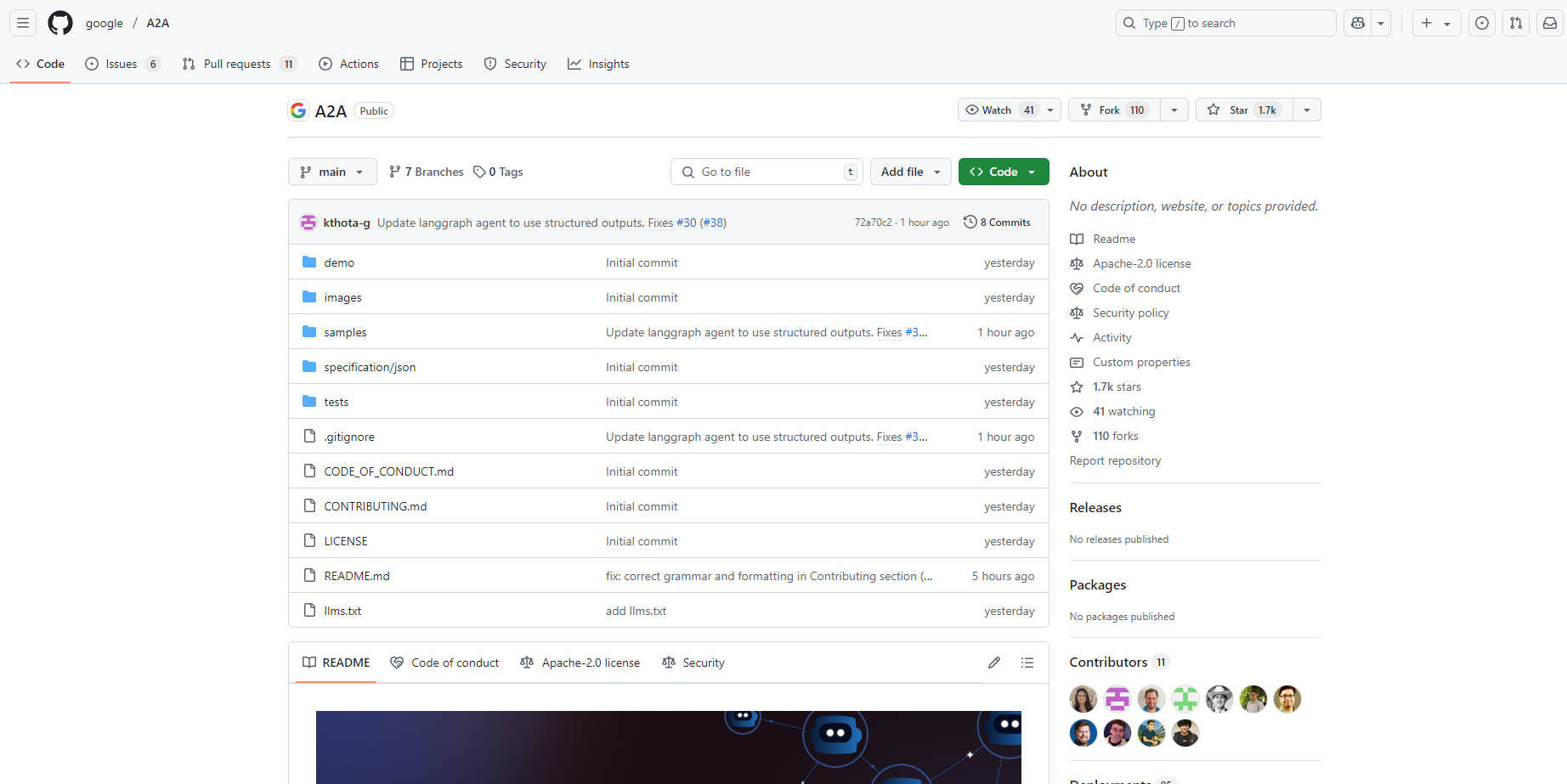
More information on A2A
Launched
Pricing Model
Free
Starting Price
Global Rank
Follow
Month Visit
<5k
Tech used
A2A was manually vetted by our editorial team and was first featured on 2025-04-10.
A2A Alternatives
Load more Alternatives-

-

-
OpenAgents is an open-source project for building Agent Networks and connecting AI Agents at scale. Developers use OpenAgents to launch and join networks with thousands of agents to collaborate, tackle complex challenges, learn and grow in one community.
-

Agent Squad: Open-source framework to orchestrate AI agent teams for complex conversations. Python & TS support, flexible context & routing.
-

Atomic Agents: Python framework for predictable AI. Build modular, reliable agent pipelines with full control.