

Click outside to close
What is Adala?
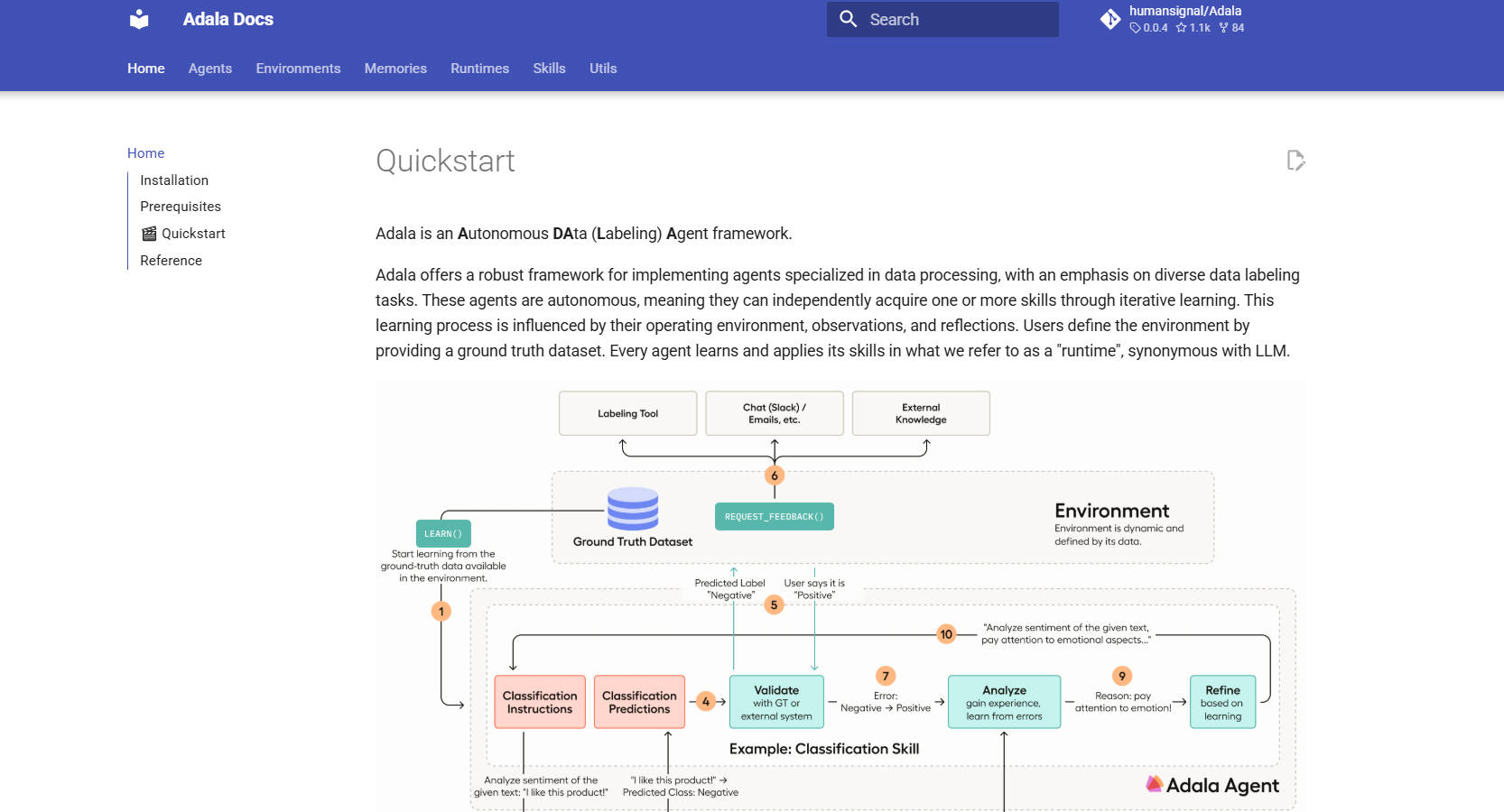
Data labeling and processing can be a bottleneck in AI development. Adala is an Autonomous Data Labeling Agent framework designed to streamline this process. It empowers you to build intelligent agents that learn and adapt to your specific data needs, ensuring reliable and consistent results. Instead of manual, repetitive tasks, Adala allows you to focus on higher-level AI development.
Key Features:
🤖 Build Reliable Agents: Create agents grounded in your provided ground truth data. This foundational approach ensures that your agents produce trustworthy and consistent outputs, crucial for data integrity.
⚙️ Control Agent Output: Fine-tune the desired output for each skill your agent possesses. You can set specific constraints, ranging from strict guidelines to more flexible, adaptive responses based on the agent's learning.
Specialize in Data Processing: Tailor agents for a wide array of data processing tasks. While they excel in data labeling, Adala's flexibility extends to various data-centric needs.
🧠 Enable Autonomous Learning: Adala agents aren't just pre-programmed; they learn. Through interaction with their environment, observations, and reflection, they develop and refine their skills iteratively and independently.
🛠️ Utilize a Flexible and Extensible Runtime: Deploy a single skill across multiple runtimes (LLMs), enabling dynamic architectures like student/teacher models. The open framework encourages community contributions, fostering continuous evolution and adaptation.
🚀 Customize with Ease: Develop and tailor agents to address your unique challenges quickly. Adala's design minimizes the learning curve, allowing you to get up and running efficiently.
Use Cases:
AI Engineer Workflow Enhancement: Imagine you're building a complex AI system requiring multiple data preprocessing steps. With Adala, you can architect a system of interconnected, modular agents, each handling a specific task. This modularity allows for easier maintenance, updates, and scaling of your AI pipeline. You are freed up, to concentrate on production level systems, abstracting the low-level ML details to Adala and LLMs.
Machine Learning Research Experimentation: As a researcher, you're exploring complex problem decomposition. Adala provides a platform to experiment with different agent architectures and skill combinations, allowing you to test hypotheses about causal reasoning and problem-solving approaches in a controlled environment.
Data Scientist Pre/Post Processing: You have a large dataset that needs cleaning and transformation before model training. Instead of writing numerous custom scripts, you can deploy Adala agents to automate these tasks. For instance, one agent might handle missing value imputation, while another performs feature scaling, all within a Python notebook environment.
Conclusion:
Adala offers a powerful and flexible approach to data labeling and processing. By leveraging autonomous agents grounded in your data, you can achieve greater efficiency, reliability, and control over your AI development workflow. Whether you're an AI engineer, machine learning researcher, or data scientist, Adala provides the tools to streamline your tasks and focus on innovation.
More information on Adala
Adala was manually vetted by our editorial team and was first featured on 2025-02-23.
Adala Alternatives
Adala Alternatives-

Adaline transforms the way teams develop, deploy, and maintain LLM-based solutions.
-
TaskingAI brings Firebase's simplicity to AI-native app development. Start your project by selecting an LLM model, build a responsive assistant supported by stateful APIs, and enhance its capabilities with managed memory, tool integrations, and augmented generation system.
-

Stop AI agent failures in production. Atla AI automatically detects, diagnoses, & provides actionable fixes to build reliable AI agents faster.
-

AutoAgent: Zero-code AI agent builder. Create powerful LLM agents with natural language. Top performance, flexible, easy to use.
-
AutoLearn is the MCP server that automatically converts your AI agent's reasoning steps into reliable, cost-effective code that runs deterministically every time.