

What is Cloudflare Workers MCP?
Imagine extending the capabilities of AI assistants like Anthropic's Claude to interact directly with your applications. No more complex integrations or endless configuration. With Cloudflare's new workers-mcp tooling, you can build and deploy Model Context Protocol (MCP) servers directly within Cloudflare Workers, making your services accessible to powerful LLMs with minimal effort. This means you can empower users to interact with your application's functionality using natural language, opening up exciting new possibilities.
Key Features:
🚀 Simplify MCP Server Deployment: The
workers-mcplibrary handles the complex translation between your code and the MCP standard. Forget manual schema definitions and routing – focus on building your application's core logic.✍️ Define Tools with JSDoc: Use familiar JSDoc comments to describe your Worker's functions (methods). These comments automatically generate the documentation that AI assistants like Claude need to understand and utilize your tools.
🔗 Seamless Integration with Cloudflare Workers: Leverage the power and scalability of Cloudflare Workers. Deploy your MCP server with the same ease and speed you're used to.
🤖 Extend AI Capabilities: Unlock new functionalities for AI. Add custom features to LLMs by simply writing code, without worrying about server infrastructure or request schemas.
🛡️ Built on a Secure and Reliable Platform: Leverage Cloudflare's global network and security infrastructure. Your MCP server benefits from DDoS protection, a robust network, and a path towards Zero Trust security.
Use Cases:
AI-Powered Image Generation: Enable Claude to generate images on demand using Cloudflare's Workers AI. A user could simply say, "Create an image of a futuristic cityscape at sunset," and your Worker, leveraging
@cf/black-forest-labs/flux-1-schnellor another image generation model, would handle the request and return the image.Automated Email Follow-ups: Allow Claude to send follow-up emails on a user's behalf. By integrating with Cloudflare's Email Routing, a user could say, "Send a follow-up email to John Doe thanking him for the meeting," and your Worker would handle the email composition and sending.
Database Interaction: Give Claude the ability to query and update data in your D1 database. A user could ask, "What's the current inventory level for product X?" and your Worker would retrieve the information directly from your database.
Conclusion:
Cloudflare's workers-mcp tooling dramatically simplifies the process of building MCP servers, empowering you to create AI-powered applications that were previously out of reach. By leveraging the familiar environment of Cloudflare Workers and the power of JSDoc, you can focus on innovation, not infrastructure. Start building the future of AI interaction today!
FAQ:
What is MCP? Model Context Protocol (MCP) is an open standard that provides a universal way for Large Language Models (LLMs) to interact with services and applications. It's like a "USB-C port for AI," allowing standardized connections between AI models and various data sources and tools.
Why use Cloudflare Workers for MCP? Cloudflare Workers provides a serverless, scalable, and secure environment for building and deploying MCP servers. The
workers-mcptooling eliminates the complexity of manual MCP implementation, allowing you to focus on your application logic.How does
workers-mcpsimplify development? Theworkers-mcplibrary handles the MCP protocol translation, request routing, and schema definition. You simply write your Worker's functions and annotate them with JSDoc, and the library takes care of the rest.What other Cloudflare services can I integrate with? You can integrate your MCP server with a wide range of Cloudflare services, including Email Routing, Browser Automation, Durable Objects, D1 databases, and even your existing Workers.
How secure is this solution?
workers-mcpleverages Cloudflare's robust security infrastructure. This includes DDoS protection, a global network optimized for performance and security, and the ability to implement Zero Trust principles.Where can I learn more and get started? Check out the tutorial [link to tutorial, as mentioned in the source text] to walk through the setup and examples. We're excited to see what you build!
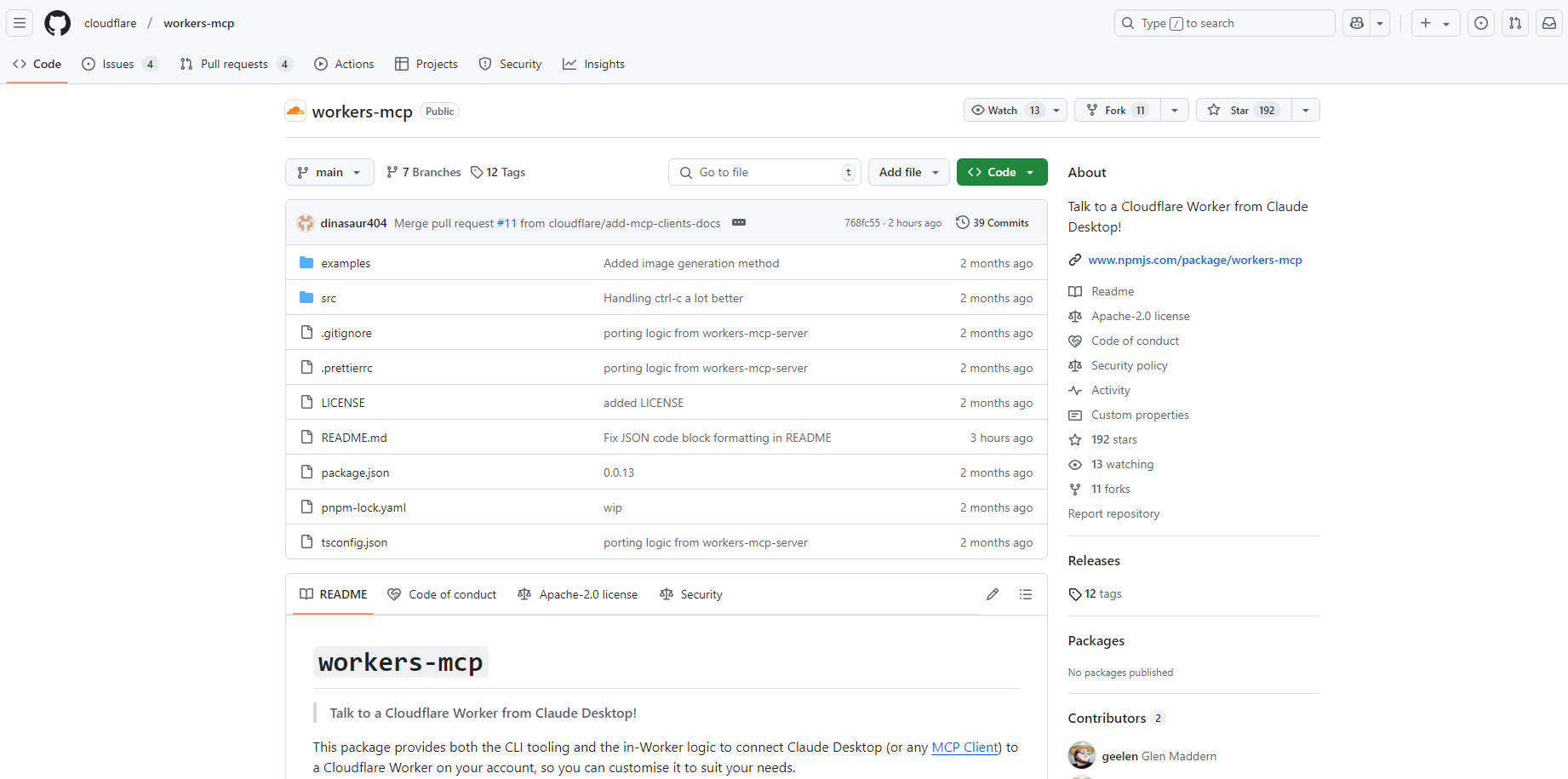
More information on Cloudflare Workers MCP
Launched
Pricing Model
Free
Starting Price
Global Rank
Follow
Month Visit
<5k
Tech used
Cloudflare Workers MCP was manually vetted by our editorial team and was first featured on 2025-02-28.
Related Searches
Cloudflare Workers MCP Alternatives
Load more Alternatives-

-

-

-

Supercharge your AI! Find MCP servers for Claude & more at mcp.so. Unlock data & tools. Explore the best MCP server directory now.
-
