

What is Grist?
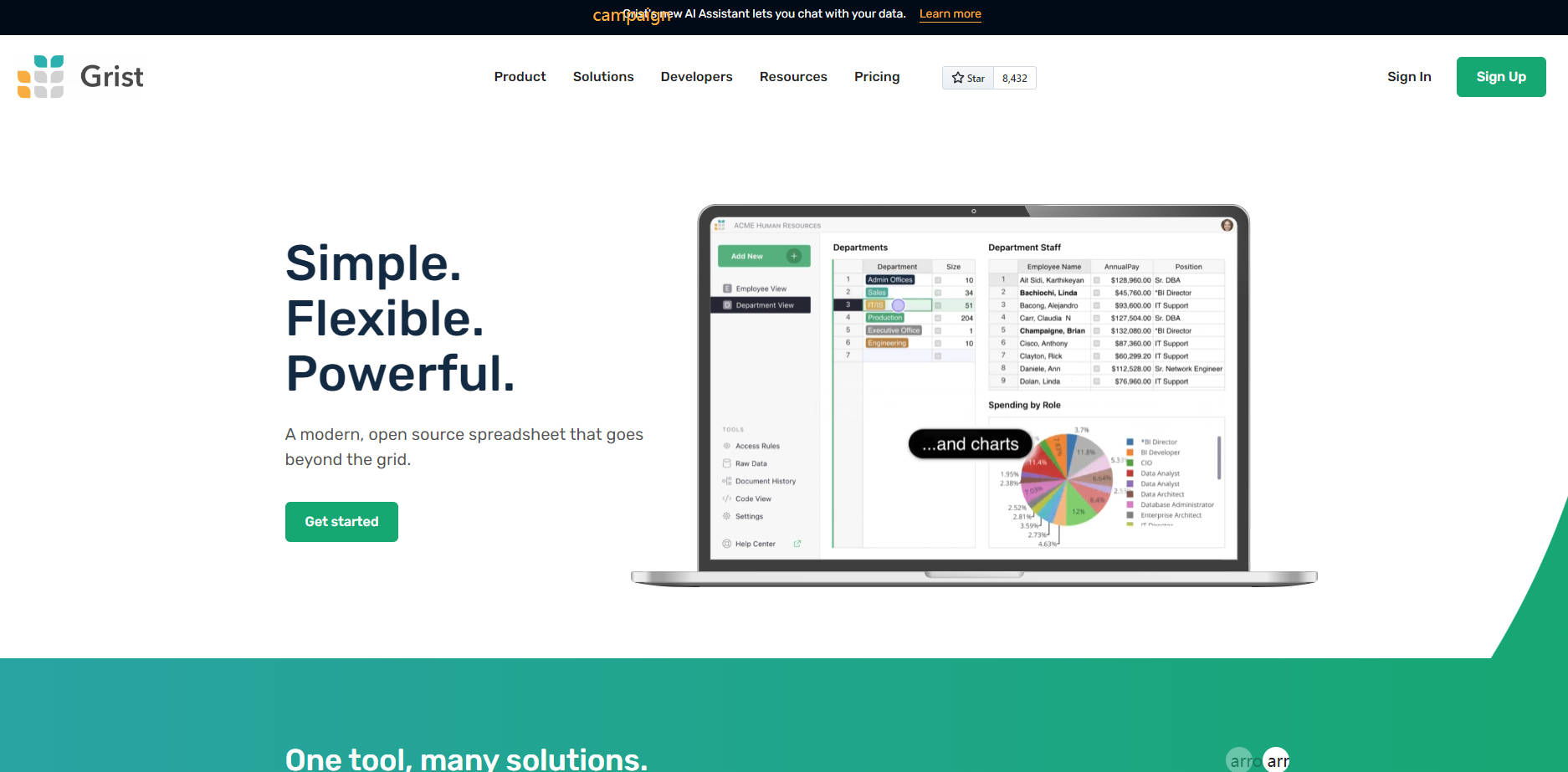
Traditional spreadsheets can become unwieldy as your data grows and relationships between information become complex. Grist transforms your data management by combining the familiar grid interface of a spreadsheet with the robust capabilities of a database. It's designed for anyone who needs to organize, analyze, and collaborate on data in a flexible, powerful, and intuitive way.
Key Features
📊 Relational Data Model: Unlike standard spreadsheets where data is isolated in cells, Grist lets you easily link different tables together. This means you can connect customers to orders, projects to tasks, or inventory to suppliers, creating a single, organized source of truth without repeating information.
🤖 Integrated AI Assistant: Chat directly with your data using the AI assistant. Ask questions in plain language, analyze formulas, and even create or modify records and formulas conversationally, leveraging the context of your document.
🖱️ Flexible Layouts & Linked Views: Arrange your data visually using drag-and-drop widgets. Display linked data from different tables side-by-side, turn rows into detailed data cards, and attach relevant files or images for a comprehensive view tailored to your workflow.
🔒 Granular Access Rules: Collaborate confidently with precise control over who sees what. Define permissions down to individual rows and columns, allowing you to share specific parts of your data with colleagues or external parties while keeping sensitive information secure, all within a single document.
🐍 Powerful Formulas: Go beyond standard spreadsheet functions. Grist supports familiar Excel formulas alongside the full power of Python syntax and its standard library, enabling sophisticated data manipulation, custom logic, and complex calculations directly within your cells.
How Grist Solves Your Problems
Are you struggling with disconnected spreadsheets, repetitive data entry, or limited collaboration? Grist offers a solution:
Manage Complex Projects & Clients: Instead of separate spreadsheets for clients, projects, and tasks, link them in Grist. See all tasks related to a client or all projects for a team member in one place, ensuring data consistency and easy navigation.
Streamline Data Collection & Analysis: Create simple forms to collect data (like survey responses or order requests) and automatically feed it into your structured Grist tables. Then, use visualizations like pivot tables and charts to analyze the data in real-time, gaining insights without manual consolidation.
Securely Share Information: Need to share project progress with a client but hide internal notes or budgets? Grist's access rules let you create limited views, sharing only the relevant columns and rows, ensuring data privacy and trust while still collaborating in real-time.
Why Choose Grist?
Grist provides a unique blend of accessibility and power. Its relational foundation solves common data organization headaches that traditional spreadsheets can't, while features like the AI assistant and Python formulas unlock advanced capabilities. As an open-source platform, Grist also offers flexibility and control, including the option for self-hosting for enhanced data ownership and compliance.
Conclusion
Grist is the evolution your data needs, offering the simplicity of a spreadsheet interface with the power and structure of a database. It helps you organize your data, your way, enabling more efficient workflows, deeper insights, and secure collaboration.
Explore how Grist can help you achieve better data management and unlock new possibilities.
More information on Grist
Launched
2014-05
Pricing Model
Freemium
Starting Price
$10 / user / mo
Global Rank
246990
Follow
Month Visit
144.6K
Tech used
Google Tag Manager,WordPress,jQuery,Gzip,HTTP/3,JSON Schema,OpenGraph,PHP,RSS,LiteSpeed Server
Top 5 Countries
28.94%
7.33%
5.54%
4.92%
3.46%
United States
France
Russia
Germany
United Kingdom
Traffic Sources
6.09%
1.2%
0.13%
9.67%
42.11%
40.8%
social
paidReferrals
mail
referrals
search
direct
Source: Similarweb (Sep 25, 2025)
Grist was manually vetted by our editorial team and was first featured on 2025-06-03.
Related Searches
Grist Alternatives
Load more Alternatives-

-
-

-

-

Gather is an AI Journal for teams. It automatically captures knowledge from various data sources, tracks everything from OKRs to meeting notes. With weekly AI recaps, built - in OpenAI o3 for chat, and easy capture from team members. Simple pricing, free for small teams to start. Try it in minutes!