
What is Haystack?
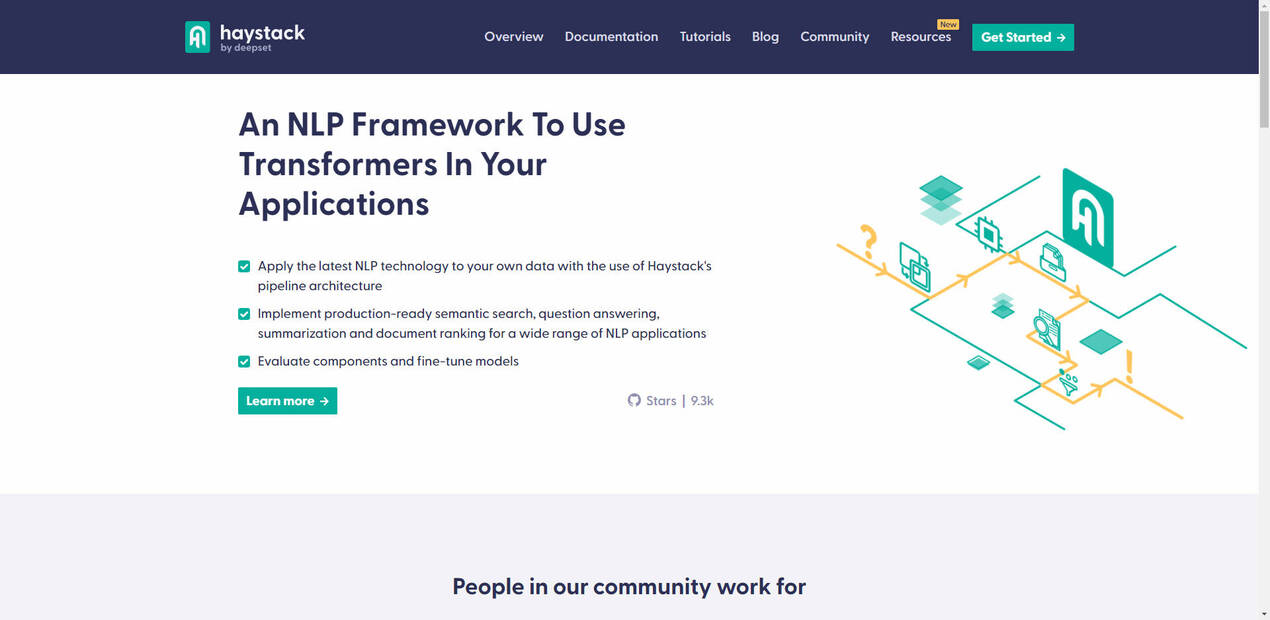
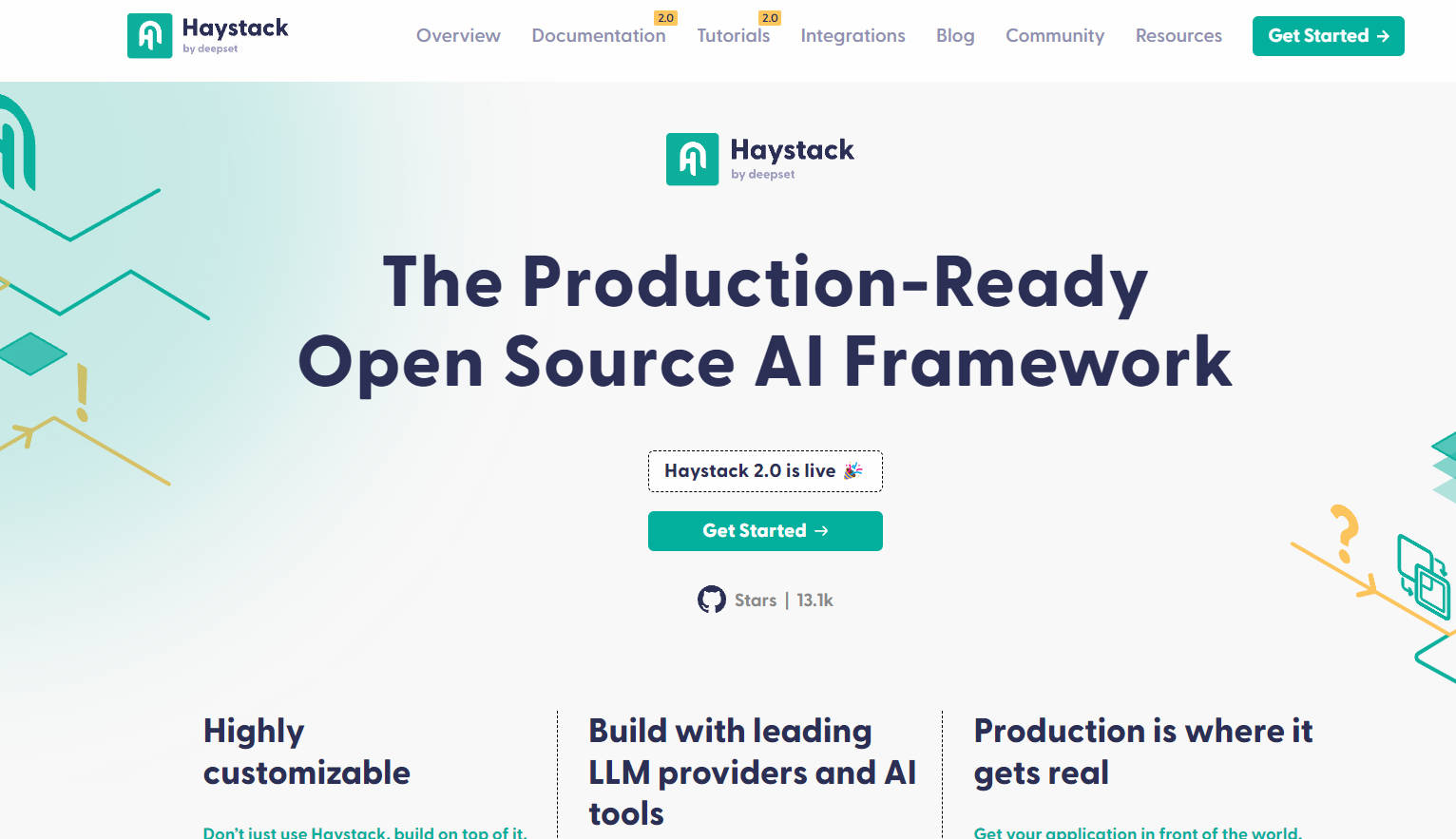
Haystack is an open-source AI orchestration framework designed for Python developers who need to build, customize, and deploy sophisticated, production-grade applications powered by Large Language Models (LLMs). It provides a complete and intuitive toolkit to connect all the necessary components—from models to vector databases—allowing you to move your ideas from a simple prototype to a scalable, real-world system with confidence and control.
Key Features
🧩 Modular Pipeline Architecture Haystack's core strength lies in its powerful and flexible pipeline system. You can visually or programmatically connect modular components like Retrievers, Generators, and Rankers to create custom data and logic flows. This explicit control allows you to design and debug complex systems with ease, whether you're building an advanced RAG workflow, a multi-step agent, or a custom text-processing sequence.
🔌 Technology-Agnostic & Extensible Avoid vendor lock-in and use the best tools for your specific job. Haystack is designed for seamless integration with a wide range of technologies. You can easily swap between models from providers like OpenAI, Cohere, and Hugging Face, or connect to your choice of vector databases. If a pre-built component doesn't fit your needs, the framework is fully extensible, allowing you to create custom components to integrate with any API or proprietary data source.
🚀 Production-Ready by Design Haystack is engineered to bridge the gap between experimentation and deployment. With built-in features for monitoring, logging, and evaluation, you gain full observability into your application's performance. When you're ready to go live, you can effortlessly serve your pipelines as robust REST APIs using integrations like Hayhooks, ensuring your application scales with your user base, not your complexity.
Use Cases
With Haystack, you can move beyond simple demos and build applications that solve real-world problems:
Advanced Retrieval-Augmented Generation (RAG): Build a sophisticated question-answering system that queries your company's internal knowledge base. When a user asks a question, a Haystack pipeline can retrieve the most relevant sections from thousands of documents, then use an LLM to synthesize a precise, context-aware answer, complete with source citations.
Intelligent Semantic Search: Power a search engine for a technical documentation site or a legal case database. Instead of relying on keywords, Haystack enables semantic search that understands the intent behind a query. A user can ask a complex question in natural language, and the system will retrieve documents based on their conceptual meaning, delivering far more accurate and relevant results.
Complex Conversational Agents: Create autonomous agents that can execute multi-step tasks. For example, you could build a customer support agent that not only answers questions but also interacts with multiple internal tools—like a CRM and a knowledge base—to resolve a complex support ticket without human intervention.
Why Choose Haystack?
A Clear Path from Prototype to Production: Many tools are great for experimentation in a notebook but falter when it's time to deploy. Haystack is built differently. Its robust architecture, careful dependency management, and easy-to-deploy API servers provide a reliable and scalable foundation, ensuring the application you prototype is the one you can confidently ship.
Unmatched Flexibility and Control: Haystack gives you full control over your LLM stack. Its modular, technology-agnostic design means you're never forced into a specific model, database, or architecture. You have the freedom to compose, customize, and extend every part of your application to meet your exact requirements.
Conclusion:
Haystack is the definitive framework for developers serious about building reliable, powerful, and scalable LLM-powered applications. By providing a flexible, production-focused toolkit, it empowers you to orchestrate state-of-the-art models and data sources into intelligent systems that deliver tangible value.
More information on Haystack
Launched
2018-03
Pricing Model
Free
Starting Price
Global Rank
Follow
Month Visit
59.8K
Tech used
Google Tag Manager,Hugo,Vercel,HSTS
Top 5 Countries
19.7%
12.08%
11.39%
5.31%
5.05%
United States
Germany
India
United Kingdom
Nigeria
Traffic Sources
3.26%
0.92%
0.1%
9.36%
49.58%
36.72%
social
paidReferrals
mail
referrals
search
direct
Source: Similarweb (Sep 24, 2025)
Haystack was manually vetted by our editorial team and was first featured on 2023-06-30.
Related Searches