

Click outside to close
What is Nextnet?
Navigating the vast and fragmented world of biomedical information consumes precious time, often pulling you away from the core task of research and discovery. Finding relevant papers, connecting disparate data points, and ensuring the accuracy of AI-generated insights can feel like a constant uphill battle.
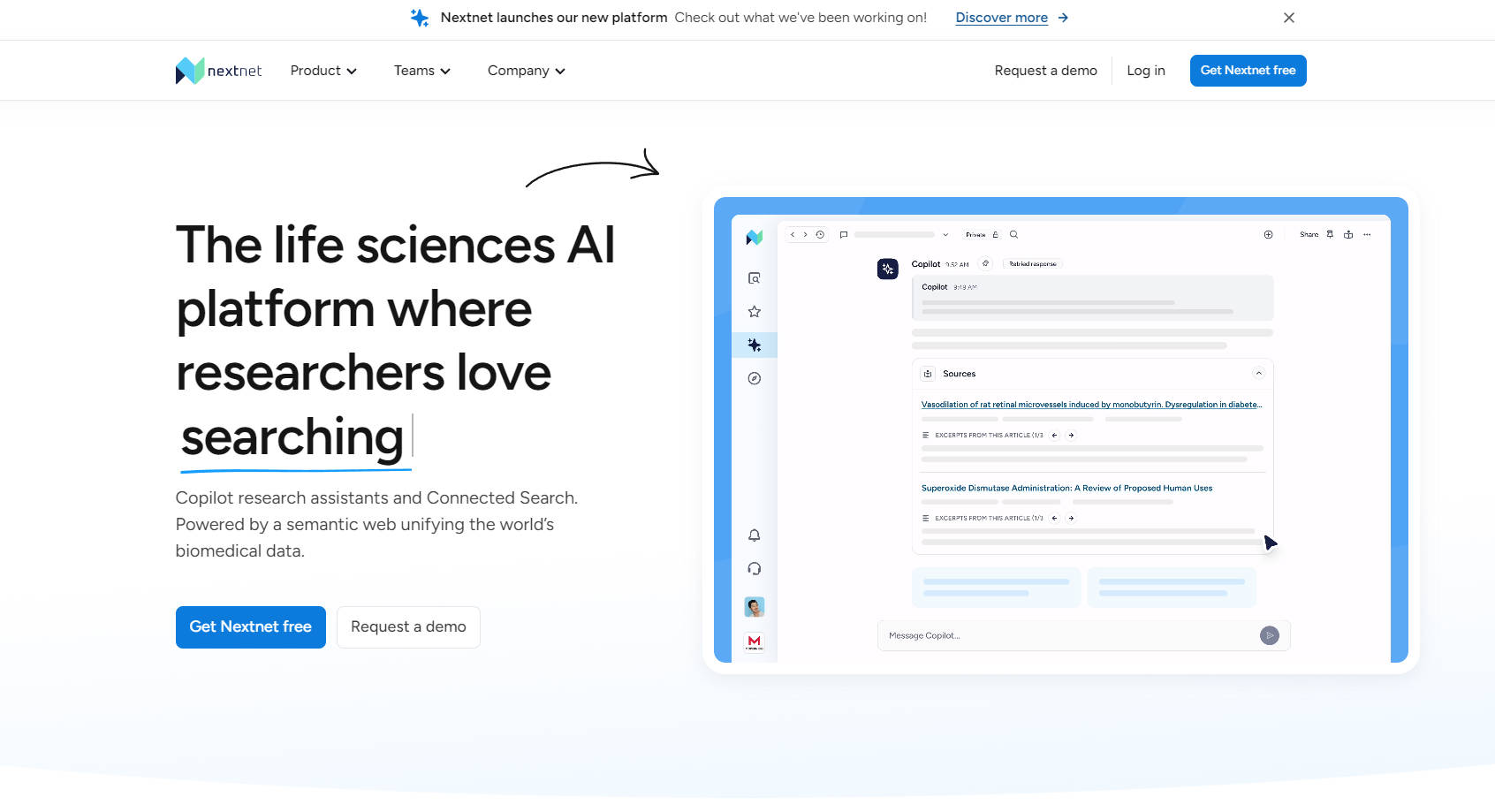
Nextnet offers a unified AI platform specifically designed for life sciences researchers like you. It integrates powerful AI assistance with comprehensive, connected data exploration, helping you work faster and uncover deeper insights. Think of it as your specialized research partner, built on a massive semantic web that links together the world's biomedical knowledge from trusted sources.
Key Features: Your Research Toolkit, Enhanced
Nextnet Copilot:
💡 Receive AI-generated answers grounded in science. Copilot provides responses sourced directly from verified literature and data (like PubMed, ChEMBL, Ensembl) within Nextnet's semantic web, significantly reducing the risk of hallucinations found in general AI tools.
🎯 Pinpoint relevant papers and excerpts quickly. Copilot doesn't just give you an answer; it links directly to specific text passages and data points within the source documents, allowing you to evaluate evidence efficiently and curate key findings.
⏱️ Focus your reading time effectively. By surfacing only the most relevant science connected to your query, Copilot helps you cut through the noise and dedicate your time to analyzing impactful papers.
Nextnet Explorer:
🗺️ Visualize complex scientific connections. Go beyond simple search results. Explorer maps out relationships between literature, genes, drugs, targets, pathways, diseases, institutions, and authors, revealing patterns and insights you might not have found otherwise.
📚 Access multiple databases through one interface. Search across integrated and continuously updated sources without constantly switching between different tools, saving valuable research time and effort.
🤝 Share discoveries and collaborate easily. Share specific insights, visual maps, or curated lists with colleagues or external partners directly within Nextnet, fostering teamwork and accelerating project iterations.
How Researchers Use Nextnet
Kickstarting a New Project: You're exploring a potential new drug target. Instead of spending days sifting through hundreds of papers manually, you ask Nextnet Copilot about the target's known interactions, associated pathways, and recent relevant studies. Copilot returns a concise summary with direct links to key papers and supporting data points from sources like Ensembl and PubMed, giving you a solid, evidence-based foundation in minutes.
Uncovering Hidden Connections: While investigating a specific gene using Copilot, you identify several key papers. You send these curated findings to Nextnet Explorer to visualize their connections. The interactive map reveals unexpected links between your gene, a specific metabolic pathway, and a less-common disease phenotype – connections that weren't obvious from reading the papers in isolation, opening up a novel research direction.
Preparing for Team Review: Your team needs to evaluate several potential therapeutic approaches. Using Explorer, you map out each approach, linking supporting evidence, relevant clinical trial data (coming soon), and associated drug information from ChEMBL. You then share this interactive map and a curated list of source papers directly through Nextnet, allowing collaborators to review the findings, add comments, and discuss efficiently before the meeting.
Your Partner in Scientific Advancement
Nextnet is designed to streamline your research by replacing fragmented tools and time-consuming manual searches with an integrated, AI-powered platform. With Copilot, you get reliable, evidence-backed answers quickly. With Explorer, you uncover deeper connections through intuitive visualizations. The platform facilitates collaboration and ensures you're working with verified information drawn from a unified knowledge base. It empowers you to spend less time searching and more time focused on what truly matters: advancing scientific discovery.
Ready to see how Nextnet can support your work?
Frequently Asked Questions (FAQ)
Q1: How is Nextnet Copilot different from ChatGPT or other general AI tools? A: While built using advanced AI like general tools, Nextnet Copilot is purpose-built for life sciences. Its key differentiator is its foundation: it draws answers exclusively from Nextnet's dedicated semantic web of verified biomedical data and literature (like PubMed, ChEMBL, etc.). This focus, combined with specific AI guardrails, dramatically reduces the risk of "hallucinations" and ensures answers are scientifically relevant and evidence-backed, unlike general AI tools trained on the broader internet.
Q2: What specific data sources does Nextnet integrate? A: Nextnet unifies data from numerous critical life science sources into its semantic web. Key examples include PubMed for literature, ChEMBL for drug information, Google Scholar for broader academic papers, and Ensembl for genomic data. The platform continuously expands its integrations, with patents, clinical trials, and grants planned soon. The goal is to provide a single access point to this diverse information.
Q3: Can I share my findings from Nextnet with collaborators outside my immediate team or organization? A: Yes. Nextnet includes features for collaboration, allowing you to share specific findings, curated lists, or interactive Explorer maps with external partners or colleagues using guest access permissions, facilitating broader scientific discussion and teamwork.
Q4: How does Nextnet Explorer visualize connections? A: Explorer uses interactive mapping technology built upon the knowledge graph structure of the semantic web. When you search or analyze entities (like a gene or drug), it displays them as nodes and shows the relationships (e.g., 'inhibits', 'associated with', 'published by') between them as connecting lines. You can explore this map visually, clicking on nodes to see detailed information and discover related concepts. You can also switch to a traditional list view if preferred.
More information on Nextnet
Top 5 Countries
48.77%
31.64%
19.59%
United States (48.77%)
Indonesia (31.64%)
Turkey (19.59%)
Traffic Sources
5.43%
17.13%
59.48%
17.38%
social (5.43%)
paidReferrals (0.54%)
mail (0.03%)
referrals (17.13%)
search (59.48%)
direct (17.38%)
Source: Similarweb (Sep 25, 2025)
Nextnet was manually vetted by our editorial team and was first featured on 2025-04-01.
Nextnet Alternatives
Nextnet Alternatives-
Visualize life science research data with Minicule AI knowledge graphs. Uncover hidden connections & accelerate discovery from publications, patents & your data.
-

We are revolutionising drug discovery and development with agentic AI that can answer queries, analyse data and perform complex tasks, elevating innovation.
-

DecipherIt AI: Unlock research insights. Analyze docs/web, bypass access, get audio/visual summaries for students & pros.
-
Noah AI: Specialized AI for life science. Automate complex research, get trusted insights, and turn weeks of work into minutes.
-

SciMaster: Your AI research assistant. Synthesize 1.7 billion scientific papers & web data for clear, verifiable answers and deep insights.