

Click outside to close
What is RolmOCR?
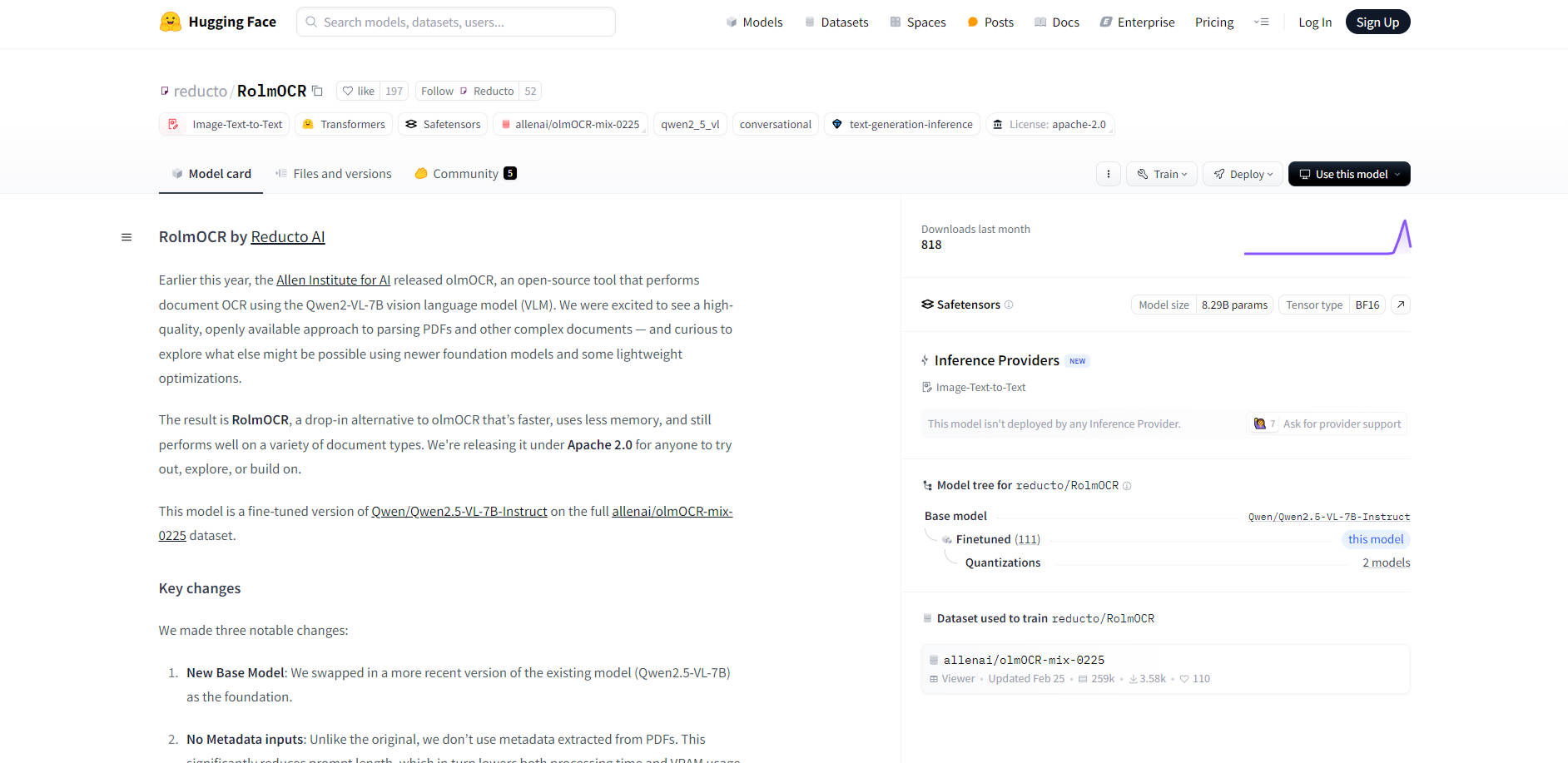
Extracting text accurately from images and PDFs is fundamental for countless development projects and research initiatives. If you're seeking an efficient and adaptable Optical Character Recognition (OCR) solution, RolmOCR presents a compelling open-source option. Developed by the Reducto AI team, RolmOCR leverages the powerful Qwen2.5-VL-7B vision language model to deliver high-quality text extraction. It's engineered to be faster and require less memory than comparable tools like olmOCR, offering a practical advantage for developers and researchers working with document digitization.
Key Features
⚡️ Extract Text Rapidly: Process images and PDF files quickly. RolmOCR is optimized for speed, making it suitable for handling substantial volumes of documents without significant delays.
📄 Handle Diverse Document Types: Reliably recognize text across various formats. Whether you're working with standard printed documents, scanned handwritten notes, or complex tables within academic papers, RolmOCR adapts to the content.
🧠 Operate with Lower Memory Footprint: Run OCR tasks more efficiently. By eliminating the need for PDF metadata inputs and leveraging model optimizations, RolmOCR consumes less VRAM compared to olmOCR, easing resource constraints.
📐 Improve Tilted Document Recognition: Achieve better results from imperfect scans. RolmOCR includes enhanced robustness for documents captured at an angle, thanks to specific rotation augmentations (applied to 15%) during its training phase.
🔓 Utilize Open-Source Flexibility: Integrate and adapt RolmOCR freely. Released under the permissive Apache 2.0 license, you can download the code, modify it for your specific needs, and incorporate it into your applications without licensing fees.
🔗 Simplify Processing via Direct Analysis: Work directly with document content. RolmOCR processes the visual information from images or PDFs without depending on external metadata, streamlining the extraction pipeline.
⬆️ Leverage an Up-to-Date Foundation: Benefit from recent advancements in AI. RolmOCR is fine-tuned from Qwen2.5-VL-7B-Instruct, a contemporary vision language model, contributing to its accuracy and efficiency.
Use Cases
Bulk Document Digitization: Imagine you have a large digital archive of scanned historical records, research papers, or internal reports stored as images or PDFs. You can implement RolmOCR in a batch processing script to automatically extract the text content, making the entire archive searchable and ready for analysis or data mining. Its speed and efficiency are particularly beneficial here.
Integrating OCR into Custom Applications: You might be developing a tool that needs to ingest user-uploaded documents – perhaps receipts for expense tracking or forms for data entry. By hosting RolmOCR (e.g., using vLLM as suggested) and calling its API, you can seamlessly embed powerful text extraction capabilities directly within your application's workflow, offering added value to your users.
Research and Data Extraction Projects: Suppose your research involves analyzing text from varied sources, such as photographs of conference posters, scans of handwritten lab notebooks, and complex multi-column PDF articles. RolmOCR’s ability to handle these different formats allows you to use a consistent, open-source tool across your data pipeline, simplifying development and ensuring reproducibility.
Conclusion
RolmOCR provides a practical, efficient, and open-source solution for developers and researchers needing reliable text extraction. Its advantages in speed, lower memory usage, and ability to handle diverse and even tilted documents, all built upon a modern VLM and free from metadata dependencies, make it a strong contender for your OCR toolkit. Under the Apache 2.0 license, it offers the freedom to innovate and integrate. Consider exploring RolmOCR for your next project involving document understanding.
More information on RolmOCR
Launched
Pricing Model
Free
Starting Price
Global Rank
Follow
Month Visit
<5k
RolmOCR was manually vetted by our editorial team and was first featured on 2025-04-08.
RolmOCR Alternatives
RolmOCR Alternatives-

Unlock document data with Mistral OCR! Fast, accurate API extracts text, tables, equations & more. Multilingual support.
-

Rowfill, an open - source platform, simplifies document processing. Extract data effortlessly from PDFs, images, audio & video. Create custom workflows, ensure privacy. Ideal for research, business, content mgmt. Free to use. Click to streamline your document handling.
-
Unlock text from images globally! EasyOCR is a Python library for accurate multilingual OCR in 80+ languages & complex scripts. Simple, powerful, deep learning.
-

PaddleOCR converts complex documents & images into structured, AI-ready data. Power LLMs & RAG with SOTA multilingual OCR (109 langs) & high accuracy.
-
Boost LLM efficiency with DeepSeek-OCR. Compress visual documents 10x with 97% accuracy. Process vast data for AI training & enterprise digitization.