
What is Supavec?
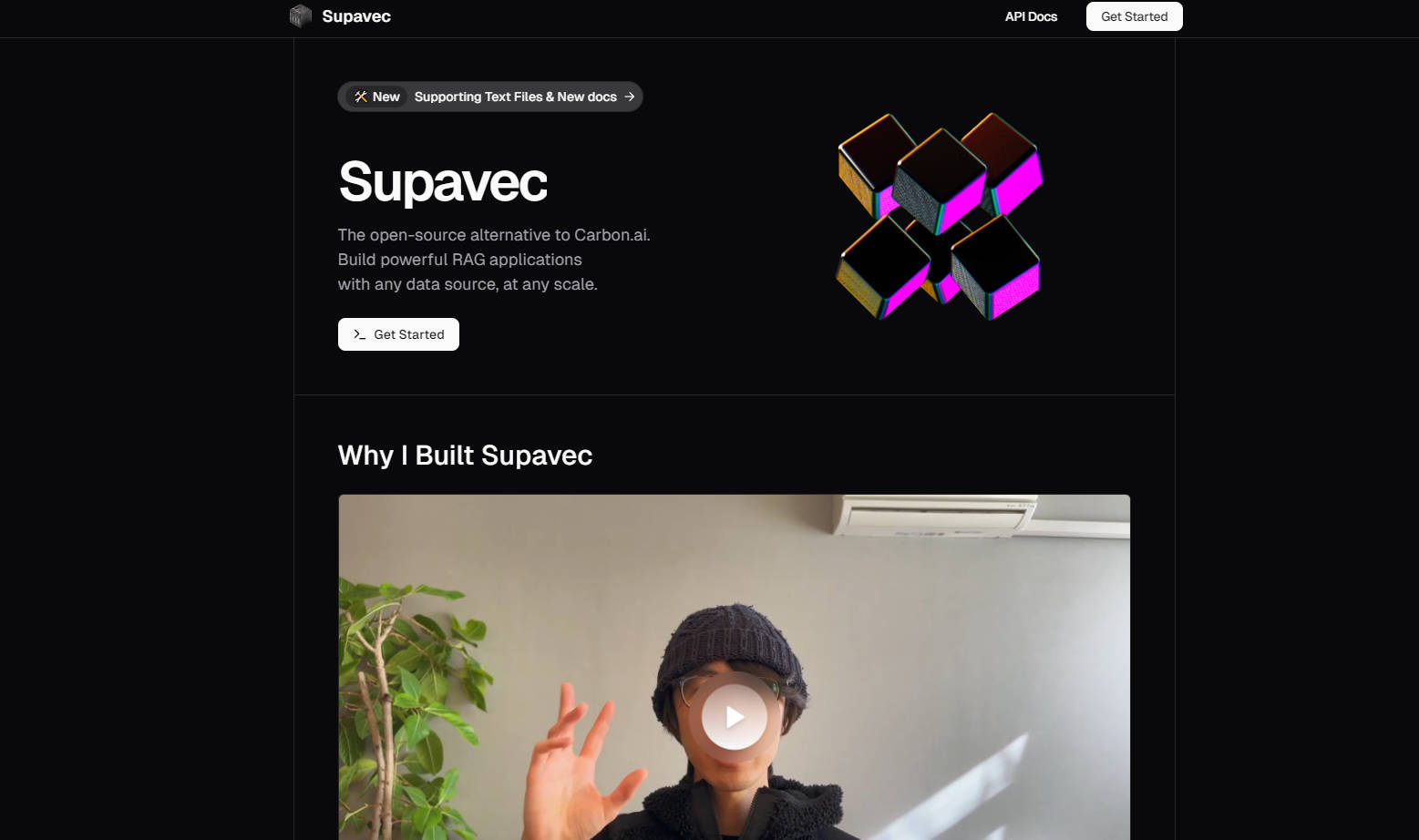
Supavec is the open-source RAG (Retrieval-Augmented Generation) infrastructure designed to give you full control over your AI-powered applications. Imagine building a customer support chatbot that instantly answers queries from your knowledge base, or creating an internal search engine that unlocks the wealth of information hidden in your company documents. Supavec makes this possible, and more, with the flexibility and transparency of open source.
Key Features that Empower Your AI Development:
🔓 Open Source Freedom & Control: Tired of vendor lock-in? Supavec offers the ultimate flexibility. Choose our cloud version for convenience or self-host on your own infrastructure. Being fully open source under the MIT license, you have the freedom to adapt, modify, and truly own your RAG infrastructure – unlike proprietary solutions.
🛡️ Enterprise-Grade Privacy & Security: Data security is paramount. Supavec is built with Supabase Row Level Security (RLS), ensuring your sensitive data remains private and secure within your infrastructure. Gain granular access control and peace of mind knowing you are in charge of your data's security.
🚀 Built for Massive Scale & Performance: Don't let data volume limit your AI ambitions. Supavec is engineered to handle millions of documents, process files of any size, and support concurrent processing. Built on robust technologies like Supabase, Next.js, and TypeScript, Supavec scales horizontally to meet the demands of your growing applications.
🧑💻 Developer-First & Easy to Integrate: We understand the importance of developer experience. Supavec provides a simple API, comprehensive documentation, and a quick setup with a modern tech stack. Integrate Supavec seamlessly into your existing workflows and start building powerful RAG applications without a steep learning curve.
Use Cases: Unlock the Potential of RAG with Supavec
Boost Customer Support Efficiency: Imagine your customer support team instantly accessing accurate answers to complex queries directly from your product documentation and help articles. With Supavec, you can build a smart support chatbot that uses RAG to provide context-aware solutions, reducing response times and improving customer satisfaction. No more generic answers – just precise information derived from your own knowledge base.
Empower Internal Knowledge Sharing: Is critical company knowledge buried in countless documents and scattered across different drives? Supavec can power an internal knowledge base that acts like a company-wide search engine for information. Employees can ask questions in natural language and receive accurate answers sourced directly from internal documents, fostering collaboration and boosting productivity.
Enhance Document Analysis & Insights: Need to quickly extract key insights from large volumes of reports, research papers, or legal documents? Supavec enables you to build intelligent document analysis tools that use RAG to understand context and provide summaries, identify trends, or answer specific questions based on document content. Transform raw data into actionable intelligence efficiently.
Conclusion: Take Control of Your AI Future with Supavec
Supavec isn't just another RAG tool; it's an open-source foundation for building powerful, private, and scalable AI applications. By choosing Supavec, you gain the freedom of open source, the security of enterprise-grade architecture, and the scalability to handle any data challenge. Start building smarter, data-driven applications today with Supavec.
Frequently Asked Questions (FAQ):
What exactly is RAG (Retrieval-Augmented Generation)? RAG enhances AI responses by grounding them in your own documents. Instead of relying solely on the AI's general knowledge, RAG first searches your documents for relevant information and then uses this context to generate more accurate and context-aware answers.
What does "open source" mean for Supavec? Being open source means Supavec's code is publicly accessible and available for you to inspect, modify, and distribute. This provides transparency, community support, and freedom from vendor lock-in.
How does Supavec ensure data privacy? Supavec leverages Supabase Row Level Security (RLS) to provide granular access control and ensure that your data remains secure within your chosen infrastructure. You control who has access to what data.
More information on Supavec
Launched
2024-12
Pricing Model
Free
Starting Price
Global Rank
9857076
Follow
Month Visit
<5k
Tech used
Next.js,Vercel,Gzip,OpenGraph,Webpack,HSTS
Top 5 Countries
100%
India
Traffic Sources
3.39%
1.91%
0.06%
44.68%
15.49%
34.47%
social
paidReferrals
mail
referrals
search
direct
Source: Similarweb (Sep 25, 2025)
Supavec was manually vetted by our editorial team and was first featured on 2025-02-16.
Related Searches
Supavec Alternatives
Load more Alternatives-
-

-

Superexpert.AI: Open source platform for developers. Build flexible AI agents easily with no code, custom tools, RAG. Get full control and deploy anywhere.
-

Supametas.AI: Effortlessly convert messy, unstructured data into clean, structured formats for seamless LLM integration. Simplify AI workflows—start today!
-