

What is Twigg?
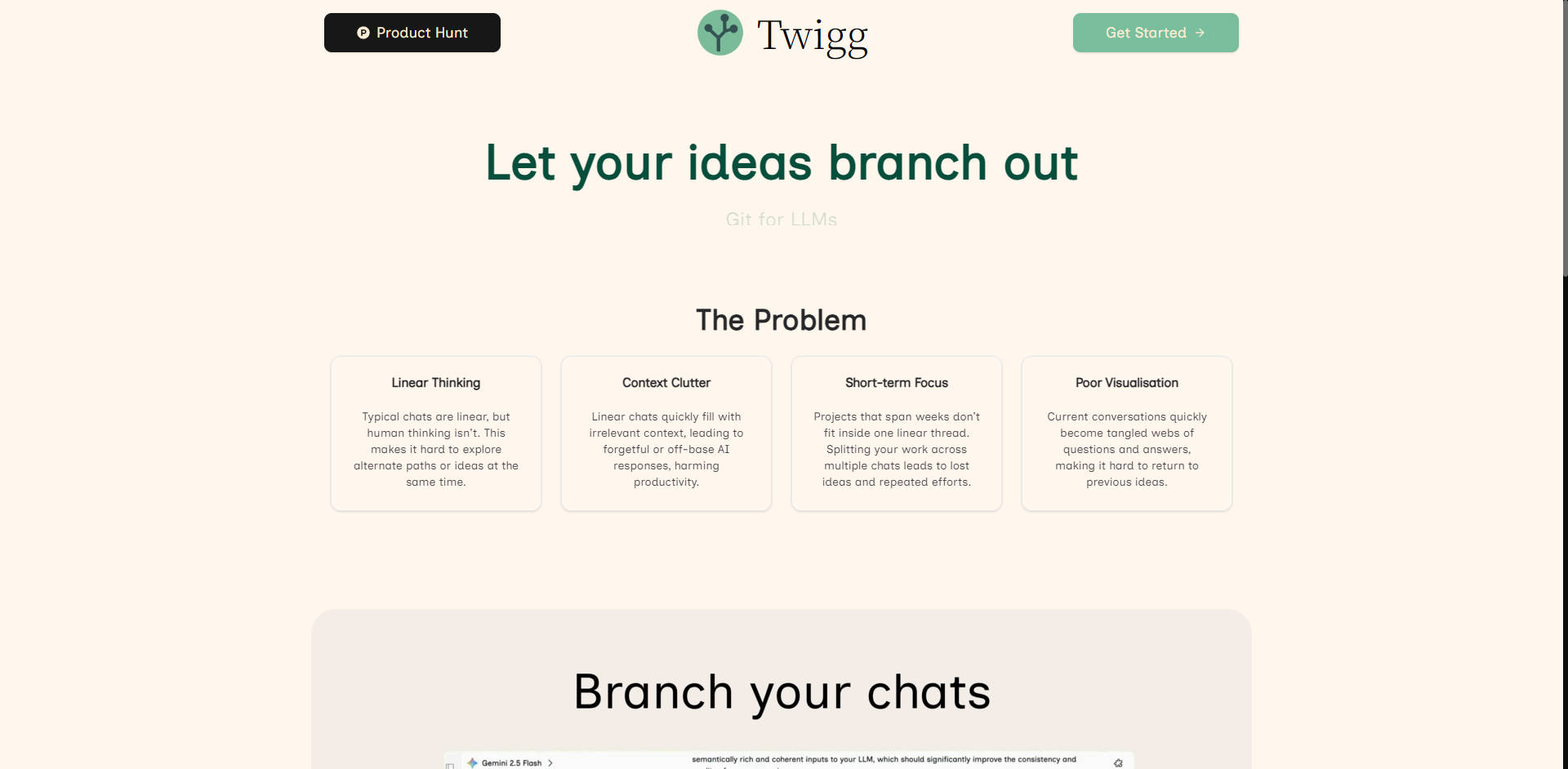
Linear chat interfaces often fail when managing complex, long-term AI projects, causing crucial ideas to get lost, context to be repeated, and workflows to become tangled. Twigg reframes your LLM interaction, treating your conversation not as a flat timeline, but as a dynamic, living tree of ideas. It provides individuals and teams a structured, visual, and highly efficient platform for complex projects, enabling precise context control, reducing redundant work, and maximizing the value of your LLM interactions.
Key Features
Twigg is built around the principle of non-linear interaction, offering the structural tools necessary to manage complexity and maintain clarity across extensive projects.
🌲 Interactive Tree Visualization
Visualize your entire project history and all exploratory paths instantly with an interactive tree diagram. This feature acts like version control for your LLM interactions, allowing you to quickly navigate back to any point, understand the evolution of an idea, and ensure you never lose valuable context from previous iterations.
✂️ Branch Any Chat Effortlessly
Instantly create a new branch from any node in your conversation tree. This capability allows you to explore tangents, test alternative prompts, or refine specific concepts without cluttering the context of your main working thread. You maintain a clean, focused mainline while simultaneously pursuing parallel lines of inquiry.
🧠 Precise Context Management
Gain complete control over the information fed back into the language model. You can manipulate the tree structure—moving, deleting, or selecting specific nodes and branches—to define the exact context for your next prompt. This precision ensures the LLM receives only the most relevant data, leading to higher quality outputs and significantly reducing unnecessary token expenditure.
🗓️ Built for Long-Term Project Persistence
Say goodbye to restarting chats and manually copying context across multiple sessions. Twigg sustains one structured tree for your entire project, regardless of duration. As you refine ideas and gather relevant information, your tree grows with the project, continually accumulating and improving the critical context needed for success.
Use Cases
Twigg transforms how individuals and teams approach complex, ongoing AI-driven tasks, ensuring efficiency and clarity at every step.
1. Developing Complex Architectures or Research Reports
When tackling projects that span weeks—such as drafting a comprehensive software architecture or synthesizing a detailed market research report—you inevitably explore multiple paths and discard early concepts. Twigg allows you to branch off to test different structural approaches or research angles, ensuring that only the validated, successful context branches are maintained and fed back into the final synthesis, leading to a coherent and focused final output.
2. Collaborative Strategy Refinement
For teams, Twigg facilitates parallel collaboration. A marketing team, for instance, can use a central tree for a new campaign strategy. One member can branch off to test messaging for a specific demographic, while another explores budget allocation strategies. All work remains structured, visible, and easily merged back into the main strategy when ready, eliminating the confusion common in standard, shared chat logs.
Conclusion
Twigg solves the fundamental challenge of managing complexity in LLM collaboration. By providing a structured, visual, and efficient environment with unparalleled context control, it ensures that your ideas remain organized, your work is precise, and your long-term projects are built on a solid foundation of clear, curated history.
Explore how Twigg transforms complex LLM workflows and helps you build better things with AI.
More information on Twigg
Launched
2025-07
Pricing Model
Freemium
Starting Price
Global Rank
Follow
Month Visit
<5k
Tech used
Twigg was manually vetted by our editorial team and was first featured on 2025-10-24.
Twigg Alternatives
Load more Alternatives-

-
-

Transform ideas into live apps & websites with Trickle AI. Build & launch functional digital products using visual AI co-creation, no code.
-

Claude-Mem seamlessly preserves context across sessions by automatically capturing tool usage observations, generating semantic summaries, and making them available to future sessions. This enables Claude to maintain continuity of knowledge about projects even after sessions end or reconnect.
-

ContextChat is a platform that helps you unlock the power of your information. It allows you to ingest content from various sources, including websites, files, and GitHub repositories, and transforms it into a knowledge base for AI-powered conversations and content extraction.