

Click outside to close
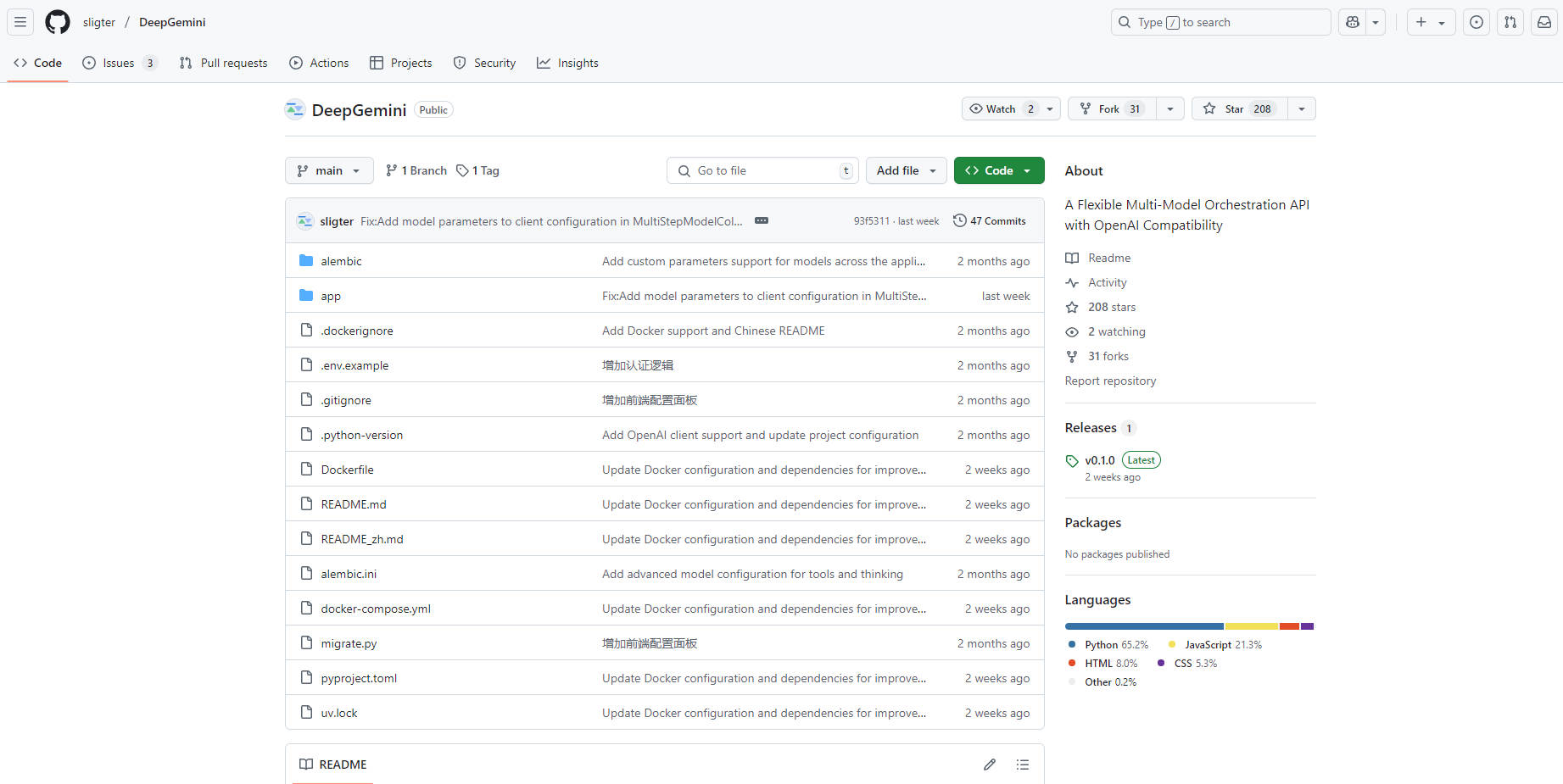
What is DeepGemini?
Unlock the combined power of diverse AI models through a single, unified interface. DeepGemini is an open-source tool designed for developers and AI enthusiasts who need to seamlessly integrate and manage multiple AI providers and models within their applications. Built with Python and FastAPI, it offers a robust platform for creating sophisticated AI workflows while maintaining compatibility with existing OpenAI integrations.
At its core, DeepGemini addresses the challenge of leveraging the unique strengths of different AI models without the complexity of managing multiple APIs and configurations. You gain the flexibility to choose the best model for specific tasks – perhaps one for intricate reasoning and another for nuanced text generation – and orchestrate their interactions effortlessly.
Key Features
✨ Multi-Model Orchestration: Define custom workflows that chain multiple AI models together. Route requests dynamically based on task requirements, allowing you to combine the strengths of different AI architectures (e.g., use DeepSeek for reasoning followed by Claude for generation).
🔌 Broad Provider Support: Integrate seamlessly with a variety of leading AI providers including DeepSeek, Claude, Gemini, Grok, OpenAI, and platforms like OneAPI, OpenRouter, and Siliconflow. Avoid vendor lock-in and switch providers as needed.
🔄 OpenAI Compatible API: Utilize DeepGemini as a drop-in replacement for the standard OpenAI API. Point your existing applications to the DeepGemini endpoint (
/openai/v1/chat/completions) with minimal code changes to instantly access its multi-model capabilities.🤖 Role Management & Discussion Groups: Create distinct AI "roles" with specific system prompts, configurations, and assigned models. Combine these roles into Discussion Groups to simulate complex interactions using various modes like Brainstorming, Debate, SWOT Analysis, or Six Thinking Hats.
🔗 Relay Chain Configuration: Design multi-step AI processes. Define distinct "Reasoning" and "Execution" steps, potentially using different models or configurations for each stage of a task, enabling more complex problem-solving pipelines.
⚡ Stream Support: Enable real-time streaming responses from compatible models directly through the DeepGemini API, providing a more interactive experience for end-users in applications like chatbots.
⚙️ Advanced Configuration: Exercise fine-grained control over model parameters (like temperature, top_p) and system prompts for each configured model or role directly through the web interface or environment variables.
🖥️ Web Management UI: Access a built-in web interface (
/dashboard) for intuitive management of AI providers, model configurations, roles, and discussion groups. Monitor system status and manage API keys.💾 Database Integration: Configurations are stored persistently in a SQLite database, with Alembic handling schema migrations for easier updates and maintenance.
🐳 Docker Deployment: Easily deploy DeepGemini using Docker or Docker Compose, ensuring a consistent and isolated environment. Pre-built images are available for quick setup.
🌐 Multi-language Support: The web interface is available in both English and Chinese.
Use Cases
Seamless Model Upgrades: Your application currently uses OpenAI's GPT-3.5. You want to test Anthropic's Claude model for a specific text generation task without rewriting your API integration logic. Configure Claude within DeepGemini and simply redirect your application's API calls to the DeepGemini endpoint. You can switch between models via configuration, not code changes.
Building a Specialized Research Agent: Create a Relay Chain where the first step uses a model optimized for information retrieval and analysis (e.g., Gemini configured for reasoning) to process research papers, and the second step uses a different model strong in summarization and report writing (e.g., Claude) to generate a concise summary based on the first step's output.
Simulating Multi-Perspective Analysis: Set up a Discussion Group for a "Debate" on a new feature proposal. Create AI roles representing different stakeholders (e.g., 'Optimistic Engineer', 'Cautious Product Manager', 'User Advocate'), each configured with distinct system prompts and potentially different underlying models. Initiate a debate through the API to gather diverse viewpoints automatically.
Conclusion
DeepGemini empowers you to move beyond single-model limitations. It offers a flexible, developer-friendly, and open-source solution for orchestrating multiple AI models through a unified, OpenAI-compatible API. Whether you're integrating diverse AI capabilities into existing applications, experimenting with complex AI workflows, or seeking greater control over your AI stack, DeepGemini provides the tools you need to build more sophisticated and adaptable AI-powered solutions. Its straightforward setup and web UI make managing complex configurations accessible.
More information on DeepGemini
Launched
Pricing Model
Free
Starting Price
Global Rank
Follow
Month Visit
<5k
DeepGemini was manually vetted by our editorial team and was first featured on 2025-04-01.
DeepGemini Alternatives
DeepGemini Alternatives-
Discover Gemini, Google's advanced AI model designed to revolutionize AI interactions. With multimodal capabilities, sophisticated reasoning, and advanced coding abilities, Gemini empowers researchers, educators, and developers to uncover knowledge, simplify complex subjects, and generate high-quality code. Explore the potential and possibilities of Gemini as it transforms industries worldwide.
-

Stop worrying about Gemini API limits & failures. Gemini Balance provides smart load balancing, resilience, and OpenAI compatibility.
-

MultitaskAI is a powerful browser-based chat interface that transforms how you interact with AI. Connect directly to leading models from OpenAI, Anthropic, and Google using your own API keys—ensuring complete privacy and control over your data.
-

Gemini Robotics: Discover adaptable AI robots powered by Gemini. Intelligent & versatile for homes, factories, and beyond. The future is here!
-

Gemini CLI: Get AI power right in your terminal. Open-source agent for developers. Enhance coding, research, & automation workflows.