
What is MiniMind?
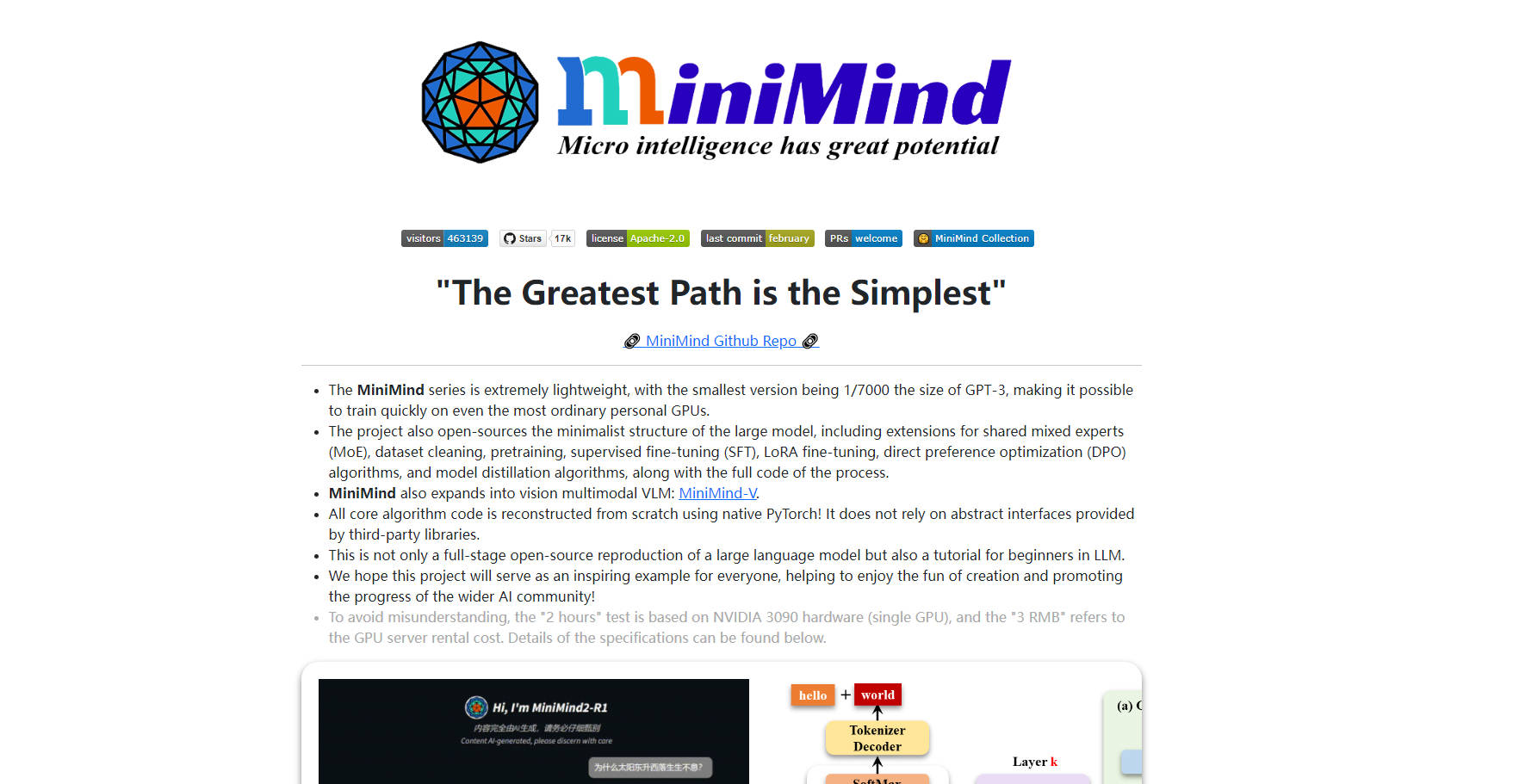
Ever felt the buzz around Large Language Models (LLMs) like ChatGPT, but found the idea of training your own completely out of reach? The immense scale, cost, and complexity often create a barrier, while high-level toolkits, though convenient, can feel like a "black box," hiding the fascinating details underneath.
MiniMind is here to change that. Created by developer jingyaogong, this open-source project puts the power of AI model creation directly into your hands. Imagine training a capable 26 million parameter GPT-style model entirely from scratch, not just fine-tuning someone else's work. Now imagine doing it in about 2 hours on a single NVIDIA 3090 GPU, for a server rental cost of roughly 3 RMB (less than $0.50 USD). That's the core idea behind MiniMind – making foundational AI model training accessible to everyone. It's not just a tool; it's your hands-on guide to understanding the entire LLM lifecycle, from raw data to a working model.
Key Features
🚀 Achieve Ultra-Low Cost & Fast Training: Go from zero to a trained 26M parameter model in approximately 2 hours for about 3 RMB on a single NVIDIA 3090. This dramatically lowers the barrier to entry for hands-on LLM experimentation.
📚 Master the Full LLM Workflow: MiniMind provides open-source code for the entire process: dataset cleaning, tokenizer training, pretraining, supervised fine-tuning (SFT), LoRA adaptation, Direct Preference Optimization (DPO), and even model distillation. You experience the complete journey, not just the final steps.
🔧 Understand Core Mechanics with Native PyTorch: Forget opaque abstractions. All core algorithms in MiniMind are reconstructed from scratch using native PyTorch. This transparency allows you to dive deep, understand each line of code, and truly grasp how these models work internally.
💡 Work with Extremely Lightweight Models: The MiniMind series focuses on efficiency. With models starting as small as 25.8M parameters (a tiny fraction of giants like GPT-3), you can realistically train and experiment on readily available consumer hardware.
📊 Utilize Provided High-Quality Datasets: Get started faster with access to cleaned, deduplicated, and open-source datasets curated for various training stages (pretraining, SFT, DPO, reasoning). Focus on learning and building, not tedious data wrangling.
🧩 Explore Advanced Architectures & Techniques: Experiment with structures like Mixture-of-Experts (MoE) and implement cutting-edge alignment techniques like DPO, all within the MiniMind framework.
👁️ Extend into Multimodal AI: The project includes MiniMind-V, showcasing how the core concepts can be expanded into the exciting realm of vision-language models.
⚙️ Flexible Training & Deployment Options: Train on single GPU, multi-GPU (DDP, DeepSpeed), visualize with
wandb, and easily deploy your trained models using a minimal OpenAI-compatible API server or a simple Streamlit WebUI.
How You Can Use MiniMind:
Deep Dive into LLM Fundamentals: Are you learning about LLMs and find abstract frameworks unsatisfying? Clone MiniMind, run the pretraining script, and step through the native PyTorch code. You'll gain a concrete understanding of tokenization, attention mechanisms, and training loops that high-level libraries often hide. See how a model learns, not just that it learns.
Experiment with Custom Models on a Budget: Want to build a small chatbot specialized for your hobby, a technical support assistant for a niche product, or a creative writing helper trained on a specific style? Use MiniMind's SFT or LoRA scripts with your own curated dataset. You can achieve this on a single accessible GPU, iterating quickly without significant financial investment.
Prototype and Teach LLM Concepts: As an educator demonstrating AI principles or a researcher prototyping new techniques, MiniMind offers a transparent, manageable platform. Show students the full training pipeline, compare SFT vs. DPO outcomes directly, or explore MoE efficiency at a scale suitable for academic environments or small-scale experiments.
MiniMind is more than just code; it's an invitation to participate in the creation process. It demystifies LLM training, offering a practical, affordable, and deeply educational path for anyone curious about building AI from the ground up. By providing the full toolkit and transparent code, MiniMind empowers you to move beyond being just a user of AI, becoming a creator and innovator. It’s your chance to truly understand, experiment, and contribute to the evolving world of artificial intelligence.
More information on MiniMind
Launched
Pricing Model
Free
Starting Price
Global Rank
Follow
Month Visit
<5k
Tech used
MiniMind was manually vetted by our editorial team and was first featured on 2025-03-29.
Related Searches
MiniMind Alternatives
Load more Alternatives-
-

LM Studio is an easy to use desktop app for experimenting with local and open-source Large Language Models (LLMs). The LM Studio cross platform desktop app allows you to download and run any ggml-compatible model from Hugging Face, and provides a simple yet powerful model configuration and inferencing UI. The app leverages your GPU when possible.
-

MonsterGPT: Fine-tune & deploy custom AI models via chat. Simplify complex LLM & AI tasks. Access 60+ open-source models easily.
-
NetMind: Your unified AI platform. Build, deploy & scale with diverse models, powerful GPUs & cost-efficient tools.
-

Transformer Lab: An open - source platform for building, tuning, and running LLMs locally without coding. Download 100s of models, finetune across hardware, chat, evaluate, and more.