

What is TraceRoot.AI?
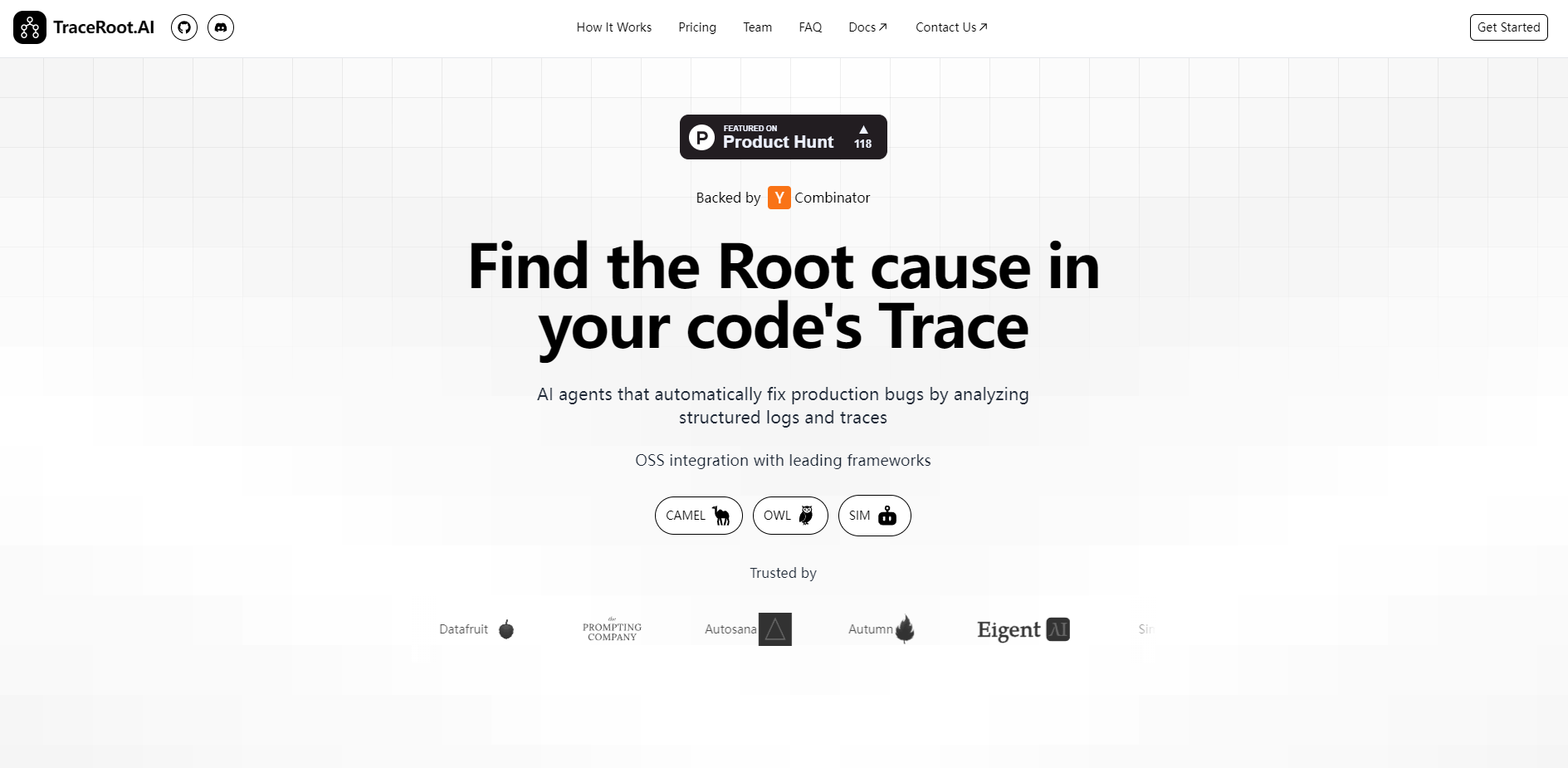
TraceRoot.AI is an AI-enhanced debugging platform designed for developers who need to resolve production issues with speed and precision. It moves beyond traditional logging by not only identifying the root cause of errors but by deploying AI agents to automatically fix them, transforming your debugging workflow from a manual chore into an efficient, automated process.
Key Features
🤖 AI-Powered Analysis & Automated Fixes Our intelligent agents analyze your application's logs and execution traces to pinpoint the exact root cause of an error. For supported plans, these agents can collaborate—accessing source code, internal documentation, and team conversations—to autonomously generate and submit a pull request with the proposed fix.
🌳 Interactive Trace Visualization Stop sifting through endless text logs. TraceRoot.AI visualizes your entire request lifecycle—from function calls to log outputs—in an intuitive, interactive tree structure. This clarity allows you to instantly grasp complex execution flows and identify performance bottlenecks or failure points at a glance.
⚙️ Seamless SDK and Tool Integration Get started in minutes with our lightweight SDKs for Python and TypeScript/JavaScript. TraceRoot.AI integrates directly into your existing development ecosystem, connecting with essential tools like GitHub, Slack, and Notion to provide your AI agents with the context they need to resolve issues effectively.
Use Cases
1. Rapidly Resolve Production Incidents When a critical error occurs in production, you can't afford to waste time. TraceRoot.AI immediately captures the faulty trace, and its AI agent analyzes the context to identify the root cause. Instead of spending hours manually debugging, you get a precise diagnosis and, with the agent mode, a ready-to-review PR, reducing your mean time to resolution (MTTR) significantly.
2. Understand and Optimize Complex Codebases If you're working with microservices or a complex legacy system, understanding how data flows can be a major challenge. The visual trace explorer provides a clear map of every function call and its latency, helping you identify inefficient code paths, optimize performance, and onboard new developers with a clear picture of the application's architecture.
3. Automate Issue Triage and First Response Connect TraceRoot.AI to your production environment to enable automated issue triaging. When an error is detected, the platform can create a ticket, notify the relevant team on Slack with a summary of the issue, and begin its root cause analysis—all without human intervention. This frees up your on-call engineers to focus on higher-level problems.
Why Choose TraceRoot.AI?
Traditional monitoring and observability tools are excellent at telling you that a problem occurred. TraceRoot.AI is built to tell you why it happened and then actively fix it for you.
The key difference lies in its proactive, multi-agent approach. While other tools provide dashboards and logs for you to interpret, TraceRoot.AI’s agents act as an automated extension of your engineering team. They don’t just present data; they synthesize it with context from your codebase (GitHub), documentation (Notion), and team discussions (Slack) to deliver actionable solutions. This shifts the paradigm from passive observation to active, automated remediation.
Frequently Asked Questions (FAQ)
1. What is TraceRoot.AI in a nutshell? TraceRoot.AI is an advanced debugging platform that uses AI to help developers trace, monitor, and resolve issues in production applications. It provides not only deep root cause analysis through visualized traces but also offers automated bug fixes generated by AI agents.
2. How does TraceRoot.AI work? You integrate our SDK (available for Python and TypeScript) into your application. The SDK captures detailed traces, logs, and metrics and sends them to our platform. From there, our AI agents can analyze the data, visualize the execution flow, and interact with you via a chat interface or work autonomously to resolve bugs.
3. What programming languages do you currently support? We offer dedicated SDKs for Python and TypeScript/JavaScript. Our team is actively working to expand support for additional languages based on user demand. The platform also integrates with open-source standards like OpenTelemetry and Jaeger for broader compatibility.
More information on TraceRoot.AI
Launched
2025-05
Pricing Model
Free Trial
Starting Price
$49/month
Global Rank
5471787
Follow
Month Visit
<5k
Tech used
Top 5 Countries
98.41%
1.59%
United States
Japan
Traffic Sources
10.01%
28.1%
1.97%
59.91%
social
referrals
search
direct
Source: Similarweb (Sep 25, 2025)
TraceRoot.AI was manually vetted by our editorial team and was first featured on 2025-08-25.
Related Searches
TraceRoot.AI Alternatives
Load more Alternatives-

-

Langtrace AI is an open-source observability tool for monitoring, evaluating and improving LLM apps, providing end-to-end visibility, security and integration to optimize performance and build with confidence.
-

-

-
