

What is Traceformer?
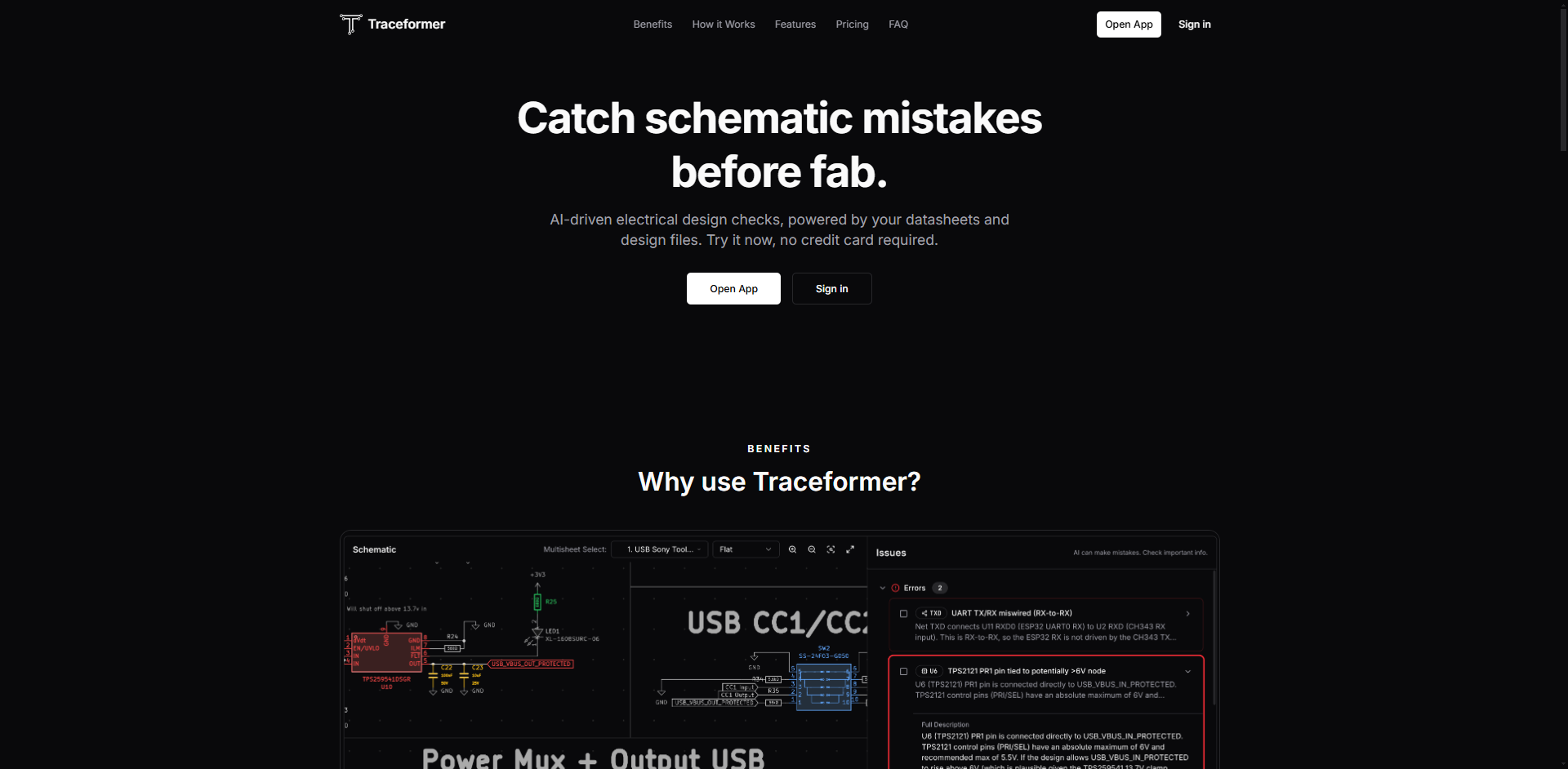
Design errors discovered after fabrication are costly, often resulting in weeks of delay and expensive board respins. While standard Electrical Rule Checks (ERC) catch basic wiring issues, they cannot "read" a datasheet to verify if your components are actually implemented correctly.
Traceformer.io bridges this gap. It acts as an automated design review layer that analyzes your KiCad projects or Altium netlists against the actual technical specifications of your components. By leveraging a multi-agent AI pipeline, it identifies complex application-level mistakes that traditional software misses.
Key Features
- 🔍 Multi-Agent Orchestration: The system uses a three-phase pipeline—Planning, Retrieval, and Synthesis. A "Planner" agent breaks your schematic into subsystems (like power or communications), while up to 10 "Worker" agents simultaneously analyze datasheets to verify each section.
- 📑 Automated Datasheet Retrieval: You no longer need to manually gather PDFs. Traceformer automatically fetches datasheets from trusted sources using your design files, ensuring the AI review is always grounded in the specific requirements of your components.
- ✅ Evidence-Based Findings: To eliminate guesswork and AI hallucinations, every error or warning includes direct citations from specific datasheet pages. This allows you to instantly verify the reasoning behind a flag and make informed corrections.
- ⚙️ Configurable Review Parameters: You maintain control over the depth of the analysis. You can set specific design rules, adjust token limits, and choose between different AI models from OpenAI or Anthropic to suit the complexity of your project.
Use Cases
- Subsystem Validation: Before sending a board to fab, use Traceformer to verify that your power delivery network and high-speed communication interfaces (like SPI or I2C) strictly adhere to the electrical characteristics defined in the manufacturer’s documentation.
- Final "Unforced Error" Sweep: Run a parallel review to catch simple but devastating mistakes—such as swapped TX/RX lines or incorrect pull-up resistor values—that standard ERC tools are not programmed to detect.
- Documentation Gap Analysis: If the AI cannot find sufficient evidence in the provided datasheets to verify a connection, it categorizes the check as "Missing Info." This highlights exactly where your design relies on assumptions rather than documented facts.
How Traceformer Enhances Your Workflow
The primary value of Traceformer is its ability to perform contextual analysis. Standard EDA tools understand that two pins are connected, but they don't understand why. Traceformer understands the intent of the circuit by reading the component specifications.
By automating the tedious process of cross-referencing netlists with 80-page datasheets, you reduce the cognitive load of the review process. This doesn't replace your expertise; it provides a high-fidelity "second set of eyes" that works at a scale and speed impossible for manual review, ultimately increasing the likelihood of a functional first-turn board.
Professional Summary
Traceformer.io transforms the schematic review from a manual, error-prone chore into a structured, AI-assisted verification process. By grounding its analysis in verifiable datasheet evidence, it provides hardware engineers with a reliable method to catch complex design flaws before they reach the production line.
More information on Traceformer
Launched
2025-12
Pricing Model
Freemium
Starting Price
$10 per month
Global Rank
Follow
Month Visit
<5k
Tech used
Traceformer was manually vetted by our editorial team and was first featured on 2026-01-05.
Traceformer Alternatives
Load more Alternatives-

-
-
-

-
TraceRoot.AI: AI-powered debugging that doesn't just find bugs, it automatically fixes them. Resolve production issues fast.