

Click outside to close
What is Cebra?
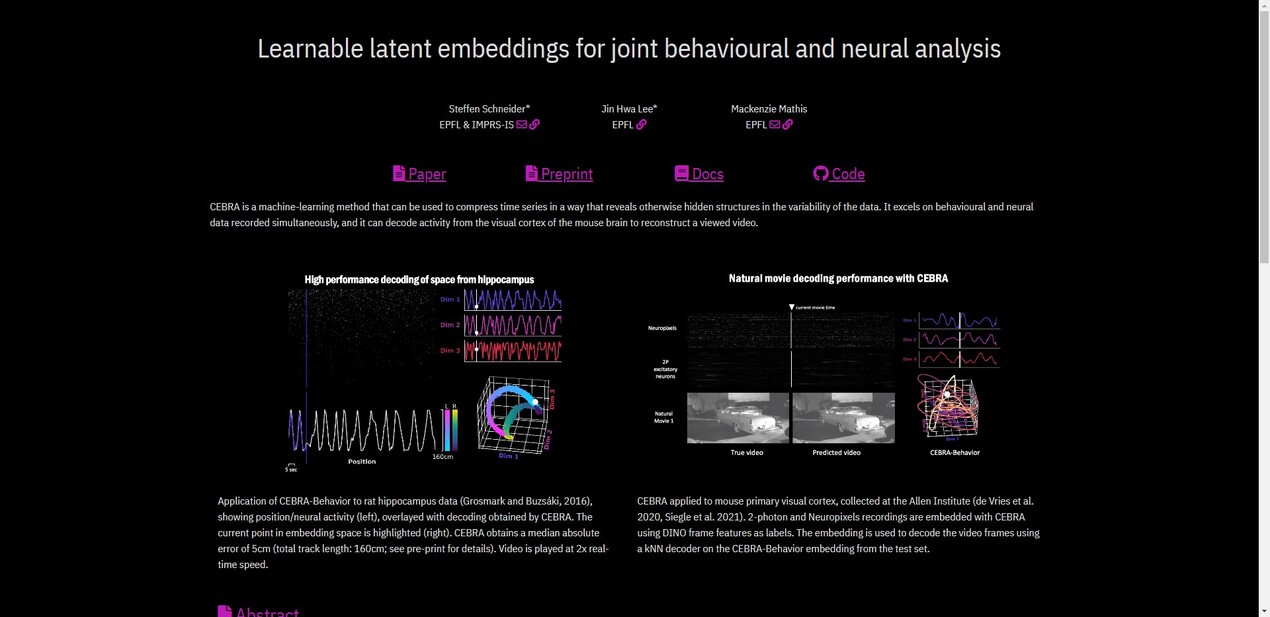
CEBRA, a cutting-edge machine-learning method, is transforming the field of neuroscience by revealing hidden structures in behavioral and neural data. Developed by a team at EPFL, this innovative tool excels in decoding activity from the mouse brain’s visual cortex, reconstructing viewed videos with remarkable accuracy. Its application ranges from rat hippocampus data to mouse primary visual cortex recordings, showcasing its versatility and precision in understanding neural dynamics during adaptive behaviors.
Key Features:
🧩 Joint Behavioral and Neural Analysis: CEBRA uniquely combines behavioral and neural data, offering a comprehensive understanding of the relationship between actions and neural activity.
🔄 Consistent and High-Performance Latent Spaces: By utilizing both supervised and self-supervised learning, CEBRA produces latent spaces that are both consistent and high in performance.
🔍 Decoding Capabilities: The inferred latents can be used for decoding, allowing for the reconstruction of videos from neural activity, a groundbreaking achievement in neuroscience.
🦎 Versatility Across Species and Behaviors: Validated on calcium and electrophysiology datasets, CEBRA is applicable to a wide range of sensory and motor tasks, across simple or complex behaviors in different species.
🔄 Label-Free Usage: CEBRA can be used in a label-free manner, making it a flexible tool for both hypothesis testing and discovery-driven research.
More information on Cebra
Top 5 Countries
90.1%
9.1%
United States (90.1%)
Switzerland (9.1%)
Japan (0.8%)
Traffic Sources
47.16%
30.63%
12.59%
8.43%
mail (0.1%)
direct (47.16%)
search (30.63%)
social (12.59%)
referrals (8.43%)
paidReferrals (1.1%)
Source: Similarweb (Jan 3, 2026)
Cebra was manually vetted by our editorial team and was first featured on 2023-06-24.
Cebra Alternatives
Cebra Alternatives-

Cerebras is the go-to platform for fast and effortless AI training.
-
Caffe is a deep learning framework made with expression, speed, and modularity in mind.
-

Cerebras is the go-to platform for fast and effortless AI training and inference.
-

Deploy machine learning models effortlessly with our platform. Enjoy 40%+ cost savings over AWS or GCP with serverless GPUs. Just bring your Python code, we handle the rest!
-

AI Interpretability Research? Neuronpedia offers data, tools & open-source platform to understand neural networks. Explore now!