

What is DLRover?
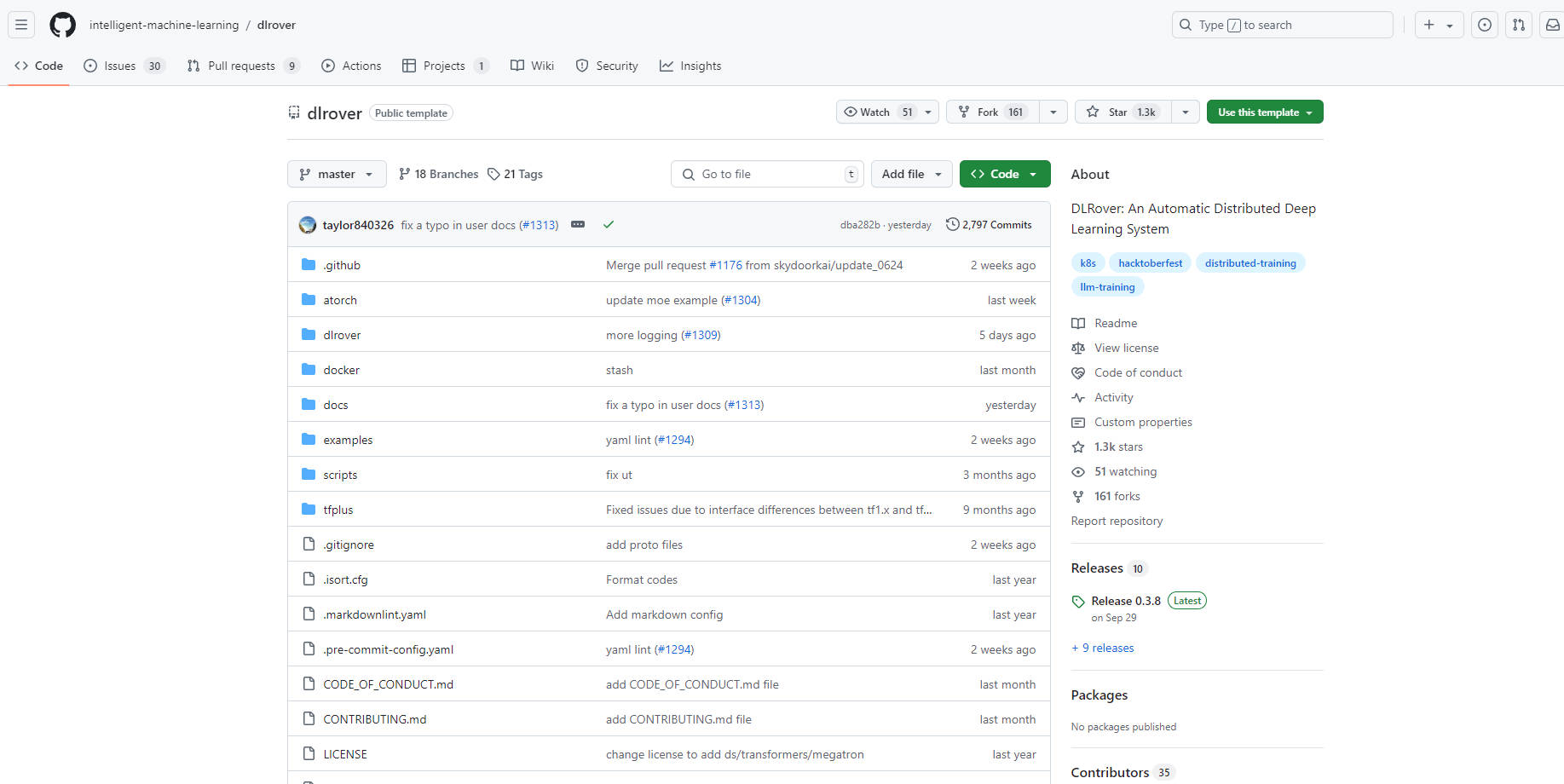
DLRover is an open-source system designed to simplify and optimize the distributed training of large deep learning models. It automates complex engineering aspects like hardware acceleration and distributed execution, allowing developers to focus on model architecture. DLRover enhances training stability and speed through features like fault tolerance, flash checkpoints, and auto-scaling, while supporting both PyTorch and TensorFlow frameworks.
Key Features:
⚙️ Fault Tolerance:Automatically detects and recovers from failures in distributed training, ensuring continuous operation and minimizing downtime.
⚡️ Flash Checkpoint:Enables rapid saving and loading of training checkpoints in seconds, facilitating swift recovery from failures and minimizing lost progress.
📈 Auto-Scaling:Dynamically adjusts resources based on real-time training needs, optimizing performance and resource utilization.
⏱️ Speed Up Training:Provides specialized extension libraries, ATorch for PyTorch and TFPlus for TensorFlow, to enhance training speed for various model types.
🎛️ Automated Operation and Maintenance:Simplifies management of training jobs on Kubernetes (K8s) and Ray clusters.
Use Cases:
A research team uses DLRover to train a large language model on a multi-GPU cluster, ensuring continuous progress despite occasional node failures.
An AI company leverages DLRover to optimize the training of a recommendation model, dynamically scaling resources to meet demand and reduce costs.
A data scientist utilizes DLRover to experiment with different deep learning architectures for image recognition, accelerating training iterations and simplifying distributed execution.
Conclusion:
DLRover empowers developers to train large AI models more efficiently and reliably. Its automation capabilities, coupled with performance-enhancing features like flash checkpoints and auto-scaling, make it an invaluable tool for accelerating research and development in the field of deep learning. By simplifying distributed training complexities, DLRover enables developers to focus on innovation and achieve faster time-to-results.
More information on DLRover
Launched
Pricing Model
Free
Starting Price
Global Rank
Follow
Month Visit
<5k
Tech used
DLRover was manually vetted by our editorial team and was first featured on 2024-10-30.
Related Searches
DLRover Alternatives
Load more Alternatives-

-
-

Activeloop-L0: Your AI Knowledge Agent for accurate, traceable insights from all multimodal enterprise data. Securely in your cloud, beyond RAG.
-

KTransformers, an open - source project by Tsinghua's KVCache.AI team and QuJing Tech, optimizes large - language model inference. It reduces hardware thresholds, runs 671B - parameter models on 24GB - VRAM single - GPUs, boosts inference speed (up to 286 tokens/s pre - processing, 14 tokens/s generation), and is suitable for personal, enterprise, and academic use.
-

FastRouter.ai optimizes production AI with smart LLM routing. Unify 100+ models, cut costs, ensure reliability & scale effortlessly with one API.